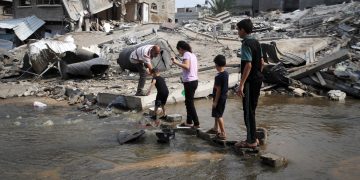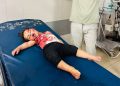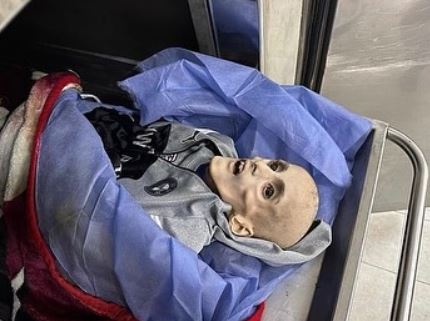
Since October 2023, Israel has imposed man-made starvation on Gaza’s population. After March 2025, the blockade tightened even further, allowing even less aid to enter. The results have been catastrophic: hundreds of men, women, and children have died from severe malnutrition. Doctors survive on scraps of bread and oil, sometimes drinking seawater for electrolytes. Journalists are too weak to report, and men are too frail to queue at aid distribution sites. Across the strip, bodies resemble little more than skin stretched over bone.
History has witnessed this level of starvation before, and the toll it takes on the human body is well-documented. One by one, organs fail. Fatigue becomes constant. The body begins consuming itself. In the Soviet Union between the 1920s and 1940s, witnesses described performers collapsing mid-act, dying where they stood. People fell dead in the streets as though asleep. In some cases, hunger drove people to horrific extremes — court records tell of a mother dismembering her unconscious husband, believing him dead, to feed their children.
But the suffering doesn’t end when food arrives. Recovery from starvation can be just as deadly. One of the earliest known accounts of this comes from Jerusalem in 70 CE. For five months, Roman forces under Titus besieged the city, cutting off all supplies. Survivors, emaciated and disease-ridden, were reduced to eating leather. When the Romans breached the walls, many who finally had access to food died soon after eating, gorging themselves until they vomited, some passing away within hours.
Similar tragedies occurred after World War II, when emaciated Japanese prisoners of war were liberated in the Philippines and New Guinea. Given calorie-rich food, roughly one in five died during the refeeding process. Post-mortems revealed heart failure, organ shrinkage, and other severe complications. This same deadly pattern has been seen in famine survivors, post-surgery patients, those with anorexia nervosa, and chronic alcoholics.
We now refer to this as refeeding syndrome — a dangerous metabolic shock that occurs when feeding is resumed too quickly. During starvation, the body suppresses insulin and breaks down muscle and fat, depleting vital minerals inside cells. When food returns, insulin surges, pulling glucose and electrolytes into cells, dropping blood levels of phosphate, potassium, and magnesium. Sodium and water flood the bloodstream, causing dangerous fluid overload. If not managed properly, the heart, lungs, and nervous system can fail.
Preventing refeeding syndrome takes far more than slow eating. Patients must be given vitamin and electrolyte supplements before food, monitored closely by skilled teams, and tested regularly. Pharmacists, lab technicians, psychiatrists, and other specialists must work together to bring someone back from the brink of starvation safely.
In Gaza, such care is almost impossible. The health system has collapsed. Hospitals run without anaesthetics, using vinegar to clean wounds. Children’s limbs are amputated without pain relief. Israel’s blockade deliberately prevents medical supplies from entering, while health workers, ambulances, and hospitals are repeatedly targeted.
A starving person cannot be expected to pace themselves when food finally comes. Hunger changes the mind — the instinct to eat as much as possible overwhelms everything else. In the follow-up to Ancel Keys’ famed malnutrition study, several recovered participants went on to work in the food industry, driven by a lifelong fixation on eating.
This is why medical access is as important as food aid. Without it, thousands could die from refeeding syndrome even after food reaches them. International pressure must focus not just on opening the crossings for aid, but on allowing in medical equipment, laboratory facilities, and trained personnel — and on stopping Israel’s attacks on healthcare itself.
Western governments have the tools to compel this. They choose not to use them, making them complicit in one of the gravest atrocities of our time. The world must demand more. Food alone will not save Gaza. Without medical care alongside it, it could just as easily kill.
Shortlink for this post: https://daysofpalestine.ps/?p=66637