Gaza is grappling with an unprecedented water crisis, with a 100% shortage of clean drinking water, raising alarms over rising cases of skin diseases and long-term health risks, including cancer, according to Palestinian environmental expert Abdul Rahman Al-Tamimi.
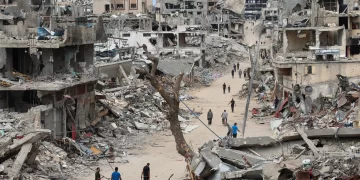
On Monday, Al-Tamimi described the crisis as the worst in Gaza’s history, exacerbated by the recent war that devastated the enclave’s infrastructure.
Before the war, the coastal territory already suffered from a severe water deficit of 90 million cubic meters annually. Now, access to safe drinking water has all but disappeared.
“The war destroyed critical infrastructure and essential facilities, directly impacting the availability of clean water,” said Al-Tamimi, who also heads the Palestinian Hydrologists Group.
He warned that water consumption per person has plummeted from 19 liters per day to less than one liter—an alarming drop of over 90%. Meanwhile, 60% of Gaza’s population has been consuming contaminated water.
Collapsing System
Gaza’s main water source—the underground aquifer—has been overdrawn far beyond its sustainable capacity, with annual extraction reaching 192.5 million cubic meters—three times its limit of 50-60 million cubic meters. Even before the war, 97% of Gaza’s water was deemed unfit for consumption by World Health Organization standards.
Desalination plants, which once provided 15 million cubic meters annually—only 10% of Gaza’s total water needs—have been destroyed. Israel’s blockade on fuel supplies has also crippled the main desalination facility in central Gaza, pushing the water crisis to its breaking point.
Mekorot, ‘an Israeli water company’, previously supplied Gaza with 10 million cubic meters of water per year. But following the widespread destruction of pipelines and networks, that figure has dropped to just one million cubic meters.
Environmental Catastrophe
Beyond shortages, Gaza faces a growing environmental disaster. Sewage water and toxic landfill runoff are seeping into the groundwater, further contaminating the already scarce supply.
The war has also left behind a legacy of pollution, with chemical residues from Israeli bombs and explosives poisoning the water sources.
Al-Tamimi warned that if desalination plants are not urgently restored, Gaza’s underground reservoir could become permanently unusable. “Without a fully operational, centralized desalination system, the aquifer may never recover,” he said.
He also highlighted the increasing presence of heavy metals in Gaza’s water supply due to repeated Israeli offensives. “This will lead to both immediate health risks, such as skin diseases, and long-term consequences, including a surge in cancer cases,” he cautioned.
Urgent Appeals
With no immediate solution in sight, experts are calling for emergency intervention to secure alternative water supplies.
Al-Tamimi suggested that water could be brought in from southern parts of the West Bank or from Egypt until desalination plants are restored. “Even that would only solve half the problem,” he admitted.
Meanwhile, Gaza’s municipal authorities have issued dire warnings of an imminent water catastrophe. The city’s main water supply line, Mekorot, accounts for 70% of its daily needs, and Israeli threats to cut off this lifeline could trigger mass dehydration and a public health disaster.
The United Nations Children’s Fund (UNICEF) echoed these concerns, stating that only one in ten Gazans currently has access to safe drinking water.
UN agencies estimate that 1.8 million people—more than half of them children—are in urgent need of water, sanitation, and medical assistance.
The crisis has worsened following Israel’s decision to cut electricity to Gaza, shutting down vital desalination and water purification operations.
Shortlink for this post: https://daysofpalestine.ps/?p=61435