DaysofPal- On March 16, 2025, Eng. Maher Salem, Director General of Planning, Water, and Sanitation at the Gaza Municipality, issued a stark warning about the dire state of Gaza’s sewage system, exacerbated by the Israeli prolonged closure of crossings.
In an exclusive interview with Filastin newspaper, Salem described the situation as a “state of disaster,” highlighting how the blockade has paralyzed essential maintenance work and left the system completely out of service.
A Crisis Unfolding in Gaza’s Streets
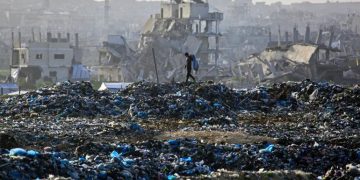
Each day, approximately 30,000 cubic meters of wastewater are discharged into the Sheikh Radwan Pond to prevent overflows, while more than 190,000 cubic meters of waste have accumulated throughout the streets and neighborhoods. Additionally, 185,000 linear meters of sewage lines —one-third of the total network—are destroyed and require urgent repair. However, the occupation prevents the entry of critical materials such as pipes, cement, and machinery needed for rehabilitation.
Salem explained that the municipality cannot currently maintain or replace damaged infrastructure, leaving sewage networks and pumping stations in disrepair.
At least 5,000 manholes are clogged with rubble and sand, further complicating efforts to address the crisis. Without intervention, untreated wastewater continues to spill onto streets, contaminating rainwater pools and threatening groundwater reservoirs.
“The situation is catastrophic,” Salem warned. “If temperatures rise and the crossings remain closed, we cannot predict the extent of diseases and epidemics that could spread.”
Devastated Infrastructure and Limited Resources
Gaza City relies on eight wastewater pumping stations, three of which were entirely destroyed during recent hostilities, while five others sustained partial damage. These stations once transported wastewater to the central treatment plant in Sheikh Ajlin, which itself suffered significant damage. Transmission lines connecting these facilities also require urgent repairs, but the necessary equipment remains prohibited from entering the Strip.
Salem stressed that the municipality has managed to maintain 50% control over the problem through minimal operations aimed at preventing public health crises. However, without access to essential supplies like generators, machinery, and spare parts, the municipality cannot sustain even this limited functionality indefinitely.
He noted that the Israeli occupation destroyed 133 municipal and private vehicles , including those used for waste collection, roadworks, and sewage management—nearly three-quarters of the municipality’s fleet of 180 vehicles. This loss severely hampers daily operations, compounding existing challenges.
“If the required equipment and materials were brought in,” Salem said, “the municipality could resolve the sewage and garbage problems within three to four months. But as it stands, our hands are tied.”
The Sheikh Radwan Pond: A ticking time bomb
The Sheikh Radwan Pond, originally designed to collect rainwater, now holds over 400,000 cubic meters of wastewater due to the absence of functional drainage systems. To mitigate overflow risks, the municipality discharges around 30,000 cubic meters of wastewater into the sea daily . However, the inflow from the city matches this amount, making it nearly impossible to reduce the pond’s contents significantly.
A setback in one of the pipelines carrying water from the pond to the sea forced the municipality to replace a 90 cm diameter pipeline (prohibited by Israeli occupation) with a smaller 63 cm diameter pipe , which is insufficient for effective drainage. As a result, stagnant water has persisted in the pond for two months, leading to foul odors, insect infestations, rodent proliferation, and viral contamination.
“This is not just an environmental issue—it’s a plague among people,” Salem emphasized. “Foul odors, mosquitoes, and rodents create ideal conditions for disease outbreaks, posing grave dangers to public health.”
Compounding Challenges: Garbage and Rubble Accumulation
In addition to the sewage crisis, Gaza faces a mounting garbage problem. Only three waste collection vehicles remain operational out of the original 40 destroyed by the occupation, leaving much of the city’s trash uncollected. Large quantities of rubble and debris also clutter the streets, overwhelming the municipality’s ability to clear them.
Efforts to remove rubble are hampered due to the lack of available space within the city. The Jhar al-Dik area, designated for dumping debris, is inaccessible to municipal crews due to restrictions imposed by the occupation. These limitations render current cleanup projects inadequate and unsustainable.
Urgent Appeal for International Intervention
Salem called on the international community to expedite pressure on the Israeli occupation to lift the blockade and allow the entry of essential materials and equipment. “Without immediate action,” he warned, “the consequences will be devastating—not only for Gaza but for the entire region.”
The ongoing crisis underscores the urgent need for humanitarian support and accountability. With Gaza’s sewage and sanitation systems teetering on the brink of collapse, the world must act swiftly to avert a humanitarian catastrophe that threatens the lives and well-being of over two million Palestinians.
Shortlink for this post: https://daysofpalestine.ps/?p=61433