Days of Palestine – Gaza
On May 16, Israeli airstrikes destroyed three apartment buildings, decimating several families. In an investigation released by New York Times, who visited the scene, interviewed survivors, and analyzed videos, photos, and satellite images to find out what happened.
The investigation affirmed that the strikes were the deadliest of the 11-day Israeli aggression on the Gaza Strip last May.
The Times has uncovered new details about these attacks that show how the Israeli occupation military used advanced precision-guided bombs to hit the Al-Remal neighborhood more than 20 times that night.
According to the report, the Israeli occupation has said that these strikes were carefully targeted. But the Times investigation showed how Israel dropped some of the heaviest bombs in its arsenal without warning on a densely packed neighborhood and with limited intelligence about what they were attacking.
Israeli occupation said Hamas intentionally builds military infrastructure under residential buildings, which would violate the laws of war and the Israeli occupation hasn’t provided evidence of what it says was the command center, the investigation added. Experts said that the type of Israeli strikes was documented could easily lead to catastrophe and could be a war crime.
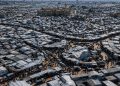
One of the areas most ravaged by Israeli occupation airstrikes was the neighborhood of Rimal in downtown Gaza City. Bisected by Al Wahda Street, it’s home to malls, schools, restaurants, government buildings, and Gaza’s biggest hospital, Dar Al Shifa.
Because Rimal had been spared in the last Israeli bombing campaign in 2014, many Gazans considered it safe. On the night of May 15, several families are sheltering in their homes on the same block by Al Wahda Street.
The extended Qawlaq family lives here in two buildings that were home to 31 people. Thirty-seven people live in this building, among them Riad Ishkontana, his wife, and their five children.
At around 1 a.m., Israeli airstrikes begin to pound Rimal. The Israeli Air Force said that it launched around 100 guided bombs at Hamas tunnels across Gaza that night.
The reporter in the investigation said that we watched Israeli Air Force videos to see whether they provided clues about the kind of bombs dropped on Al Wahda Street.
Many showed troops loading jets with Mark-80 series bombs and outfitting those bombs with American-made Joint Direct Attack Munition or JDAM guidance kits.
These allow the bombs to strike with precision, using GPS. We visited the Gaza police, who showed The Times fragments of munitions that they said were recovered from the strikes on Al Wahda Street that night.
Looking at the markings on the tail fins, the first five numbers indicate that Boeing in the United States manufactured it. And these numbers are associated with the JDAM kit.
Gaza police said that the fragments indicated the use of a GBU-31, a 2,000-pound Mark-84 equipped with a JDAM. It’s the heaviest bomb that most militaries use on a regular basis.
The Red Cross says weapons like these shouldn’t be used in urban areas because of the potentially dangerous consequences.
“We found that Israeli jets likely dropped at least four of these bombs within feet of the apartment buildings. Israeli military officials told us that they programmed fuses to allow these bombs to explode deep underground to increase the impact on the tunnels and minimize damage above,” the reporter said.
Experts said, is consistent with a nearby strike from a GBU-31 that penetrated deep underground before exploding. The Israeli military said that all the bombs that night hit their intended targets. But even if that’s true, experts say it doesn’t make the attacks legal.
Saleh Higazi of Amnesty International said that Israel should have foreseen the disastrous effects of such strikes on a dense civilian neighborhood could have.
Without warning and heavy bombs, attacking anyway could be a war crime and should be part of an ongoing investigation into Palestine by the International Criminal Court, he said.
The survivors of the Al Wahda Street strikes have spent the night beneath the rubble. Rescuers find Shoukry al-Qawlaq alive after 11 hours. And in the early morning, Ishkontana is also pulled from beneath his home.
Hours later, his daughter Susie, seven years old, is brought out alive. Her mother, two brothers, and two sisters didn’t survive.
In all, 22 people in the building were killed, among them 15 members of the Abul Ouf family. One of them was Ayman Abul Ouf, a doctor and head of internal medicine at Dar Al Shifa Hospital, where he oversaw the coronavirus response.
Another 22 members of the Qawlaq family were killed down the road, ranging in age from 6 months to 90 years.
Without a home, Ishkontana and his daughter are now staying with his uncle. Ishkontana had been working as a waiter in a restaurant. But the coronavirus pandemic cost him his job. Now, the airstrikes have left only him to care for Susie.
The Israeli aggression killed at least 230 people, according to the United Nations and the Gaza Health Ministry.
Shortlink for this post: https://daysofpalestine.ps/?p=9731