DaysofPal – The British Museum has faced significant backlash after it removed references to Palestine from its ancient Middle Eastern exhibits. This decision has been condemned by scholars and activists, who argue that it reflects a systematic effort to undermine Palestinian cultural identity and history.
The museum announced that it would no longer use the term “Palestine” in its displays related to ancient Egypt and the Phoenicians, claiming the term lacked historical significance in these contexts. According to a report by the Telegraph, this alteration followed a letter from the pro-Israel group UK Lawyers for Israel (UKLFI). In their correspondence to museum director Nicholas Cullinan, UKLFI contended that the use of “Palestine” in the exhibits contributed to the erasure of the historical kingdoms of Israel and Judea, thus misrepresenting the origins of the Israelites and Jewish people.
Specifically, the group objected to labels in displays dated 1700-1500 BC that referred to the eastern Mediterranean coast as “Palestine” and identified the Hyksos as being of “Palestinian descent.” These labels have since been altered to “Canaan” and “Canaanite descent.”
Museum’s Response
A spokesperson for the British Museum denied that the decision was influenced by UKLFI’s complaint, asserting that the term “Palestine” is applicable to the southern Levant only in the later second millennium BC. The spokesperson emphasized that the museum employs United Nations terminology for modern geographic boundaries, using terms like “Gaza” and “West Bank” while referring to “Palestinian” as a cultural identifier when appropriate.
However, academics, including Marchella Ward, a classical studies lecturer at the UK’s Open University, argue that “ancient Palestine” is a historically accurate term for the region. Ward maintains that claims against the term’s legitimacy are misleading and serve to erase Palestinian identity amid ongoing violence against them.
The campaign group Energy Embargo for Palestine accused the museum of hypocrisy, claiming it presents itself as a guardian of artifacts and an objective communicator of history while simultaneously erasing Palestine from historical narratives. The group remarked that, after appropriating Palestinian artifacts, the museum now seeks to rewrite history, thereby erasing the existence of millions of people.
A Broader Pattern of Pressure
Scholars and activists have pointed out that the British Museum is part of a larger trend involving public institutions, including local councils and hospitals, coming under pressure from UKLFI. Recent reports indicate that the Encyclopaedia Britannica updated several entries related to Palestine, including the removal of the term from maps of the region, following UKLFI’s influence.
In February 2023, London’s Chelsea and Westminster Hospital removed a student artwork from Gaza after UKLFI claimed to have received complaints from patients, though a freedom of information request later revealed that only UKLFI had filed a complaint. Furthermore, the Open University capitulated to UKLFI’s demands to eliminate the term “ancient Palestine” from future educational materials.
A forthcoming report by the European Legal Support Centre (ELSC) documents nearly 900 incidents of anti-Palestinian repression in the UK from January 2019 to August 2025, with UKLFI appearing in 128 of these cases. Giovanni Fassina, ELSC’s executive director, noted that UKLFI often initiates such pressures through letters threatening legal action or alleging violations of UK law, often leading institutions to comply with these requests.
In response to UKLFI’s tactics, ELSC, along with the Public Interest Law Centre (PILC), has submitted a complaint to the Solicitors Regulation Authority regarding the group’s use of strategic lawsuits against public participation (SLAPPs), which aim to intimidate critics. The complaint urges the regulation of UKLFI as a law firm.
In July 2025, the UK Charity Commission confirmed that it is investigating UKLFI’s charitable arm following complaints from organizations such as Cage International and Led By Donkeys.
Historical Erasure and Accountability
Ward underscores that institutions yielding to these pressures contribute to the ongoing oppression of Palestinians by erasing their historical narrative. She argues that such rewriting of history is crucial in the context of occupation and genocide, where the colonization and destruction of archaeological sites play a significant role.
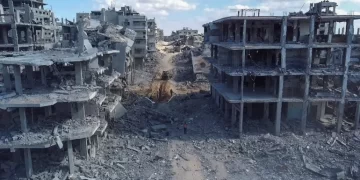
During recent conflicts, Israeli forces have reportedly destroyed over 316 archaeological sites in Gaza, many dating back to the Mamluk and Ottoman periods. Ismail al-Thawabteh, head of Gaza’s Government Media Office, labeled these attacks as part of a broader policy aimed at obliterating Palestinian identity and culture, which he described as organized looting—an act condemned under international law.
A UN report published in July revealed that Israeli military actions have damaged more than half of Gaza’s religious and cultural sites and concluded that these operations lacked legitimate military justification.
Shortlink for this post: https://daysofpalestine.ps/?p=72227