
DaysofPal- In a dim corner of a tent set up on sandy ground in the Al-Daraj neighborhood in central Gaza City, 33-year-old Suad Al-Aklouk sat staring at an empty pot for hours.
Around her, her three children, pale and exhausted, gathered with tired eyes, asking when food would be ready.
The widowed mother, who lost her husband during the war, had no answer but silence.
The nearby community kitchen that once provided them with a modest daily meal is no longer able to operate regularly.
“Just weeks ago, we used to get at least one meal every day,” said Suad, who was displaced from the Shuja’iyya neighborhood east of Gaza City.
“Now we barely get anything to quiet my children’s hunger, and sometimes we get nothing at all.”
International organizations working in Gaza have reduced the number of free meals provided to displaced people in shelters, as harsh humanitarian conditions worsen.
Although a ceasefire agreement that came into effect on October 10, 2025, guarantees the entry of 600 aid trucks daily into the Gaza Strip, restrictions have prevented enough trucks from entering, worsening shortages of food and essential supplies.
Moreover, the Israeli siege continued amid ongoing crimes and bombing in Gaza.
For Suad and her children, who survived two years of war, the situation has become unbearable.
Her husband, Mahmoud Al-Aklouk, who used to provide for the family, was killed during the conflict, leaving a void that no one has been able to fill.
“Even bread has become rare, and when it is available, it is too expensive for us,” she said in a tired voice.
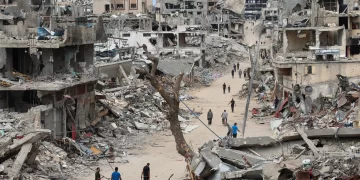
Since being displaced months ago, Suad has been living in a tent lacking the most basic necessities, after her two-story home was destroyed.
She and her children now depend on irregular humanitarian aid that is no longer enough to meet their needs.
Across Gaza, residents and aid organizations report a decline in the number of incoming aid trucks, along with restrictions on various food items, fuel, and reconstruction materials. This has worsened the humanitarian crisis, especially in overcrowded displacement camps.
The drop in supplies has directly affected community kitchens, which hundreds of thousands of displaced people rely on. Dozens have been forced to reduce meals or shut down completely due to a lack of basic ingredients.
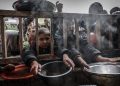
In a crowded camp in Gaza City, 39-year-old Mona Al-Jarousha stands daily in long lines, hoping to receive a meal for the eight people living with her in a small, worn-out tent.
Often, she returns disappointed after receiving only a small portion of lentils or beans, or nothing at all.
“I stand for hours under the sun, and in the end they say the food is finished,” she said, her voice filled with anger and helplessness.
“My children go to sleep hungry most days, and I cannot afford to buy anything from the market.”
With rising prices of food such as meat, vegetables, and fruit, and the disappearance of many items from the markets, buying basic necessities has become impossible for Mona and most displaced families who have lost their income due to the war.
Inside their small tent, her 17-year-old daughter, Marfat, tries to prepare whatever food is available, even if it is just water with some lentils or rice.
“Sometimes we divide one meal among the children only, while the adults go to sleep without food,” she said.
The suffering of displaced families goes beyond hunger. Poor living conditions, lack of clean water, and the spread of insects and disease have worsened health conditions in the camps, amid ongoing warnings of a deepening humanitarian disaster.
Relief workers confirm that reduced aid has left humanitarian organizations unable to meet the growing needs of hundreds of thousands of affected families.
They warn that continued restrictions and declining assistance could have serious consequences, potentially leading to famine.
Supervisors at displacement centers say the number of meals provided daily has dropped significantly compared to previous months, making it impossible to provide even one meal per day for all families.
As the crisis continues, families like Suad’s and Mona’s remain trapped in a daily struggle for survival, waiting in lines, facing empty pots, and hoping for food that may never arrive.
Shortlink for this post: https://daysofpalestine.ps/?p=74672