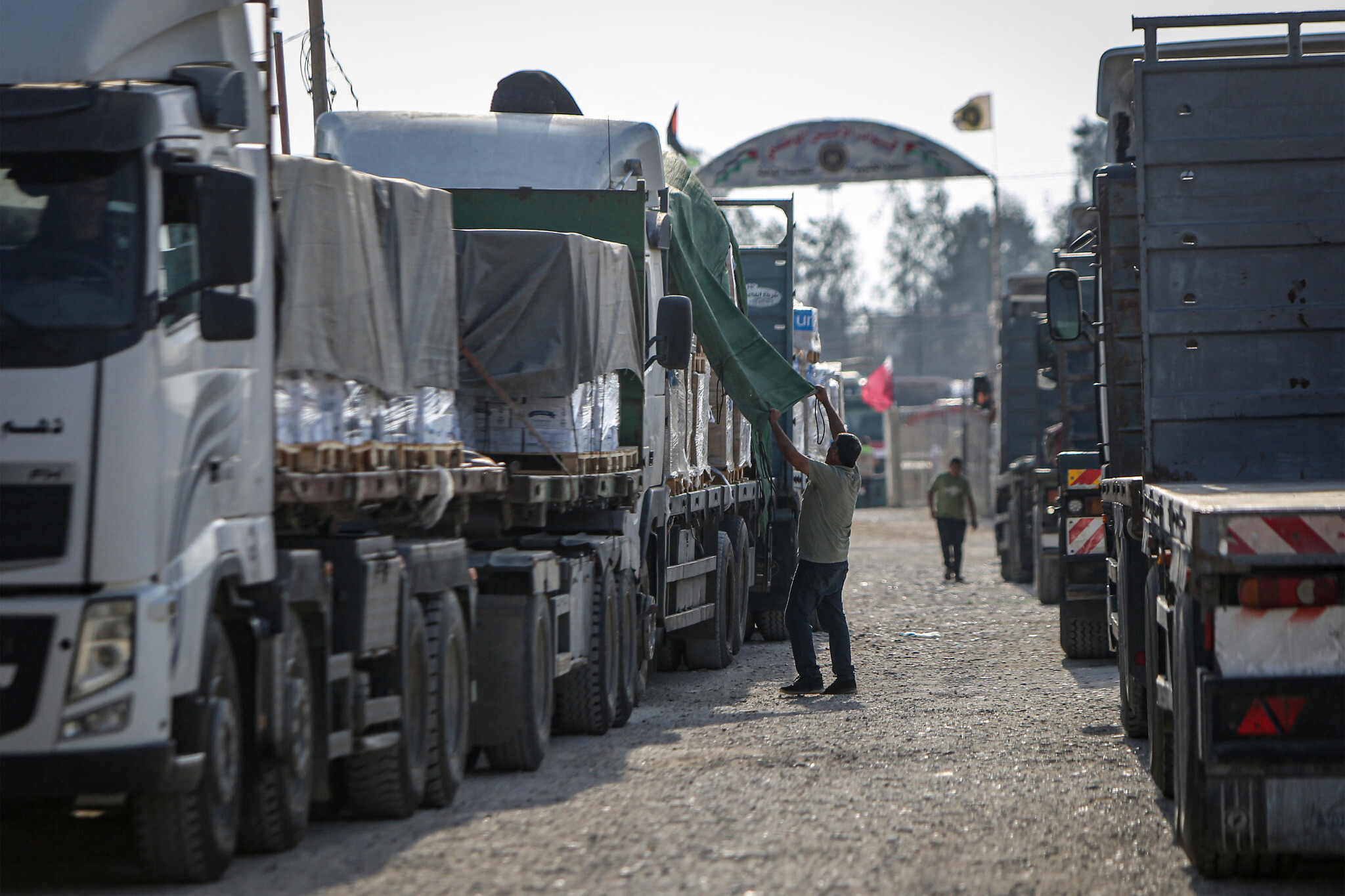
Israeli occupation forces continue to impose severe restrictions on the entry of humanitarian aid into the Gaza Strip, leading to a sharp drop in the number of aid and supply trucks reaching the territory. The decline has worsened in the aftermath of the recent U.S.-Israeli escalation against Iran, further limiting access to essential needs, including water, fuel, and medical supplies.
At the same time, medical evacuations from Gaza and the return of Palestinians stranded abroad remain suspended, as the Rafah crossing has been closed for the fourth consecutive day.
The Al Mezan Center for Human Rights said the volume of aid currently allowed into Gaza covers only a very small fraction of daily needs.
According to the center, Gaza requires more than 600 trucks per day, as stipulated in the ceasefire agreement signed in Sharm el-Sheikh. However, aid deliveries have seen a significant decline—from an average of over 900 trucks per week in January and February to fewer than 400 trucks in March. Despite a slight improvement in the second half of the month, the numbers remained below half of pre-escalation levels by March 30, reflecting ongoing Israeli restrictions on the flow of goods.
The composition of incoming supplies has also remained largely unchanged, with food making up around 70–75% of shipments and fuel about 10%, while critical shortages persist in shelter materials and sanitation supplies.
Prices Soar as Goods Disappear
With fewer trucks entering Gaza, prices have surged across local markets. Vegetables have seen the sharpest increases, followed by wheat flour and eggs.
The price of a 25-kilogram bag of flour has risen from 30 shekels to around 100, while tomatoes have jumped from approximately 5 shekels per kilogram to 12. Essential items such as cooking oil and canned goods have largely disappeared from the الأسواق, while retailers struggle to restock under ongoing restrictions.
Health Sector Near Collapse
Gaza’s healthcare system is facing near-total collapse due to systematic targeting and prolonged siege conditions, turning access to medical care into a daily struggle for survival.
According to the Palestinian Ministry of Health, shortages have reached 50% for medications, 57% for medical consumables, and 71% for laboratory supplies. Cancer treatment is particularly affected, with a 61% shortage in specialized drugs, putting around 4,100 cancer patients at risk of death.
Essential medical services—including primary care, neurology, kidney treatment, surgery, and intensive care—are also experiencing shortages exceeding 40%. Critical procedures such as open-heart surgeries and catheterizations have completely stopped, while supplies for eye surgeries are lacking by up to 89%.
More than 21,000 patients and wounded individuals are awaiting permission to travel abroad for treatment, including 195 critical cases. At least 1,517 patients have already died while waiting for evacuation.
Rafah Closure Deepens the Crisis
The continued closure of the Rafah crossing—following an Israeli attack that targeted a contractor working with the World Health Organization during a humanitarian mission—has placed thousands of patients and wounded individuals at immediate risk.
Al Mezan warned that these ongoing violations, despite the ceasefire agreement, alongside the blockade, starvation policies, and forced displacement, constitute a continuation of the genocide being carried out against Palestinians in Gaza.
The center held the Israeli occupation fully responsible for the worsening humanitarian catastrophe and warned of an even deeper disaster threatening the lives of more than two million people if urgent international action is not taken.
Calls for Urgent International Intervention
Al Mezan called on the international community—particularly the United Nations, signatories to the Fourth Geneva Convention, the International Court of Justice, and the International Criminal Court—to take immediate and effective action.
This includes pressuring Israel to halt all military attacks on civilians, fully open all crossings without restrictions, and allow the entry of humanitarian aid, fuel, medical supplies, and relief materials.
The center also stressed the need to enable engineering teams and municipalities to access affected areas to repair water and sewage networks, remove rubble, and manage waste to prevent the spread of disease and environmental disasters.
It renewed its call for the international community to uphold its legal and moral responsibilities, end impunity, and ensure the protection of Palestinian civilians in Gaza under international law.
Shortlink for this post: https://daysofpalestine.ps/?p=73701