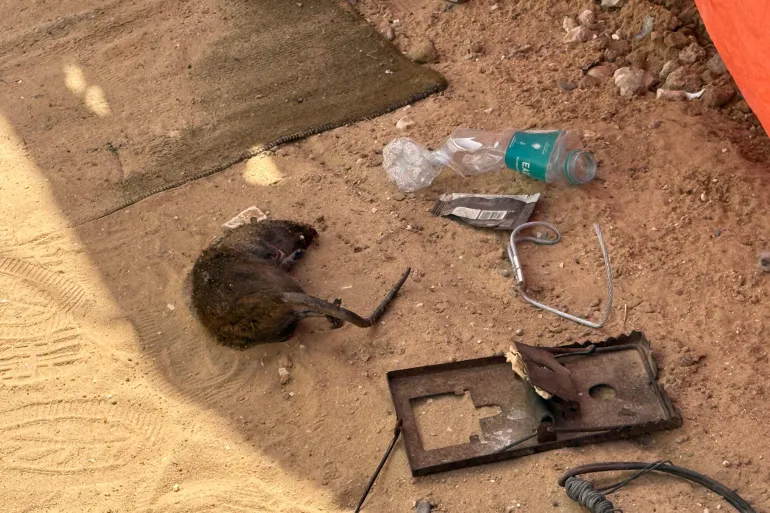
Ten-year-old Noah Al-Khour never imagined that a brief outing with friends at dusk in the “Jawazat” displacement camp in central Gaza City would turn into one of the most terrifying moments of his life. A large rat suddenly crawled up from inside his pants, reaching his stomach.
“I grabbed it and threw it away, then I fell to the ground and started crawling back to the tent, screaming,” Noah told Al Jazeera, curling his legs in fear. When he made it back, his body went into severe convulsions from shock.
Since that night, Noah refuses to step outside after sunset. He stays close to his mother, saying what he misses most is his home—his bed—where he once slept safely, without fear.
Rats Invade Daily Life
Noah’s mother, who had just thrown away a pot of soup after spotting a rat inside it, says rodents have become part of daily life in the camp.
“They don’t stop coming in and out. I see them jumping on pillows, crawling from everywhere,” she says, before asking bitterly: “How can I protect my children? Can I put a door on a tent?”
She spends her time patching torn fabric, blocking holes with stones, and closing the tent early each evening—as if bracing for another attack.
A Nightly Struggle for Survival
While Noah clings to his mother, Ashraf Abu Al-Kheir lives in constant vigilance, battling exhaustion and fear to protect his children.
He seals burrows, covers food, and blocks every opening in the tent, knowing the rats will keep searching for a way in.
“They come out from holes in the ground. If I fall asleep even briefly, my wife wakes up—we can’t risk losing focus on the children,” he says. “It’s a continuous battle every night.”
A Bite That Could Turn Deadly
For Umm Yahya Al-Ashqar, the danger is even greater. After Israeli occupation forces withdrew from her area following months of genocidal assault, she set up a tent over the ruins of her home in Al-Yarmouk with her 13-year-old son Yahya, who has chronic diabetes.
Within weeks, the boy developed constant fear, panic attacks, insomnia, and a stutter, as rats moved around them without pause.
“I was terrified for him with every movement,” she says. “He might not feel a rat bite, and any small wound could quickly worsen because of his illness.”
Unable to bear the risk, she rented a small house despite severe financial hardship. “I was ready to go without food just to keep him safe,” she adds.
A Man-Made Public Health Disaster
Gaza has effectively become a public health disaster zone, with an unprecedented spread of rodents.
According to Ayman Abu Rahma, head of preventive medicine at Gaza’s Ministry of Health, the surge is driven by massive waste accumulation, the destruction of sewage systems by Israeli attacks, and the presence of rubble and decomposing bodies beneath the ruins.
Hospitals and clinics are recording rising numbers of injuries, especially among children and the elderly, caused by bites leading to deep wounds and infections. People with chronic illnesses, particularly diabetes, face even greater risks due to reduced sensation and slow healing.
Rodents also transmit diseases through urine and droppings, causing fevers and unclear symptoms that further strain an already devastated healthcare system.
Waste and Blockade Fuel the Crisis
The Israeli occupation continues to block the entry of rodenticides once used to control infestations, while municipalities struggle to find alternatives.
Meanwhile, Gaza’s waste crisis is spiraling. The main landfill now holds around 300,000 cubic meters of garbage, turning it into a breeding ground for rodents in the middle of densely populated areas.
With access to the primary landfill near the eastern border now too dangerous due to ongoing attacks, efforts are being made to relocate waste to other areas with lower population density.
At the same time, around 80% of municipal equipment has been destroyed, making effective waste management nearly impossible.
Sewage Collapse and Decomposing Bodies
The destruction of sewage networks has left open drains where rodents breed and move freely, with temporary fixes offering little relief.
Adding to the crisis, Gaza’s Civil Defense reports that approximately 8,500 decomposing bodies remain trapped under the rubble—further accelerating the spread of disease and rodents.
As local authorities call on the international community to pressure the occupation to allow in urgently needed supplies and equipment, families across Gaza continue to endure what many describe as a “silent war”—one that invades their tents, their sleep, and their sense of safety, with fears intensifying as summer approaches.
Shortlink for this post: https://daysofpalestine.ps/?p=73683