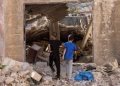
Early Tuesday, Gaza’s Director General of the Ministry of Health, Munir Al-Bursh, described a grim humanitarian reality in the Gaza Strip, saying that while the recovery of one body can shake the world’s conscience, thousands of Palestinian bodies buried under rubble provoke little more than silence.
Al-Bursh highlighted a stark moral imbalance, noting that while extensive efforts are made to recover the remains of one Israeli soldier, thousands of Palestinians remain trapped beneath destroyed homes, denied burial, dignity, or even acknowledgment of their fate.
His remarks came as Israeli forces announced the recovery of the body of captured soldier Ran Ghafili from Gaza. The operation was portrayed as a major achievement, while on the ground it involved extensive military activity and grave desecration.
Israeli occupation forces carried out a two-day operation at Al-Batsh Cemetery in the Al-Tuffah neighborhood of eastern Gaza City, exhuming hundreds of graves and removing Palestinian remains to verify the soldier’s identity.
In addition, the operation was accompanied by heavy gunfire and explosions to secure troop withdrawal.
The incident drew widespread criticism as more than 10,000 Palestinian bodies are believed to remain under rubble across Gaza, with no access granted for recovery or burial.
Human rights and political observers questioned the international focus on a single recovered body while Palestinian martyrs, prisoners, and unidentified remains continue to be ignored.
Israeli articles noted that some analysts believe the operation was used to delay ceasefire commitments, including reopening the Rafah crossing and allowing humanitarian aid, turning human remains into a political bargaining tool.
Statistics cited showed that negotiations led to the release of 126 Israeli captives alive, while military operations recovered only eight alive and resulted in the deaths of 41 detainees, some due to Israeli fire.
Human rights organizations warned that systematic cemetery destruction violates international humanitarian law and called for any such searches to be internationally supervised, documented, and followed by the restoration of cemeteries and the reburial of remains.
The case, observers said, exposes a global moral failure in which one body is honored while thousands are stripped of dignity, reflecting a broader humanitarian crime unfolding in Gaza.
Shortlink for this post: https://daysofpalestine.ps/?p=71682