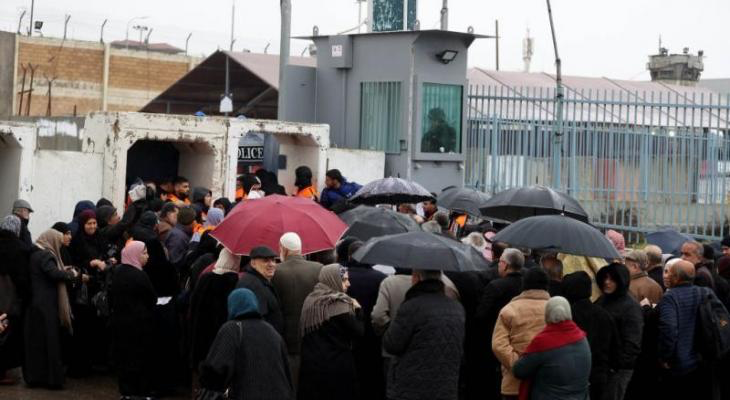
The Jerusalem Governorate said Israeli measures—stemming from recommendations issued by the so-called Israeli parliamentary National Security Committee to occupation forces—aimed at restricting the entry of worshippers from the West Bank to Jerusalem and the Al-Aqsa Mosque during the upcoming month of Ramadan constitute a flagrant violation of freedom of worship and an arbitrary preemptive escalation.
In a statement released Tuesday, the governorate said the recommendations include quantitative and categorical restrictions on entry, as well as arrests and pursuit of citizens, as part of preemptive plans intended to impose greater control over Jerusalem and tighten restrictions on Palestinians’ fundamental religious rights, particularly those coming from the West Bank and the Gaza Strip. It warned that the most dangerous aspect is the risk that these recommendations will be enforced as facts on the ground.
The governorate noted that the measures come amid an escalation in settler incursions into the Al-Aqsa Mosque and the recording of unprecedented violations carried out with the backing of the occupation authorities. Restrictions have intensified since October 2023, including complex permit requirements and age limits, effectively barring hundreds of thousands of Palestinians from reaching Al-Aqsa except in extremely limited numbers.
It added that Palestinians from the West Bank and Gaza have, for decades, viewed Ramadan as a rare opportunity to enter Jerusalem, given that the occupation bars most of them from accessing the city throughout the rest of the year.
During Ramadan in 2024 and 2025, the occupation imposed unprecedented restrictions, limiting entry to Jerusalem to 10,000 worshippers per week—and only on Fridays—while requiring hard-to-obtain permits and magnetic cards, mandating departure before evening, and enforcing age limits on men, women, and children. These measures led to the partial emptying of the Al-Aqsa Mosque.
As a result, attendance at Friday prayers fell sharply—from about 250,000 worshippers before October 2023 to just 80,000 on the second Friday of Ramadan 2025.
For the first time since 2014, the occupation also banned overnight i‘tikaf (devotional retreat) at Al-Aqsa on Friday and Saturday nights, forcibly removing the few worshippers who attempted to remain. The governorate said this contributed to the occupation’s unprecedented success in asserting control over the mosque and enforcing its restrictions.
The statement further pointed to a discriminatory reality in Jerusalem, where Palestinian neighborhoods and main roads are closed during Jewish holidays and occasions to facilitate the arrival of hundreds of thousands of settlers to the Al-Aqsa compound, the Western Wall, and the Old City’s surroundings.
By contrast, severe restrictions are imposed on Palestinians during Islamic and Christian holidays—especially Ramadan—effectively turning the city into a closed military zone, with intensive searches at the gates of Al-Aqsa and the Old City.
While the occupation cites “security” as justification, the governorate said the real reason lies in its repressive policies, ongoing violations, the continuation of an illegal occupation, and its comprehensive aggression against the Palestinian people.
The governorate added that these discriminatory policies also include settler attacks on Palestinians and restrictions preventing Christians from reaching the Church of the Holy Sepulchre to celebrate religious holidays. It noted that last Ramadan saw the imposition of a new, unprecedented restriction inside Al-Aqsa, with occupation police present around the clock during dawn, night, Tarawih, and Friday prayers, conducting thorough searches of worshippers and even i‘tikaf tents, and arresting any Palestinian found inside the mosque without a permit.
According to the governorate, the impact of these measures extends beyond freedom of worship to the city’s economic life, including Ramadan-related commercial activity, deepening the social and economic strain on Jerusalem and its residents.
The Jerusalem Governorate stressed that these actions are a direct extension of the occupation’s policy to isolate Jerusalem from its Palestinian surroundings and to forcibly alter the city’s historical, legal, and political status quo. This includes attempts to impose temporal and spatial division at the Al-Aqsa Mosque, paving the way for the construction of the alleged Temple in its place.
It concluded that the measures constitute a blatant violation of international law, freedom of worship, and citizens’ rights, holding the occupation authorities fully responsible for any resulting consequences. The governorate called on the international community, human rights bodies, and media organizations to urgently intervene to halt these violations, protect Palestinians’ religious and civil rights, and ensure free access to Al-Aqsa, the Church of the Holy Sepulchre, and Jerusalem’s holy sites more broadly.
Ramadan is the holiest month in Islam, observed by Muslims worldwide through fasting from dawn to sunset, increased prayer, charity, and communal worship. In Jerusalem, Ramadan holds particular religious and cultural significance, as hundreds of thousands of Palestinians traditionally seek to pray at the Al-Aqsa Mosque—Islam’s third-holiest site—especially during Friday prayers and the final nights of the month. Access to the city and its holy sites during Ramadan is widely seen by Palestinians as a fundamental religious right and a central aspect of spiritual life.
Shortlink for this post: https://daysofpalestine.ps/?p=71272