The Sydney Festival is a dazzling, annual summer celebration of the arts in Australia’s glittering beachside city.
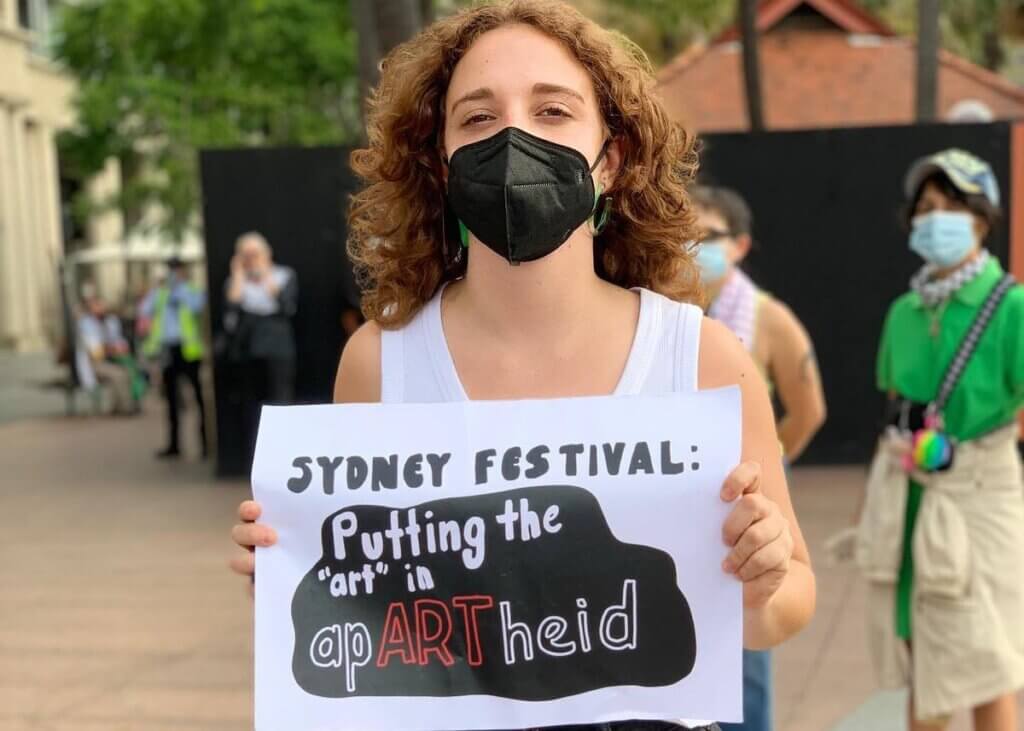
Last month a pro-Palestinian boycott by Festival artists created political shockwaves, as artists took foreign policy into their own hands.
Around 35 percent of the Festival’s participants withdrew, objecting to Israel’s $20,000 sponsorship of a dance created by an Israeli choreographer but performed by an Australian dance company.
Over 1,000 artists also signed a letter supporting the boycott. The boycott was remarkably successful compared to previous efforts in Australia and overseas, including in the U.S. where 33 states have anti-boycott laws.
The heat on Israel follows alleged war crimes in last year’s Gaza war, accusations of apartheid by Human Rights Watch and now Amnesty International, evictions and home demolitions in East Jerusalem, and the ever-expanding colonial settlements in the West Bank.
The boycott caused an uproar. The conservative federal, and New South Wales state, arts ministers condemned it, as did a conservative former Australian ambassador to Israel, conservative Australian Jewish groups, and some artists. Israel was apoplectic.
Caught like a deer in headlights, the Festival organizers belatedly acknowledged the moral objections of artists by pledging to review their policy on donations by foreign governments but refused to return Israel’s money. The Israeli dancers still danced, to rapturous reviews.
Opponents of the boycott have mounted some surprisingly weak objections when there are more serious questions to be asked. They say it censors art for political reasons.
This ignores that artists themselves chose not to perform, persuaded, in the free marketplace of ideas, by boycott campaigners. Artists who still wished to perform were free to do so, and audiences were free to attend. There were no union-style pickets. This was a relatively ‘smart’ boycott.
As the European Court of Human Rights, ruling over 47 European countries, found in 2020, advocacy of boycotting Israel is protected free speech – the opposite of censorship.
Democracies only function if citizens are free to voice their opinions, hoping to convince others. It is absurd for government ministers to condemn such advocacy as censorship. It also patronizes artists as unqualified to make up their own minds.
Opponents also say it politicizes art. Yet political critique has long been a function of art and artists, from Shakespeare to Atwood’s The Handmaid’s Tale.
Art is not just elevator music. The same arguments are often made not to politicize sport. Yet Australia is willing to diplomatically boycott the Beijing Winter Olympics but dismisses a citizen boycott of Israel.
Critics further argue that Israel is antisemitically singled out for a boycott when other states have worse human rights records. But it is not the responsibility of campaigners for Palestine to crusade for victims in every other bad country.
It is to their credit that they have mobilized an effective boycott, which campaigners elsewhere might learn from. It is not antisemitic to criticize Israel for violating international law or to take peaceful action to urge it to stop.
Opponents claim that Israel is a democracy, as if that self-evidently defeats the call for a boycott. Yet democracies violate rights too and should not be immune from sanctions.
In any case, Israel is not a democracy for five million Palestinians living under Israeli military control. They have never been allowed to vote in Israeli elections for over 50 years. For them, Israel is a military dictatorship and, through its settlements, a colonizer.
Opponents warn that Hamas has endorsed the boycott, as if invoking the specter of terrorism automatically discredits it. Hamas supports COVID vaccines too, which hardly makes them a bad thing. Smearing boycotters by association with Hamas is pitifully cheap.
Critics also claim that struggling artists need to perform because their incomes plummeted during COVID. Again, the artists themselves chose to boycott. They know better than arts ministers whether they are willing to forgo income to stand up for human rights.
There are three genuine questions that should be asked of any boycott. Are the offender’s violations serious enough to justify it? Is the collateral damage to innocents, if any, proportionate? Could the boycott potentially improve the wrongdoer’s behavior?
First, Israeli violations of international law have been exhaustively documented. It denies Palestinians their rights to self-determination and statehood, has committed war crimes and human rights violations and denies justice to victims.
Its sponsorship of illegal Israeli settlements proves its agenda is to colonize Palestine, not free it or bring it peace. It has constantly defied the international community, including the Security Council and the International Court. Palestinian violations do not excuse Israel’s violations.
That other country may be worse does not diminish the case of a boycott of Israel, but draws attention to the need to boycott others as well.
Secondly, the boycott has caused limited collateral damage. It certainly targeted Israeli support for a blameless Israeli dance performed by blameless Sydney dancers and inconvenienced audiences. The calculus of the boycott is that these are small sacrifices if stigmatizing cooperation with Israel may pressure it to change.
Sanctions imposed by governments and the UN routinely inflict far greater harm, as the dire humanitarian situation in Afghanistan currently shows.
Thirdly, a boycott inflicts pointless vengeance if it has no prospect of success. Critics cry that shunning a tiny amount of Israeli money for a harmless dance in faraway Sydney will hardly bring peace to the Middle East, when decades of violence and diplomacy have not.
Yet, Israel is hyper sensitive about its perception by western allies, particularly those like Australia, which often shields Israel from legitimate criticism in the UN votes. The spread of sympathy to the Palestinian cause among the Australian community has rattled Israel’s cage, and increases its international isolation.
Citizen boycotts are growing precisely because western governments like Australia and the U.S. have so spectacularly failed to hold Israel to account for systematic violations over half a century.
We should not only apply our new Magnitsky Act human rights sanctions to security adversaries like Russia or China but also to our “friends” when they badly misbehave.
buy cozaar generic cozaar no prescription generic
We know that China will not stop its repression of Uighurs just because Australia doesn’t send officials to watch the Olympics, but we boycott anyway, to stigmatize terrible behavior.
Who knows what might happen when the butterfly of citizen boycotts flaps its wings in the desert of Middle Eastern politics? There is so little left to lose, and so much to gain.
Australians must exercise their own conscience about different types of boycotts. But the case for boycotts is plausible and should be taken seriously – not sledded by specious or misleading criticisms.
Shortlink for this post: https://daysofpalestine.ps/?p=15260