Monday, June 8, 2026
DOP - Days of Palestine
  • Home
  • News
    • 1948 Lands
    • Gaza
    • Jerusalem
    • Refugees
    • West Bank
    • Palestinian Prisoners
  • World
  • Reports
    • Demolitions & displacement
    • Gaza blockade
    • International Reports
    • Jerusalem
    • Local Issues
    • Martyrs & Casualties
    • Occupation & Settlements
    • Palestinian prisoners
  • Media
    • Podcast
    • Infographic
    • Pictures
    • Video
      • Closer eye on the Israeli Occupation
      • Info Videos
      • My story
      • PIM
      • Trends
      • who’s gonna know
  • Opinions
  • Features
  • Pal Archive
    • Historical Palestine
    • Israel Atrocities
    • Gaza War Diaries
  • About us
Donate
No Result
View All Result
  • Home
  • News
    • 1948 Lands
    • Gaza
    • Jerusalem
    • Refugees
    • West Bank
    • Palestinian Prisoners
  • World
  • Reports
    • Demolitions & displacement
    • Gaza blockade
    • International Reports
    • Jerusalem
    • Local Issues
    • Martyrs & Casualties
    • Occupation & Settlements
    • Palestinian prisoners
  • Media
    • Podcast
    • Infographic
    • Pictures
    • Video
      • Closer eye on the Israeli Occupation
      • Info Videos
      • My story
      • PIM
      • Trends
      • who’s gonna know
  • Opinions
  • Features
  • Pal Archive
    • Historical Palestine
    • Israel Atrocities
    • Gaza War Diaries
  • About us
No Result
View All Result
DOP - Days of Palestine
No Result
View All Result
Home News

‘Through the process of documenting Palestine’s history, the old do not die and the young will not forget’

July 30, 2023
in News, Pal Archive
Reading Time: 10 mins read
‘Through the process of documenting Palestine’s history, the old do not die and the young will not forget’
Share on FacebookShare on Twitter

Nayef Mustafa Suleiman Turaani is a Palestinian refugee from the town of Samakh in the Tiberias district of Palestine. He was born in 1955 in Al-Hamma, located in the triangle of the border between Syria, Palestine and Jordan, after his family was displaced from Samakh during the 1948 Nakba. His family moved to Jobar, five kilometres east of the Syrian capital, Damascus, and then settled in the Yarmouk camp for Palestinian refugees. He began his studies in UNRWA schools in Yarmouk in 1962 and went on to read civil engineering at university, after which he joined the ranks of the Popular Front for the Liberation of Palestine, fighting in its ranks in the face of the Israeli invasion of Lebanon and to defend the people of Lebanon and Palestine.

Recalling the resistance’s removal from Lebanon, Nayef says they suffered days under siege in the Lebanese capital, Beirut. “We were surprised by the decision to leave Lebanon, and it was a clear plot to dismantle the Palestinian revolution. The resistance factions left for several countries, so I left for Syria, where my family lives.”

“We left Beirut at noon and arrived in Tartous at dawn. Thousands of families welcomed us at the coast in Tartous; many were asking about their sons and their families. Some had pictures and asked if anyone had seen their loved ones,” he explains.

“We rode the buses and headed to the military base of Al-Dhanin, east of Damascus, and we were issued identities with new names for those who wanted, and the weapons we had were handed over.”

READ: ‘In every word I speak and everything I do, I’m thinking of Palestine,’ singer tells Brazil

At first, he says, “we were like lost people” because they were no longer bearing arms as they had been accustomed to doing for over 100 days of fighting. “Our lives consisted of a willingness to sacrifice and die for the sake of the homeland,” he explains.

After he spent 14 days back with his family in Yarmouk, Nayef joined the Khalkhala military airport, south of Damascus, at the request of the Syrian government. In 1983 he moved to Jordan and worked as an engineer.

Since his retirement Nayef has been writing the history of Samakh, the town from which his family originated. He says his experience of the history changed after his father’s death when he played a more active role in the family and learnt more about its history.

“We collected photos and documents that I and the people of Samakh have, such as my father’s wedding card – from 1936, birth certificates for the people of the town and land registration documents, all of which I have in the archive,” he says.

The town of Samakh in the Tiberias district of Palestine
91033131_10158333696239884_6302386988121063424_n
My father's wedding invitation in Samakh in 1943

“My desire to write and document increased, and I began searching for the elderly who were born in the village and lived there before the Nakba.”

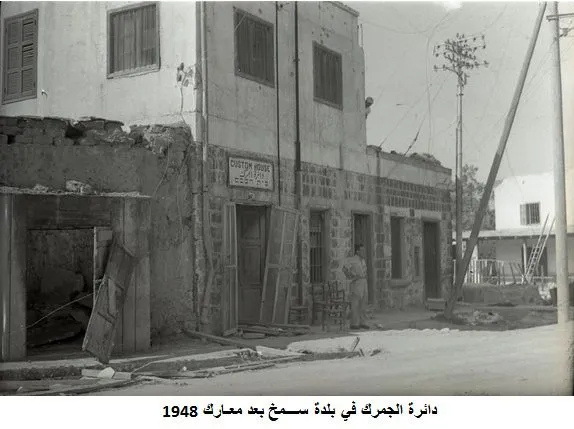
The town of Samakh was completely ethnically cleansed in 1950, and only three landmarks of the basalt base remained including traces of the railway and train carriages, in addition to the station building and the building of the Hassan Saeed Al-Damwani shop. “The Zionists established nine settlements on its land: Kinneret, Dajania Elif, Dajania B, Beit Zeira, Afokim, Ashdot Yaakov, Sa’ar Hagolan, Masada and Memghan,” Nayef says, adding that the Arabic town of Samakh is no longer.

There were approximately 3,000 Palestinians living in Samakh in 1946 and it boasts among its most famous figures the late Fayez Qandil, the political activist Khaled Al-Tar’ani and the former deputy head of the Jordanian Bar Association Falah Madi.

Learning about his town’s history he found that Zionist gangs had tried to purchase land from the Palestinians but they had refused to sell. In an effort to force their hand, the son of Samakh’s mukhtar (town chief) was kidnapped. When the Zionists came to negotiate his release in return for the purchase of the land, Suleiman Turaani said he considered that his son had been martyred and refused their conditions.

READ: ‘We can use the power and beauty of music against colonial forces,’ says Palestinian-Japanese soprano

“What also caught my eye was the respect for women; giving them all their rights,” Nayef says. “I wrote about the women’s revolution and the march of torchlights against the occupation during the tripartite aggression on Port Said in Egypt.”

“The former British colonial power and the Zionist occupation, formerly and currently, have tried to conquer the Palestinian people, end their cause and steal their land, but they have not succeeded,” Nayef says.

“The waves of normalisation with the Zionist enemy by Arab regimes and some Palestinian parties have also not succeeded in marginalising the Palestinian cause. We have found this generation of Nakba survivors stronger and fiercer than its fathers and grandfathers.”

His work to collate the memories of his town and of Palestinians as a whole is part of the resistance, he explains. “Through the process of archiving, documenting and circulating these stories, the old do not die and the young will not forget.”

Article image
During the resistance to the invasion of Lebanon in 1982
From the archive some of the kitchen collectibles
IMG_2849
From the archive photo of the driver's license in 1947

From the archive photo of the driver’s license in 1947

Shortlink for this post: https://daysofpalestine.ps/?p=27154

DONATE NOW
Previous Post

‘Well of solutions’ or problems: Why reforming the UN is critical

Next Post

Israeli Occupation Forces Detain 4 Palestinians, Including 2 Kids, in Ramallah

Next Post
Israeli Occupation Forces Detain 4 Palestinians, Including 2 Kids, in Ramallah

Israeli Occupation Forces Detain 4 Palestinians, Including 2 Kids, in Ramallah

Latest News

Three Sisters Face a Rare Disease Trapped Behind Closed Gaza Crossings
Gaza

Thousands of Critically Ill Gaza Patients Left Without Access to Treatment

by olfa olfa
June 7, 2026
0

Read moreDetails
Israeli Attacks Across Gaza Kill Ten, Including Five Children

Hamas: Gaza Tent Camp Massacre Aimed at Blocking Ceasefire Efforts

June 7, 2026
Israeli Forces Continue Ceasefire Violations as Airstrikes and Shelling Kill One in Eastern Gaza

Four Killed in Gaza Following Renewed Israeli Violations and Artillery Fire

June 7, 2026
US Approves $151.8M Arms Sale to Israel

Microsoft Admits Complicity with Israel in Palestinians’ Surveillance

June 7, 2026
Israeli Strikes Kill 10 Across Gaza Strip, Destroy Two Homes 

Israeli Strikes Kill 10 Across Gaza Strip, Destroy Two Homes 

June 7, 2026

ABOUT US

Days of Palestine Foundation is a Palestinian media organization concerned with international media. It is dedicated for getting the Palestinian narrative reached to the whole world as well as advocating the Palestinian people and the just Cause of Palestine.

TRENDS IN PALESTINE

  • Thousands of Critically Ill Gaza Patients Left Without Access to Treatment June 7, 2026
  • Hamas: Gaza Tent Camp Massacre Aimed at Blocking Ceasefire Efforts June 7, 2026
  • Four Killed in Gaza Following Renewed Israeli Violations and Artillery Fire June 7, 2026
  • Microsoft Admits Complicity with Israel in Palestinians’ Surveillance June 7, 2026

CATEGORIES

  • BDS
  • Jerusalem
  • 1948 Lands
  • Opinions
  • International Reports
  • palresponds
  • About Us
  • Contact Us
  • Donate
No Result
View All Result
  • News
    • 1948 Lands
    • Gaza
    • Jerusalem
    • Refugees
    • West Bank
    • Palestinian Prisoners
  • World
  • Reports
    • Demolitions & displacement
    • Gaza blockade
    • International Reports
    • Jerusalem
    • Local Issues
    • Martyrs & Casualties
    • Occupation & Settlements
    • Palestinian prisoners
  • Media
    • Podcast
    • Infographic
    • Pictures
    • Video
      • Closer eye on the Israeli Occupation
      • Info Videos
      • My story
      • PIM
      • Trends
      • who’s gonna know
  • Art & Culture
  • Articles
  • DOP Forum
  • Features
  • International Solidarity
    • BDS
  • Opinions
  • Over the wall
    • Brazil
    • France
    • Italy
    • Spain
  • Pal Archive
    • Historical Palestine
    • Israel Atrocities
    • Gaza War Diaries
  • Translations & Participations

© 2023 Days of Palestine