Source: Middle East Eye
By: Ramzy Baroud
The 77th session of the United Nations General Assembly was, in many ways, similar to the 76th session and many other previous sessions: at best, a stage for rosy rhetoric that is rarely followed by tangible action or, at worse, a mere opportunity for some world leaders to score political points against their opponents.
This should surprise no one. For many years, the UN has been relegated to the role of either a cheerleader for the policy of great powers, or a timid protester of socio-political, economic or gender inequalities. Alas, as the Iraq war proved nearly thirty years ago, and as the Russia-Ukraine war is proving today, the UN seems the least effective party in bringing about global peace, equality and security for all.
As is often the case, voices like those of Antonio Guterres – who called for “achieving and sustaining peace” – were drowned by those with the big guns and financial means to turn the Ukraine war into a long-drawn battlefield for their own strategic reasons.
Similar to Guterres, the words of the new UN General Assembly President Csaba Kőrösi seemed least practical or, sadly, even relevant.
“Responding to humanity’s most pressing challenges demands that we work together, and that we reinvigorate inclusive, networked and effective multilateralism and focus on that which unites us”, Kőrösi said in his speech at the opening session on Tuesday, 20 September.
Kőrösi’s frame of reference to what, at least for now, seems like wishful thinking, is his understanding that the UN was created out of the “ashes of war” with the intention of being a “well of solutions”.
READ: Whose side is the PA on?
In truth, the UN Charter was signed in June 1945 to reflect an emerging new power paradigm that resulted from World War II. The UN power structure simply confirmed the gains of the victors of that war and granted the victorious countries far greater influence through their permanent membership in the UN Security Council and veto power, than the rest of the world combined.
This was not a deviation from the historical norm. After all, the League of Nations, the predecessor of the current UN, was founded in 1920 to confirm the new geopolitical realities that resulted from World War I.
The League of Nations was scrapped as it was deemed “ineffective”. This, however, was not the real reason behind its dismissal. In actuality, the League’s old structure and makeup simply did not correspond to the new power formations resulting from the Second World War, where old enemies became new friends and old friends became new enemies.
Effectiveness had little to do with the switch from the League to the UN, as the latter hardly managed to seriously address or resolve major political issues, from Palestine, to Kashmir, to Sudan, Mali, Afghanistan, and numerous other conflicts, including today’s war in Ukraine.
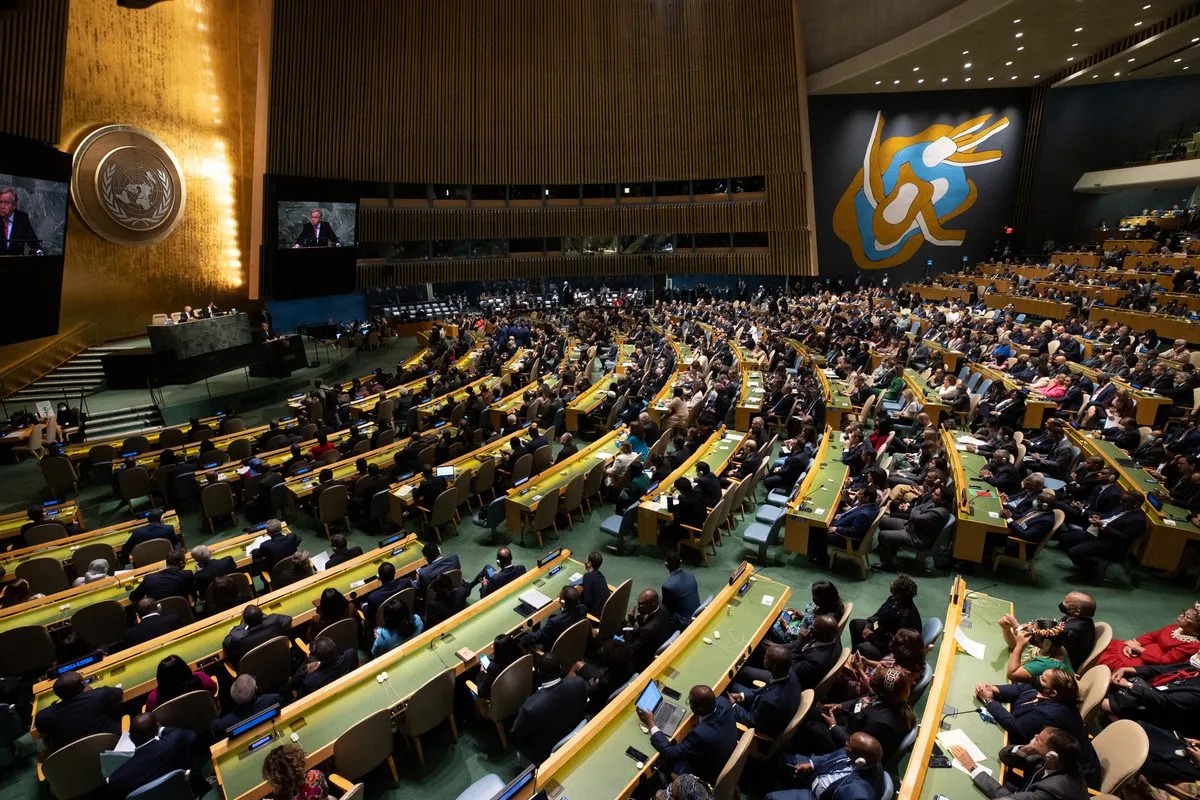
![United Nations Secretary-General Antonio Guterres addresses the 77th session of the United Nations General Assembly at UN headquarters in New York City on September 20, 2022. [Tayfun Coşkun - Anadolu Agency]](https://i0.wp.com/www.middleeastmonitor.com/wp-content/uploads/2022/09/AA-20220920-28949552-28949551-77TH_SESSION_OF_THE_UNITED_NATIONS_GENERAL_ASSEMBLY.jpg?resize=933%2C622&quality=85&strip=all&zoom=1&ssl=1)
United Nations Secretary-General Antonio Guterres addresses the 77th session of the United Nations General Assembly at UN headquarters in New York City on September 20, 2022. [Tayfun Coşkun – Anadolu Agency]
Even the hype over the UN’s role in addressing the climate change crisis, arguably the most pressing for all of humankind, has petered out quickly. Thanks to the polarisation and self-serving ‘diplomacy’ generated by the Ukraine crisis, many countries that led the way in the use of clean energy are now backtracking.
Indeed, the environmental crisis has now been moved to the back burner, to the extent that US President Joe Biden has reportedly skipped the roundtable talks on climate action, which were scheduled to take place in New York on September 21. A year ago, this would have generated much discussion and even anger among US environmentalists. Now it seems a trivial and politically inconsequential issue.
Still, despite its many contradictions, and overall failure to deliver on its promises of peace and security, the UN continues to serve a role. For the US and its western allies, it remains a stage for their political power, which they have inherited from the legacy of WWII.
However, for smaller countries – in Africa, the Middle East and much of the Global South – the UN gives them a voice, albeit barely audible, and grants them an occasional chance at relevance. This relevance, however, is temporary and ultimately intangible. After all, all the fiery, impassioned, and articulate speeches of all the leaders of the Global South combined hardly ever influenced outcomes, discouraged neo-colonialism, economic exploitations, racism, military interventions or political meddling.
In an open letter on 20 September addressing world leaders, over 200 humanitarian organisations, including OXFAM and Save the Children, stated that one person is likely to be dying every four seconds as a result of the “spiralling global hunger crisis”.
From Exodus to Marvel: A brief history of Hollywood’s justification of Israeli war crimes
This crisis is more palpable in Africa than on any other continent. Though food shortages in Africa are an ongoing challenge, many signs have already indicated that an unprecedented crisis is looming, initiated by climate change, worsened by the Covid pandemic, and further accentuated by the Ukraine war and the disruption of critical supply routes.
Despite repeated pleas by UN organisations to prioritise Africa in terms of food shipments, the opposite became true. This begs the question: If the UN does not have the means and power to provide life-saving food to starving children, is it not, then, time to question the very mission, structure, and mechanisms of the world’s largest organisation?
True, there has been talk about urgent and long overdue UN reforms. Some want the UN to be reformed to reflect new democratic or economic realities, while others feel deserving of being permanent members of the UNSC. The West, of course, wants to keep the convenient power distribution in place as long as possible.
However, for a reformed UN to serve a noble mission and to live up to its lofty promises, the new power distribution should allocate places for all, regardless of military power or economic might. Till then, the UN will remain a sad expression of the world’s existing problems, not, in the words of Kőrösi, a “well of solutions”.
Shortlink for this post: https://daysofpalestine.ps/?p=27150