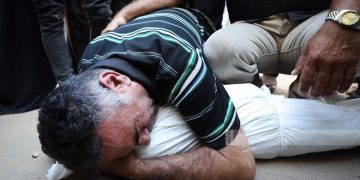
DaysofPal – Residents of the Gaza Strip are living through renewed anxiety and psychological distress following the escalation linked to the U.S.–Israeli confrontation with Iran. Continuous news coverage of regional clashes and military developments has revived painful memories of the devastating war that battered Gaza for nearly two years.
For many Palestinians in the enclave, the tension goes beyond ordinary concern. The experience of prolonged bombardment, displacement, and hunger has left deep emotional scars. Many residents interpret every report of military action or political escalation across the region as a possible sign of renewed catastrophe.
Memories of the War Increase Fear of Another Crisis
Forty-five-year-old Fouad al-Jamal describes living in a constant state of anticipation, closely following news updates that might signal further turmoil. Years of bombardment and hardship have made it impossible for him to detach daily headlines from his personal memories of war.
“Since I heard that the crossings were closed again because of the U.S.–Israeli war with Iran, I haven’t been able to sleep,” he said. “The same anxiety we lived through during the war on Gaza has returned. Even a distant reconnaissance aircraft in the sky makes us afraid.”
His children repeatedly ask whether a new war will begin or whether the family will be forced to flee again. Al-Jamal admits he has no reassuring answers. He fears not only renewed attacks but also the return of hunger, recalling how shortages and soaring prices once pushed families to desperate measures to secure food.
Signs of economic strain have already appeared. Some goods disappeared from local markets during the first days of regional escalation, reviving memories of long months marked by scarcity and humiliation.
For Heba al-Aqqad, the closure of the Rafah Border Crossing carries personal consequences. Her child, who suffers from leukemia, has waited months for medical evacuation and treatment outside Gaza. The crossing briefly reopened before shutting again due to regional tensions, leaving the family’s hopes in limbo.
Time is critical for her son, who has received little treatment in Gaza since his diagnosis four months ago. Al-Aqqad worries that further escalation could delay the crossing’s reopening indefinitely. Previous closures that lasted months remain a painful reminder of how access to treatment can disappear overnight.
Others share similar fears. Kamal Abu Aker, a 41-year-old resident, believes Gaza’s fragile situation makes another crisis possible at any moment. The ceasefire has remained unstable, punctuated by frequent violations, and he fears that renewed regional conflict could provide an opportunity for further attacks or restrictions on Gaza’s population.
Political Uncertainty and Collective Trauma
Political analyst Wissam Afifa says the expanding regional confrontation may shift international attention away from Gaza. Focus by the United States on managing a broader regional conflict could reduce pressure on the government of Benjamin Netanyahu to implement the next phase of the Gaza ceasefire agreement.
According to Afifa, the situation could slow the agreement’s implementation or lead to reinterpretation of certain provisions under the argument that regional conditions have changed. He also warned that Israel might use the escalation to delay withdrawal plans, postpone reconstruction efforts in Gaza, or advance policies in the West Bank and Jerusalem while global attention remains fixed on the broader confrontation.
Afifa cautioned against a scenario in which the Iranian conflict becomes linked to the Palestinian issue, turning Gaza into a bargaining card within regional negotiations and exposing its population to new political pressures.
Psychological Impact of Constant Tension
Psychologist Dr. Khetam Abu Ouda says the unfolding regional developments are already affecting the mental health of Gaza’s residents. Confusing news cycles and the closure of border crossings revive traumatic memories among people who lost relatives or homes during previous wars.
Even hearing words like “bombing” or “war” can trigger intense emotional reactions. Residents report insomnia, persistent tension, sudden panic attacks, and a constant sense that danger is imminent.
Abu Ouda describes the situation as a cycle in which new crises awaken earlier trauma. Years of blockade, repeated wars, displacement, and loss have created a collective psychological shock within Gaza’s society.
That shared trauma makes the population especially vulnerable to regional tensions. Even limited developments can revive widespread fear and despair, affecting daily life, concentration, and social relationships.
She stresses that psychological support and the creation of a stable environment are essential to limit long-term harm, particularly for children, women, and elderly residents who often bear the heaviest emotional burden of recurring conflict.
Shortlink for this post: https://daysofpalestine.ps/?p=72742