As Muslims around the world mark Eid al-Adha, it is a sombre affair in Gaza.
Palestinians in the blockaded coastal enclave are experiencing a crippling economic crisis following Israel’s deadly war in May, with tightened restrictions leading to shortages of goods ahead of the four-day festival.
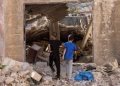
While Israeli authorities allowed the entry of clothes, fabrics, and food industry items into Gaza last week, raw materials desperately needed to reconstruct war-damaged infrastructure have been prohibited, with Gazans surrounded by devastation.
Many such banned materials such as cement and iron are defined as dual-use goods which Israel claims could serve both civilian and military purposes.
The 11 days of fighting in May damaged or destroyed over 16,000 Palestinian homes, 58 schools, nine hospitals and 19 clinics. More than 256 people were killed, including 66 children.
“Palestinians in the blockaded coastal enclave are experiencing a crippling economic crisis following Israel’s deadly war in May”
Empty shops and low sales
Gazan shopkeepers say they are suffering from record low sales amid Gaza’s tragic economic situation. Israel and Egypt’s 14-year blockade, which was tightened following Israel’s bombardment of Gaza in May, has led to a protracted humanitarian crisis.
Alaa Hamed, a 26-year-old owner of a small clothing shop in Jabaliya refugee camp in northern Gaza, says that residents were less likely to buy clothes for Eid even before the Israeli military allowed new items to enter last Thursday.
“I thought the scarcity of clothes available in my shop was the main reason for the low sales,” he told The New Arab.
“But even when clothes were allowed to enter a few days before Eid my shop remained empty, and if there were customers, I could count them because they were less than you could imagine, unlike previous Eids,” he said.
Gazan markets are usually crowded during Eid celebrations, with people purchasing clothes, accessories, candies, and other gifts, but this Eid has seen a marked deterioration for Gazan vendors, who had hoped to recoup some of the losses caused by Covid-19 and Israel’s brutal war.
“Most residents who entered my shop bought nothing at all. I sold five pieces every day, but the rest of the people took a look at the clothes and their prices and left without buying anything,” he said.
“The war occurred two or three days before Eid al-Fitr took place, depriving us of celebrations, but this time the lack of sales has prevented us from making any profits,” Hamed added.
Unaffordable prices
After goods were recently allowed to enter Gaza, Maha Saher, 28, went shopping to buy new clothes for her two daughters, Sara and Rama, trying to find items at a suitable price.
“Most Gazan shops didn’t have any of the new goods which were allowed to enter a few days before Eid. The available goods aren’t high quality despite being so expensive,” she said, adding that traders have attempted to compensate for some of their losses during the year.
Maha was forced to buy expensive clothes for her children even though her husband, who works as a photojournalist, receives only 50% of his total monthly salary, estimated at $250, which hardly covers their basic needs.
“I didn’t want to buy anything for them because of the unaffordable prices, but I couldn’t because Sara cried when she found out,” she said. “She was happy today because she wore new clothes to celebrate Eid”.
“The war occurred two or three days before Eid al-Fitr took place, depriving us of celebrations, but this time the lack of sales has prevented us from making any profits”
Due to the restrictions imposed on the entry of goods, Gazan residents have been suffering a shortage of essential electric devices, including fans and air coolers amid the hot summer. Seham Abed, 60, searched through shops in Gaza for fans, but she only found one.
“Three days ago, my husband and my daughter went to more than 10 shops and companies asking for fans, but they were empty due to the closure of the crossing,” she said.
Abed wanted at least two more fans for when her relatives visited her on Eid to keep cool amid the summer heat and widespread power cuts.
“After days of searching, my husband finally found one, but the price had doubled,” she said.
Significant losses for livestock traders
Over the past ten days, Gazan livestock traders had prepared to sell most of their sheep, cattle, calves, and other animals for Eid- al-Adha. However, sales were well below what they had expected due to Gaza’s economic crisis.
Hasan al-Masri, the owner of a livestock warehouse in Beit Lahia, only sold 12 animals out of a total of 25, even though their prices were reduced by 15%.
Every year, al-Masri’s farm is normally full of more than 40 cattle and sheep for this occasion. This year was completely different.
“I couldn’t sell all of them because of the lack of purchasing power of Gazan residents, even though they are cheaper than before,” al-Masri said. “I used to sell the sheep at around $350 in past years, whereas we sold it at $300 this year”.
Al-Masri says he had to lower his prices to ensure he made enough profit to cover the debts he incurred to pay for livestock feed and medicine.
But the decline in livestock prices caused al-Masri “significant losses” as he wasn’t able to make a profit from the discounted sale prices, which in turn has prevented him from providing for his family’s needs.
“I have two sons and one daughter who are studying at university. And I need to provide for their university fees to enrol in courses for the next semester which will start in one month,” he said.
“The university fees are unaffordable, and I don’t know how to provide for them”.
“The Israeli occupation stopped me from working, and now, they prevented me from receiving aid”
Waiting for assistance
After the Israeli war, many poor families were counting on Qatari financial aid to spend before the Eid holiday. Ibrahim Fayyad, 33, is one of them.
Fayyad is a father of five children living in Beit Hanoun. He was a construction worker, receiving $300 a month, but is now unemployed.
The prohibition on raw materials entering Gaza has affected nearly 90% of factories, which have in turn laid off most of their workers.
He was counting on external aid, estimated at around $100, in order to provide for his family on Eid, but objections from Israel over how the funds should be distributed have delayed the payments.
“I wasn’t able to receive aid for two months and therefore wasn’t able to buy new clothes for my children to celebrate Eid, like other children in Gaza,” Fayyad said.
“I know this aid was insufficient for my family, but this amount in my current situation is better than nothing,” he said.
“The Israeli occupation stopped me from working, and now, they prevented me from receiving aid”.
Khuloud Rabah Sulaiman is a Gaza-based writer for WeAreNotNumbers.org.
Shortlink for this post: https://daysofpalestine.ps/?p=9809