It was hours after sundown when the eight aid trucks drove from the makeshift jetty, cobbled together from tons of wreckage left across Gaza by months of war.
The trucks were escorted by three vehicles carrying aid workers from the World Central Kitchen, the relief organization that had arranged the massive food shipment. All seven aid workers wore body armour. The cars were marked, including on the roof, with the group’s emblem, a multi-colored frying pan.
After a gruelling crawl along a beaten up road, it seemed like mission accomplished. The convoy dropped off its precious cargo at a warehouse, and the team prepared to head home.
There wasn’t much more than a sliver of moon that night. The roads were dark, except for occasional patches where light spilled from buildings with their own generators.
By a few minutes after 10 p.m. the convoy was moving south on Al Rashid Street, Gaza’s coastal road.
The first missile struck a little more than an hour later.
Soon after, all seven aid workers were dead.
A crucial effort to ward off famine
The path to the April 1 attack started months ago, as aid groups desperately looked for ways to feed millions cut off from regular food deliveries. Gaza was sealed off by Israeli forces within hours of the Oct. 7 attack by Hamas militants that ignited the war. Since then, more than 33,000 Palestinians have been killed and more than 80 percent of the enclave’s 2.3 million people displaced.
Hunger has become commonplace. Famine, UN officials warn, has become increasingly likely in war-ravaged northern Gaza.
With the situation growing increasingly dire and deliveries through Gaza’s land crossings with Israel and Egypt limited, World Central Kitchen pioneered an effort to deliver aid by sea.
The relief group, founded in 2010 by celebrity chef José Andrés , has worked from Haiti to Ukraine, dispatching teams that can quickly provide meals on a mass scale in conflict zones and after natural disasters. The group prides itself on providing food that fits with local tastes.
Its first ship arrived in mid-March, delivering 200 tons of food, water and other aid in coordination with Israel.
On March 30, three ships and a barge left Cyprus carrying enough rice, pasta, flour, canned vegetables, and other supplies to prepare more than 1 million meals, the group said.
Two days later, some of those supplies were ready to be trucked into the heart of Gaza.
April 1, 10 p.m.
The eight-truck World Central Kitchen convoy turned south after leaving the pier, driving along the coast toward a warehouse about 10 kilometres (6.2 miles) away.
The World Central Kitchen team travelled in two armoured cars and a third unarmoured vehicle. They included a Palestinian driver and translator, Saifeddin Issam Ayad Abutaha, a young businessman whose mother was hoping to find him a wife; and security consultant Jacob Flickinger, a dual American-Canadian citizen saving to build a house in Costa Rica where he and his girlfriend could raise their 18-month-old son.
There were three British military veterans, an Australian beloved for her big hugs and relentless work ethic, and a Polish volunteer heralded by the group as “builder, plumber, welder, electrician, engineer, boss, confidant, friend, and teammate.
The team had established a “deconfliction” plan ahead of time with Israeli forces, so the military would know when they would travel and what route they would take.
Aid organizations use complex systems to try to keep their teams safe. Typically, they send an advance plan to COGAT, the Israeli defence agency responsible for Palestinian civilian matters, which then shares it with the Israeli army, said a military official. As deliveries unfold, the aid groups can communicate with the military in real time, said the official, speaking on condition of anonymity in line with army briefing rules.
Workers for World Food Kitchen carry GPS transmitters that track their locations, according to an organization employee who spoke on condition of anonymity because he didn’t have permission to talk to the media.
Many relief workers have expressed concerns about the deconfliction system.
“It hasn’t been working well,” said Chris Skopec, a Washington-based official with the aid group Project Hope, citing poor communication and coordination. “And when it doesn’t work well, people die.”
10:28 pm
Things began to go wrong a few miles from the pier.
An Israeli officer, watching from a drone, saw what he thought was a Hamas gunman climb on top of one truck and fire into the air.
Gunmen are a daily part of life in Gaza, which has been run by Hamas since 2007. They could be Hamas fighters, members of Hamas-supervised police or privately employed guards.
Some relief groups hire armed guards, aid officials said, often plain-clothed men who brandish guns or large sticks to beat back hungry Palestinians trying to snatch supplies.
The World Central Kitchen sometimes uses armed guards, the employee said, though it was not clear if they had been employed for the April 1 convoy. The employee and other aid officials insisted their guards were not part of Hamas or its militant ally, Palestinian Islamic Jihad, but did not elaborate on the guards’ affiliation. Despite such denials, it is unlikely anyone riding on top of an aid truck wouldn’t have at least tacit permission from Hamas.
Israeli military spokesperson Maj. Nir Dinar said soldiers try to distinguish between armed security guards and Hamas militants when determining targets. He said he could not rule out the possibility that the armed men accompanying the World Central Kitchen convoy were security guards.
10:46 pm
In grainy aerial footage that the Israeli military showed to journalists, people swarmed around the convoy when it arrived at a World Central Kitchen warehouse in the city of Deir Al-Balah. Two of the men, they said, were armed.
10:55 pm
The trucks remained at the warehouse but the three World Central Kitchen vehicles began driving south to take the workers to their accommodations. Another vehicle that had joined the convoy – which the Israelis say held gunmen – drove north toward another warehouse.
Planning messages sent by World Central Kitchen had made clear that the aid workers would not remain with the trucks but would travel on by car.
But Israeli officials say the soldiers monitoring the convoy had not read the messages. Then, an Israeli officer believed he saw someone step into a World Central Kitchen vehicle with a gun.
“The state of mind at that time was the humanitarian mission had ended and that they were tracking Hamas vehicles with at least one suspected gunman,” said retired Gen. Yoav Har-Evan, who led the military’s investigation into the strike.
Because of the darkness, Israeli officials said the World Central Kitchen emblems on the cars’ roofs were not visible.
11:09 pm
The first missile struck one of the armoured cars as it drove along the coastal road. Aid workers fled the damaged vehicle for the other armoured car, which Israel struck two minutes later.
The survivors piled into the third vehicle. It, too, was soon hit.
Abdel Razzaq Abutaha, the brother of the slain driver, said other aide workers called him after the blasts, telling him to check on his brother.
He repeatedly called his brother’s phone. Eventually a man answered, and said he’d found the phone around 200 meters (656 feet) from one of the bombed-out cars.
“Everyone in the car was killed,” the man told Abdel Razzaq.
Abdel Razzaq had believed his brother’s work would be safe.
“It is an American international institution with top coordination,” he said. “What is there to fear?”
The aftermath
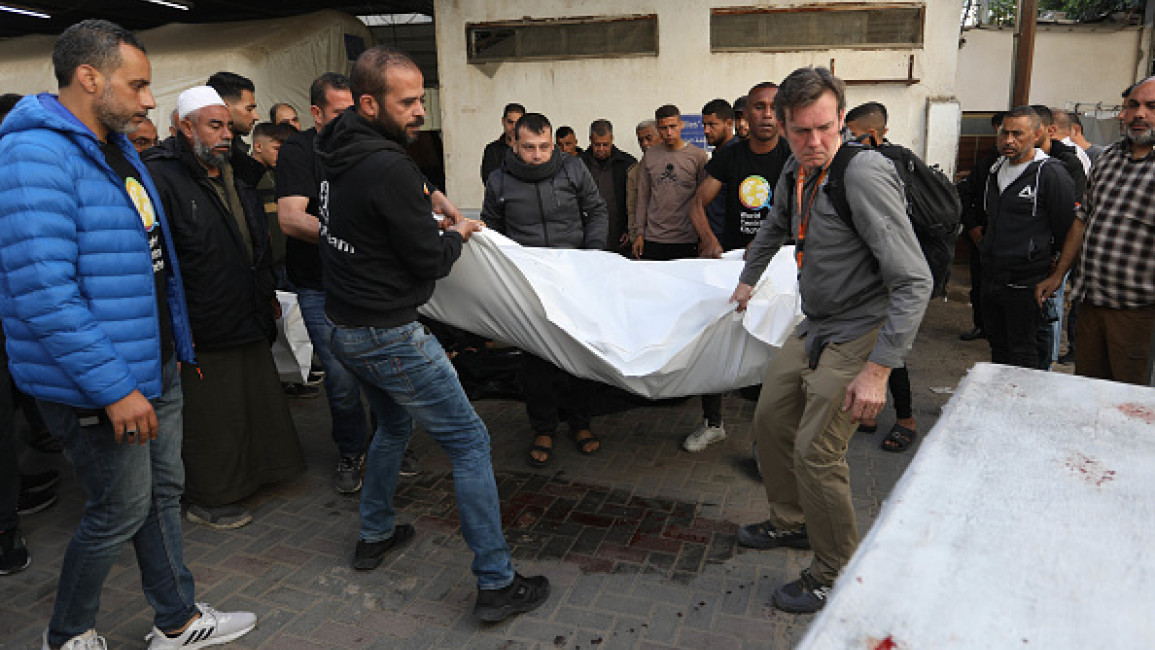
When the sun rose the next morning, the burned husks of the three vehicles were spread along a mile or so of Al Rashid Street.
Israel quickly admitted it had mistakenly killed the aid workers, and launched an investigation.
“It’s a tragedy,” military spokesman Rear Adm. Daniel Hagari told reporters. “It shouldn’t have happened. And we will make sure that it won’t happen again.”
On Friday, Israel said it had dismissed two officers and reprimanded three more for their roles, saying they had mishandled critical information and violated the army’s rules of engagement, which require multiple reasons to identify a target.
In the wake of the deadly strike, Israel and COGAT have set up a special “war room” where COGAT and military officials sit together to streamline the coordination process.
Israel’s promises have done little to quiet growing international anger over its offensive.
More than 200 aid workers have been killed in Gaza since the war began, including at least 30 killed in the line of duty, according to the UN Many aid workers noted the convoy strike stood out only because six of those killed were not Palestinian.
Aid workers are, in many ways, a hard community to define. Some are experts who earn a good living traveling from disaster to disaster. Some are volunteers looking for a way to do some good. Some are driven by ambition, others by faith.
In Gaza, though, everyone understood the risks.
John Flickinger’s son Jacob, a Canadian military veteran, was a member of the convoy’s security team.
“He volunteered to go into Gaza, and he was pretty clear-eyed,” Flickinger told the AP. “We discussed it, that it was a chaotic situation.”
While World Central Kitchen and a few other aid groups suspended operations in Gaza after the attacks, many of the largest organizations, including Doctors Without Borders and Oxfam International, barely slowed down.
The convoy strike “wasn’t outside of things that we could have predicted, unfortunately,” said Ruth James, a UK-based Oxfam regional humanitarian coordinator. Except for one cancelled trip, Oxfam staff simply kept working.
“What keeps them going?” she asked. “I can only guess”.
(AP)
Shortlink for this post: https://daysofpalestine.ps/?p=53148