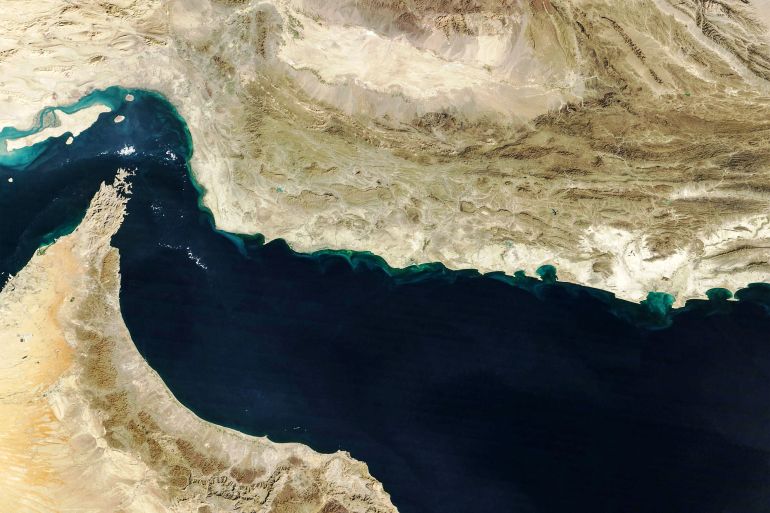
DayofPal– As the war raged in the Middle East between the United States and Israel on one side, and Iran on the other, Tehran has announced its decision to close the Strait of Hormuz.
The Strait of Hormuz is a strategic maritime passage through which about 20% of the world’s daily oil supply flows.
This move comes in response to recent U.S. and Israeli strikes on Iranian nuclear sites and follows a parliamentary vote in Iran approving an emergency closure of the strait.
The decision is now pending review by the Supreme National Security Council for implementation.
This step carries significant geopolitical and economic implications. Closing the Strait of Hormuz would effectively cripple nearly one-fifth of global oil trade, threatening international markets and global energy security.
The ongoing war raise the possibility of unprecedented regional escalation, sparking concerns of military retaliation that could destabilize the regional and global balance.
In the early days of the Israeli escalation against Iran, the Islamic Republic News Agency quoted Esmail Kosari, a member of the Iranian parliament’s security committee, stating that Iran is seriously considering shutting down the strategic Strait of Hormuz.
Located between Oman and Iran, the Strait of Hormuz serves as the world’s most critical oil shipping gateway, carrying the majority of oil exports from the region to global markets, alongside large volumes of liquefied natural gas (LNG).
The narrow strait is often referred to as the “lifeline of the industrial world,” as roughly two-thirds of the world’s consumed oil production passes through it.
Historically, the strait has been a focal point for international conflicts and was previously closed to U.S. and European oil shipments during the 1973 war in support of Israel, underscoring its strategic importance amid tensions between Tehran and the West.
Iran has previously threatened to close the strait in response to Western pressure. Experts warn that any closure could severely restrict trade flow and cause sharp spikes in global oil prices.
The Strait of Hormuz, spanning just 33 kilometers at its narrowest point between Oman and Iran, has a navigable channel only about 3 kilometers wide in each direction.
Approximately one-fifth of global oil consumption, or nearly 20 million barrels per day of crude, condensates, and fuel, passes through the strait.
Major oil-exporting countries, including Saudi Arabia, Iran, the United Arab Emirates, Kuwait, and Iraq, members of OPEC, ship most of their crude oil through this passage, especially to Asian markets.
In response, the UAE and Saudi Arabia are seeking alternative routes to bypass the strait. Qatar, the world’s largest LNG exporter, also sends nearly all its LNG shipments through the strait, which accounts for about a quarter of global LNG consumption.
In June 2024, the U.S. Energy Information Administration noted that about 2.6 million barrels per day of unused pipeline capacity (such as Saudi Arabia’s East-West pipeline and the Habshan-Fujairah pipeline in the UAE) could partially mitigate the impact of a strait closure.
However, these alternatives have limited capacity compared to the volume passing through Hormuz. Further complicating the situation, the involvement of Yemen’s Houthi rebels, who might close the Bab Wl-Mandab Strait at the southern entrance of the Red Sea, could virtually block Gulf oil exports to Asia entirely.
The potential closure of the Strait of Hormuz marks a critical flashpoint in Middle Eastern geopolitics with far-reaching consequences for global energy markets and international stability.
Shortlink for this post: https://daysofpalestine.ps/?p=65054