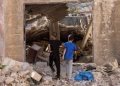
DaysofPal – In Gaza City’s al-Abbas neighborhood, the acrid smell of smoke still lingered near the charred shell of a car struck by an Israeli missile. Among scattered shards of glass and debris, 29-year-old Faiq Ajour and his relatives swept the ground in silence. Only minutes before the blast, Faiq had crossed the street to buy vegetables from a nearby stall.
“I survived by a miracle,” he said. “I had just crossed the street.”
His first thought was that his home had been hit. He ran back in panic to find his wife and young daughters physically unharmed but trembling. The sound of explosions dragged them back to the fear they had lived through for two years. The ceasefire, they worried, had collapsed.
Despite the ceasefire agreement announced in October, Israeli strikes on Gaza have continued regularly. Israel accuses Hamas of violations, claims Hamas denies, while Palestinians note that Israel has carried out over 500 violations of the agreement, killing more than 342 civilians, including 67 children.
On the day Faiq survived the strike, 24 Palestinians were killed across Gaza, five of them in his neighborhood.
“This is a nightmare, not a ceasefire,” he said. “In one moment, after a little calm, everything feels like war again. Body parts, smoke, ambulances, scenes we still haven’t healed from.”
A Life Shattered
Faiq’s life has been marked by relentless trauma. In February 2024, an Israeli airstrike killed 30 members of his extended family, including his parents, his aunt, cousins, and his brother’s son. His wife was badly injured; doctors amputated one of her fingers.
“The whole family was gone,” he said quietly.
Since then, he has moved from neighborhood to neighborhood trying to escape the violence, carrying what little remains of his life. His home now lies inside the “yellow line,” an area under total Israeli control where Palestinians are not allowed to enter, rebuild, or access services.
“There’s no work, no construction, no life, no safety,” he said. “We’re surviving on bitterness. Life in Gaza is 99 percent dead.”
Gaza’s political future remains uncertain. US President Donald Trump’s 20-point plan proposes a transitional technocratic government made up of Palestinian and international experts, supervised by an international “board of peace” led by Trump. The plan includes an economic strategy and stabilization force, but its viability remains unclear, especially given the devastation and the exclusion of any role for Hamas.
Israeli Prime Minister Benjamin Netanyahu faces mounting pressure from far-right allies and political rivals. Analysts say he is stalling the transition to the next phase of the ceasefire, where reconstruction and governance of Gaza would be negotiated.
Ahed Farwana, a Palestinian political analyst, believes Israel seeks a controlled limbo rather than a resolution. “The Israeli occupation is entrenching a situation similar to southern Lebanon: escalations, assassinations, and periodic strikes,” Farwana said.
“Netanyahu does not want to move to the second phase. He wants to seize as much land as possible so Israel has the upper hand in future arrangements.”
Israel’s pattern of limited but continuous attacks, Farwana argues, is meant to preserve chaos while avoiding a return to full-scale war. “The people of Gaza won’t feel any real calm under this.”
Living With Fear of the Next Strike
For many families, the psychological burden is unbearable. Raghda Obeid, a 32-year-old mother of four, lives in a tent in western Gaza City after her home in Shujayea was destroyed.
When a strike hit the area last week, her children screamed and ran for shelter.
“It was like the first day of the war,” she said. “People running, carrying the killed and their torn bodies. I said to myself, ‘That’s it, the war is back.’”
Her days revolve around collecting water and searching for food through community kitchens. Work is nonexistent, and winter will bring new hardships.
“We have no income. Our life is nonexistent. We live off kitchens and water. Our life is a war without an actual war.”
Let Us Live
For Faiq, the question that haunts him is the same one shared across Gaza: When will the war truly end?
“Let us live,” he pleaded. “Let us reopen our shops. Reopen the crossings. Let us live our lives.”
As Gaza enters its third year of destruction, displacement, and political uncertainty, millions remain trapped between a ceasefire that does not hold and a future that has yet to begin, living, as Raghda described it, “a war without a war.”
Shortlink for this post: https://daysofpalestine.ps/?p=69946