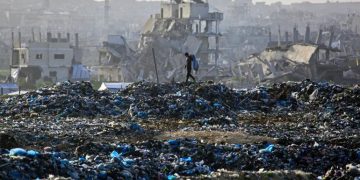
DaysofPal— Israeli control over areas designated as the so-called “Yellow Line” in the Gaza Strip has drastically reduced the space available for residents, exacerbating an already dire humanitarian situation and creating immense challenges for the provision of basic services and living conditions.
The “Yellow Line,” which stretches between two and seven kilometers deep along the length of the enclave, from northern Gaza through the central region to the outskirts of Rafah, now encompasses large swathes of territory.
Areas affected include Beit Hanoun, Beit Lahia, eastern Gaza neighborhoods such as Shujaiya, Tuffah, and Zeitoun, as well as eastern Khan Younis and parts of Rafah.
According to Mohammad al-Mughayyir, Director of Humanitarian Support and International Cooperation at the Palestinian Civil Defense, the areas within the “Yellow Line” now account for approximately 65% of the Gaza Strip’s total area.
“This leaves only 35% of Gaza available for civilians, which is insufficient to meet the population’s needs for water, infrastructure, public facilities, roads, and shelter,” al-Mughayyir said in remarks to local media.
He added that the actual usable space is significantly smaller than the remaining percentage suggests, as large portions are occupied by roads, service facilities, and debris.
“The effective residential area does not exceed 10% of Gaza’s total area,” he noted, highlighting the severe overcrowding faced by residents.
An estimated 1.8 million Palestinians remain displaced, living under extremely harsh conditions amid a shortage of shelter and continued destruction of infrastructure and essential services.
Al-Mughayyir warned that areas behind the “Yellow Line” were not empty land, but included vast agricultural zones, residential neighborhoods, industrial and commercial areas, as well as workshops and small-scale industries that once provided livelihoods for thousands of families.
“The continued denial of access to these areas intensifies both the economic and humanitarian crises, depriving Gaza of a significant portion of its productive, agricultural, and service resources,” he said.
He further stressed that Israeli control over these areas directly obstructs humanitarian relief efforts and the establishment of new shelters for displaced residents, at a time when daily needs are rising and living conditions continue to deteriorate.
The loss of agricultural land, according to Gaza’s Ministry of Agriculture, has led to a sharp decline in local food production, increasing reliance on humanitarian aid amid severe food shortages and growing food insecurity.
Restrictions preventing residents from accessing their land and livelihoods have caused widespread economic losses across key sectors, including agriculture, industry, trade, and skilled labor, further driving poverty and unemployment.
Al-Mughayyir called on the international community and humanitarian organizations to take urgent action to ensure civilian access to their lands, provide protection, and create conditions for the safe return of displaced residents.
He warned that failure to address the situation could push Gaza toward an even deeper humanitarian catastrophe.
The “Yellow Line” is a military demarcation established under a ceasefire agreement reached in October 2025, intended to define areas of Israeli occupation forces’ deployment and withdrawal.
While initially described as temporary, the line has expanded in multiple locations since the collapse of the truce’s first phase, significantly enlarging the areas under Israeli military control beyond the boundaries outlined in the original agreement.
Shortlink for this post: https://daysofpalestine.ps/?p=75073