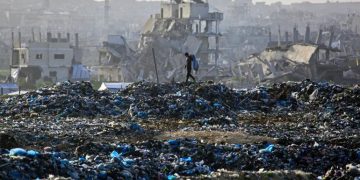
DaysofPal- A ceasefire in Gaza has brought little relief to the besieged enclave, instead coinciding with continued killing and widespread destruction, according to a new analytical report.
Writing for an analytical website, Cambridge University academic Bioni Campmark questioned the very meaning of the truce, asking: “What is the value of a ceasefire if it permits killing, maiming, and the destruction of the infrastructure of a society that was supposedly at war?”
The analysis argues that this question defines the current reality in Gaza, where Israeli forces continue policies that make life increasingly unbearable for Palestinians.
According to the report, these measures appear aimed at ensuring the depopulation of the territory, either by force or through “polished consent”, in preparation for its eventual seizure.
The report cites a New York Times investigation published on January 12, which found that the Israeli occupation has demolished more than 2,500 buildings in the Gaza Strip since the ceasefire came into effect on October 10, 2025.
While the demolitions initially began on the Israeli-controlled side of the dividing line known as the “yellow line,” the investigation also documented destruction in areas under Hamas control.
“The scale of the ongoing destruction is shocking,” the New York Times reported. Satellite imagery from eastern Gaza, areas under Israeli control, revealed entire residential neighborhoods erased since the ceasefire, along with vast tracts of farmland and agricultural greenhouses.
Campmark argues that the demolition campaign, carried out under the “thin cover of a harsh truce,” is intended to deepen the humanitarian catastrophe and impose forced displacement and collective punishment on Gaza’s population.
According to the analysis, entire neighborhoods in areas controlled by Israeli forces have been flattened in less than a month, apparently through systematic demolition operations.
Satellite images show continued, large-scale destruction of buildings across Gaza by the Israeli military.
Many of the destroyed structures showed no visible signs of prior damage, particularly in areas such as eastern Khan Younis and around the town of Abasan al-Kabira. Parks, trees, and several small orchards were also leveled during the operations.
The author noted that such actions should have been considered clear violations of the ceasefire terms. However, current and former Israeli officials have firmly rejected this interpretation.
Eitan Shamir, former head of the Israeli Security Doctrine Division, argued that the military acted within the agreement’s terms, claiming they did not apply to areas of Gaza located beyond the yellow line.
This reasoning was echoed in statements by an Israeli army spokesperson, who said that under the agreement “all infrastructure, including tunnels, must be dismantled throughout Gaza.”
Satellite imagery further showed that the most recent demolition operations took place between November 5 and December 13, with the majority concentrated in the Shuja’iyya and Tuffah neighborhoods of Gaza City.
Additional demolitions were documented in Rafah, as well as the leveling of agricultural facilities east of Deir al-Balah in central Gaza.
The analysis concludes that far from easing suffering, the ceasefire has coincided with policies that continue to reshape Gaza through destruction, displacement, and deepening humanitarian distress.
Shortlink for this post: https://daysofpalestine.ps/?p=71319