DaysofPal – Hundreds of Palestinians gather on scorching sand, waiting for food. Gunfire erupts; heads drop. Bullets strike a mound in the middle of the crowd, sending up dust clouds. This is not a battlefield; it is an aid line.
Since the war on Gaza began, Israel has throttled humanitarian aid as a weapon of war. Publicly, it claims to seek victory over Hamas. Unofficially, the policy looks like ethnic cleansing. Starvation, chaos, and displacement have become tools of control.
Aid as a Weapon
Israel restricts food in multiple ways: slashing aid convoys, enabling militias to loot supplies, targeting the very people who try to help, and, most insidiously, outsourcing food distribution to the so-called Gaza Humanitarian Foundation (GHF).
GHF is presented as a lifeline. In reality, it funnels desperate crowds toward a handful of sites deep in Israeli-controlled zones. These centers, guarded by US security contractors with little training or oversight, have become death traps. Over 2,000 Palestinians have been killed, many by sniper fire, drones, or artillery as they tried to reach or leave distribution points.
Distribution is deliberately chaotic. Sites open without warning for as little as 20 minutes. Announcements appear only on Facebook, useless to families without electricity or internet. Tens of thousands gather blindly, hoping the gates will open. Once inside, people must sprint for aid packages, while guards open fire to “manage” crowds.
Doctors at Gaza’s Nasser Hospital describe bullet wounds to heads, necks, and chests, patterns that suggest live-fire training rather than crowd control. A Sky News investigation found a direct correlation: the more distributions, the more deaths.
Beyond food, the sites serve another purpose: surveillance. Cameras, some equipped with facial recognition, stream footage to Israeli command centers. Aid seekers are scanned, identified, and logged into military databases. Hunger is leveraged as a tool for intelligence gathering and social control.
A Network of Profiteers
GHF is not a humanitarian agency. It is a network of ex-CIA officers, US mercenaries, and private contractors with no aid experience. Salaries for guards can reach $1,700 per day; operating costs run into millions. Funding comes through murky channels, with Israel allocating hundreds of millions of dollars and the US pledging its share.
The foundation markets itself as a solution where the UN has “failed,” but international agencies argue it violates every humanitarian principle: neutrality, independence, and humanity. Instead of feeding the hungry, GHF accelerates forced displacement by pushing Gaza’s population southward.
Even inside Israel, the façade is cracking. Media outlets have called the food centers “daily bloodbaths.” Protests have targeted GHF managers, while international aid groups denounce the scheme as complicit in war crimes.
Yet Washington and Tel Aviv continue to tout GHF as a model for future crises, a template where aid is militarized, privatized, and profitable.
The Bigger Picture
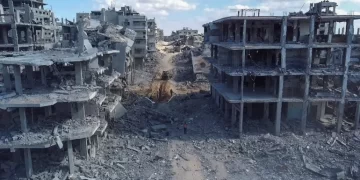
For Palestinians in Gaza, the consequences are immediate and deadly: starvation, chaos, and mass killing disguised as charity. For the world, the danger is systemic. If this model spreads, humanitarian aid everywhere risks being transformed into a weapon of war, eroding the post–World War II principles meant to protect civilians.
The winners are contractors, profiteers, and governments exploiting famine. The losers are those too weak to run for food or too unlucky to survive the gunfire.
Shortlink for this post: https://daysofpalestine.ps/?p=67581