DaysofPal– Gaza is dying of hunger as children are collapsing from starvation in the arms of their mothers, as the Gaza Strip endures one of the worst humanitarian crises of modern times.
For over a year and a half since the war began, famine has gripped the population, with emaciated bodies succumbing to hunger and disease. Meanwhile, the Israeli machinery of war and blockade continues to suffocate life, cutting off food, medicine, and water for over two million people, half of whom are children.
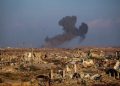
Since October 2023, Gaza has been subjected to an unprecedented siege, accompanied by the wholesale destruction of its health and humanitarian infrastructure.
Displacement shelters are overcrowded, hospitals are barely functional, and desperate families scavenge for scraps of flour or a can of milk for their starving children.
Michael Ryan, Executive Director of Emergency Programs at the World Health Organization (WHO), issued a scathing indictment of the situation: “We are breaking the bodies and minds of Gaza’s children… We are starving them… We are complicit.” WHO Director-General Tedros Adhanom Ghebreyesus echoed this sentiment, describing the situation in Gaza as “catastrophic,” with two million people suffering from hunger amid a sharp decline in international funding and aid.
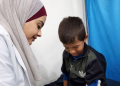
A recent report by the United Nations Office for the Coordination of Humanitarian Affairs (OCHA) revealed an 80% increase in the number of children receiving treatment for malnutrition compared to March of the previous year.
The report highlighted that 92% of infants aged between six months and two years are not receiving the minimum nutritional requirements, exposing them to long-term health and developmental risks.
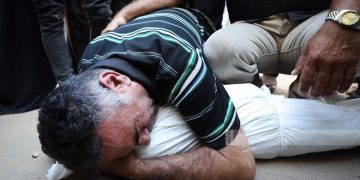
At a displacement shelter in western Gaza City, Mohammed Abu Taibeh, 40, sat beside his three-year-old daughter, her face pale and her frail body unable to stand. “She can no longer walk,” he said, his voice trembling. “I take her from one doctor to another, searching for anything that might restore her health.” He added, “There is no healthy food, and when it is available, it is unaffordable. We can barely provide for ourselves, let alone a child who needs special nutrition.”
Ghaleb Hassan, 35, from northern Gaza’s beach area, recently welcomed a newborn into a world of deprivation. “I couldn’t provide milk for her,” he said. “The siege has destroyed everything. Even charitable organizations are powerless.” Standing before empty shelves in a pharmacy, he continued, “My daughter cries day and night, and I am helpless, reduced to silence.”
Yasser Al-Khalidi, from the Nasser neighborhood, faces a double tragedy with his one-and-a-half-year-old twins. “They no longer walk properly. Symptoms of malnutrition are evident—unsteady gait, pale faces. All my efforts now focus on finding milk or nutritional supplements, but they are unavailable, and when found, they are unaffordable.” His voice choked with pain as he concluded, “I feel like I’m losing them before my very eyes.”
Recent data shows that 65% of Gaza’s population lacks access to safe drinking water, while over 1.1 million children suffer from daily hunger. Hospitals remain operational but at severely limited capacity, unable to cope with the scale of the health crisis.
A spokesperson for the Government Media Office in Gaza described the situation as an “organized crime,” stating in a press release: “The occupation is using starvation and thirst as tools of systematic warfare to extinguish life in Gaza.” The statement noted that approximately 65,000 cases of severe acute malnutrition have been recorded among children, accusing the occupation of ignoring rulings by the International Court of Justice mandating the provision of food, water, and healthcare to Gaza’s residents.
Amid this harrowing reality, doctors and humanitarian organizations are raising their voices, urging immediate action to open crossings and deliver aid. Yet, these calls continue to meet a wall of silence and political paralysis, as the specter of famine grows wider with each passing day.
In Gaza, children are not only dying from bombardment but also from hunger. They perish silently, in the arms of their mothers, under the lens of cameras, and within the reports of organizations that document the atrocities but can do little more than warn.
Shortlink for this post: https://daysofpalestine.ps/?p=62608