DaysofPal- The head of the Petroleum Authority in the Gaza Strip, Iyad Al-Shorbaji, said the territory’s ongoing gas crisis is political rather than technical, accusing Israel of using civilians’ need for cooking gas as a tool of pressure and coercion.
Al-Shorbaji made the remarks during a meeting organized on Thursday by the Palestinian Media Forum in Gaza, attended by journalists and media figures.
He stated that the core problem in managing gas supplies is the extremely limited quantities entering the territory, which fall far short of residents’ needs. He described the crisis as political, saying the shortages are being used as leverage against the population.
Before the war, Gaza’s monthly gas requirement reached about 8,000 tons, where currently, the sector faces an estimated deficit of roughly 85 percent of its needs.
At present, only six trucks enter daily, while during long periods of the war, only two trucks were allowed in. Some trucks reportedly return empty from the crossing, prompting the authority to regularly publish figures to clarify actual supply levels.
Following the ceasefire, gas deliveries resumed on October 12, with a total of 861 trucks—about 7,000 tons, entering over four months, an amount still below the territory’s pre-war monthly demand. Even after recent improvements, incoming quantities do not exceed 20 percent of Gaza’s requirements.
Al-Shorbaji emphasized that while issues such as weighing, stations, and bottling exist, the fundamental problem remains the massive supply deficit affecting individuals’ daily needs.
Fuel scarcity, he added, has severely worsened living conditions for residents in both tents and homes.
Addressing black market sales, Al-Shorbaji said multiple factors contribute to the phenomenon. Previously, each station received an operational allocation equivalent to 100 cylinders (about 1,200 kilograms) per delivery to help cover costs without raising consumer prices—otherwise, a cylinder could reach 100 shekels.
In the past two months, this allocation was reduced to only 15 cylinders to prioritize households.
Another source of diversion is distributors’ allocations, one cylinder per refill. Some residents sell part or all of their share, either due to a lack of a cylinder or financial need.
He acknowledged the possibility of violations, noting that roughly half a million beneficiaries are registered in the electronic distribution system.
The authority operates a digital system centered on residents, who select distributors based on their area. Lists are generated automatically according to registration date and geographic distribution, rotating among governorates to ensure broader coverage.
Approximately 490,000 families benefit from the system. Special provisions have been made for humanitarian cases, including families of deceased persons and minors, as well as efforts to include elderly residents.
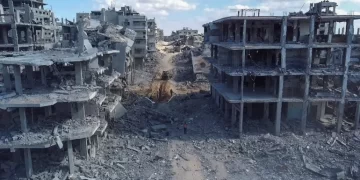
Due to wartime destruction, only 14 out of 45 gas stations remain operational, meaning about 65 percent have been destroyed. A “hosting” system allows functioning stations to serve areas where facilities were damaged.
ecent weeks saw an increase to 16 trucks entering, but officials warned that the approaching month of Ramadan will significantly increase demand.
Around 700 distributors operate across the territory, creating logistical challenges. Monitoring teams oversee weighing and pricing at stations, and residents can submit complaints through WhatsApp numbers, the electronic system, or offices in Gaza City, the central region, and Khan Younis.
Al-Shorbaji said the broader fuel supply, not cooking gas, is managed entirely by international bodies, with distribution to institutions supervised by a United Nations-affiliated organization. No Palestinian entity controls procurement or allocation.
He noted that some transportation and operating costs obtained by stations are reportedly resold on the black market. Limited quantities brought in by private traders have somewhat eased shortages.
Before the war, the power plant consumed about 15 million units of fuel, with a similar amount used by the commercial sector.
Shortlink for this post: https://daysofpalestine.ps/?p=72171