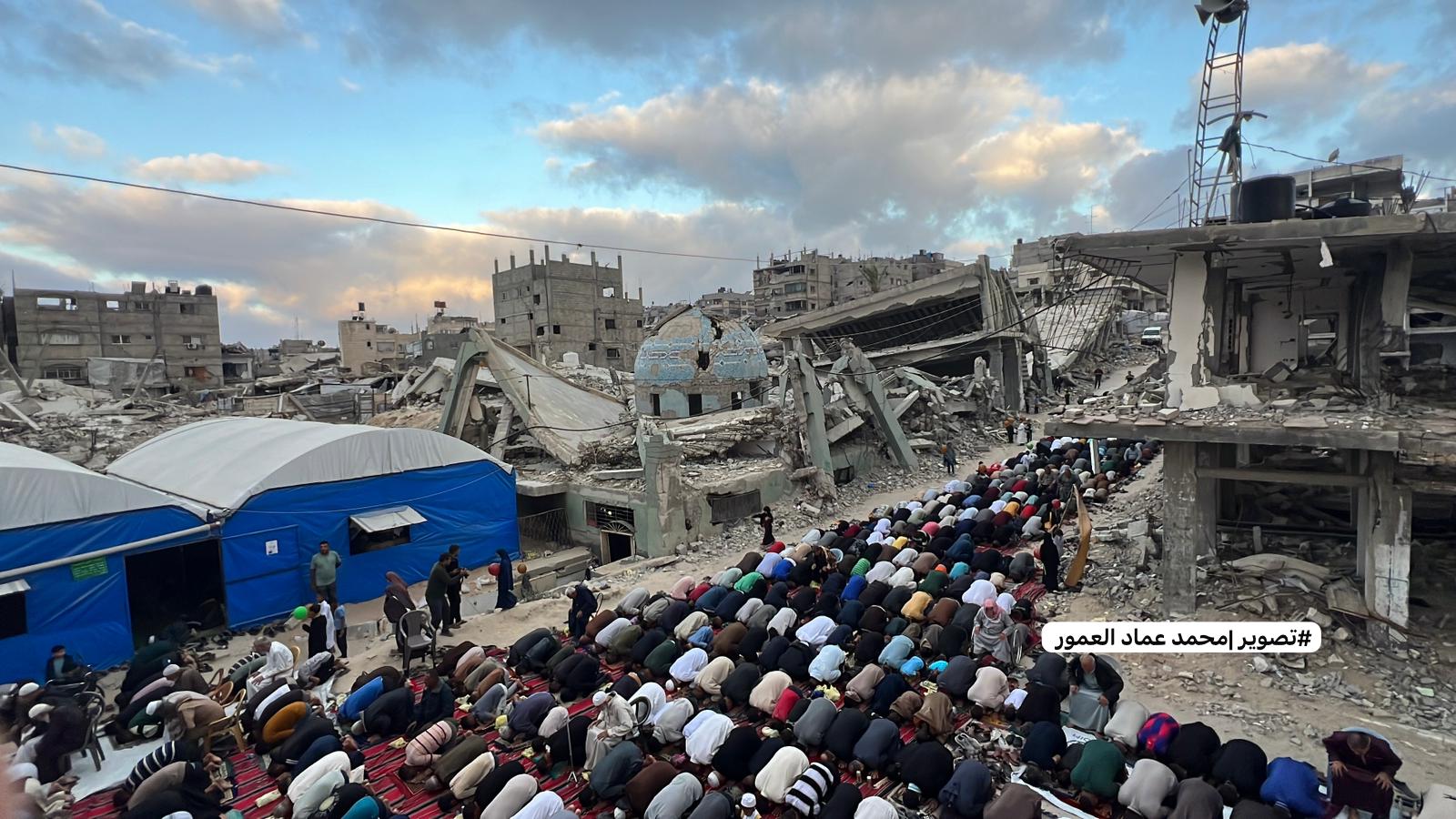
DaysofPal — Tens of thousands of Palestinians across the Gaza Strip performed Eid al-Adha prayers on Wednesday in open spaces and makeshift prayer grounds, surrounded by the rubble of destroyed homes and mosques, as the holiday unfolded under the shadow of war, deprivation, and grief.
Worshippers gathered in scattered locations throughout the enclave, praying in courtyards, streets, and atop the remnants of flattened neighborhoods.
Despite ongoing security risks, residents insisted on observing the religious ritual, though the usual joy associated with the holiday was largely absent.
Faces reflected sorrow and exhaustion, following a bloody day in which 14 Palestinians were killed in continued Israeli bombing and genocide.
Sermons delivered during the prayers emphasized resilience, unity, and mutual support. Preachers urged families to maintain social ties as much as possible under the circumstances and to remain steadfast, framing the immense suffering as a sacrifice that would ultimately be rewarded.
Traditional signs of Eid celebration were nearly nonexistent. The ritual slaughter of sacrificial animals, central to Eid al-Adha, was largely absent due to severe shortages.
Restrictions on imports, deteriorating economic conditions, and disrupted supply chains have made livestock scarce or unaffordable for most families.
Humanitarian conditions continue to worsen, with hunger once again emerging as a dominant concern. Thousands of households now rely on limited aid that falls short of meeting basic needs. Food insecurity has deepened amid the prolonged blockade and ongoing military escalation.
Air and artillery strikes persisted in several parts of Gaza even as the first day of Eid began, intensifying fear among civilians.
Many families chose to remain near shelters or displacement areas, limiting movement out of concern for their safety.
Witnesses reported hearing intermittent explosions overlapping with the sounds of Eid prayers, underscoring the stark contrast between spiritual observance and the realities of conflict.
Residents face increasingly dire living conditions, as essential services decline and infrastructure continues to collapse. Aid organizations and local authorities have warned of a looming humanitarian catastrophe if hostilities persist without intervention.
Hamas, in a statement, called for the holiday to serve as a moment to strengthen unity and solidarity, urging increased support for Palestinians in Gaza.
Meanwhile, Gaza’s Government Media Office reported that since the ceasefire agreement came into effect 227 days ago, Israeli occupation forces have committed over 3,000 violations.
These include airstrikes, direct targeting of civilians, destruction of entire residential blocks, repeated gunfire incidents, and incursions into populated areas.
According to the statement, the violations have resulted in the deaths of at least 910 Palestinians and injuries to 2,747 others, in addition to the arrest of 82 individuals.
The office also highlighted severe shortfalls in humanitarian aid delivery, noting that only 49,973 trucks have entered Gaza out of the 135,600 expected under the agreement, representing just 36 percent of the anticipated total.
As Gaza marks one of Islam’s most sacred holidays, the convergence of war, poverty, and loss continues to define daily life, leaving little room for celebration and deepening the urgency of calls for relief and stability.
Shortlink for this post: https://daysofpalestine.ps/?p=74928