DaysofPal – While millions of Muslim pilgrims gathered at Mount Arafat to mark the holiest day of the Islamic calendar, Palestinians in the Gaza Strip observed the occasion under the constraints of prolonged military conflict, mass displacement, and an ongoing blockade.
The traditional religious holiday, normally characterized by communal celebrations and family gatherings, has been entirely eclipsed by a severe humanitarian crisis. For the hundreds of thousands of civilians living in makeshift tents and hospital courtyards across the enclave, the sacred day brought no suspension of hostilities, shifting the focus of community prayers from traditional spiritual reflection to an urgent plea for basic survival.
Prayer Has Become the Language of Survival
Across narrow alleyways and crowded displacement camps, the Day of Arafat bore little resemblance to the way Palestinians in Gaza once marked the occasion.
There were no preparations for the coming Eid holiday, no bustling markets, and no joyful sounds filling the streets ahead of the celebration.
Umm Mohammed Abu Ghoneima, displaced from eastern Gaza City and now living in a tent in the Mawasi area of Khan Younis, described how drastically life has changed.
“On days like this, we used to prepare for Eid, buy new clothes for the children, make sweets, and wait for the takbirs from the mosques,” she said. “Today, all we ask from God is to survive until tomorrow and wake up without losing another loved one.”
The prolonged war has transformed the rhythm of life and stripped religious seasons of their familiar warmth, leaving people to greet sacred occasions with grief, anxiety, and uncertainty.
Yet despite everything, prayer remains the refuge of many. Mothers mourning their children, fathers searching for enough food to feed their families, and patients waiting in hospitals suffering severe shortages of medicine and equipment all share the same hope: that these days pass peacefully over Gaza and that Eid arrives without new names added to the lists of the dead.
A Delayed Eid
Inside a small tent west of Deir al-Balah, Mahmoud Abu al-Ouf, a father of five, reflected on how Eid has lost its meaning under the weight of war.
“Eid used to bring joy to the whole house,” he said. “Now we count the hours, follow the news, and search for water and bread. The Day of Arafat holds a special place for Muslims, and we also pray, but here prayer has a different meaning; it is the prayer of exhausted people still holding onto hope.”
The seasonal preparations that once accompanied Eid have all but disappeared. The few markets that remain open suffer from severe shortages, while families once united during the holidays are now scattered between shelters, tents, and hospitals.
Instead of discussing holiday clothes or family visits, the same questions dominate conversations inside displacement camps: Will this area remain safe? Will there be enough water? Will Eid pass without another airstrike?
In the mosques that still stand despite the devastation of war, takbirs rose in the early morning hours as residents cautiously watched the skies above them.
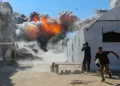
The contrast was stark and painful: the sacred chants of the Day of Arafat blending with the roar of aircraft overhead, while hearts remained suspended between the holiness of the occasion and the harshness of daily reality.
Aya al-Najjar, displaced with her family from northern Gaza, said watching pilgrims gathered at Arafat filled her with sorrow.
“When I saw the pilgrims standing on Arafat praying to God, I felt deep pain,” she said. “People there are praying, and here we are making the same prayers, but we pray for the bombing to stop, to return to our homes, and to live even one day without fear.”
From Arafat to Gaza, One Shared Prayer
For Muslims, the Day of Arafat is deeply associated with mercy, forgiveness, and answered prayers. In Gaza, that meaning feels more present than ever, as supplication has become part of everyday life, whispered in tents, outside hospital wards, through shattered streets, and in every moment of waiting.
As millions of pilgrims gather during the Hajj season in a collective scene of devotion and prayer, Gaza remains present in the hearts of many worshippers raising their hands in supplication from the holy sites and from around the world.
While pilgrims stand on Arafat on the Day of Mercy, Gazans stand on land burdened by loss, lifting the same prayers to the sky: for the war to end, for the city to survive, for families to return home, and for Eid to finally arrive in Gaza with the peace and safety it has long been denied, without another farewell, without fear, and without more absence.
Shortlink for this post: https://daysofpalestine.ps/?p=74926