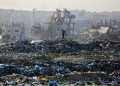

DaysofPal — For the third consecutive year, residents of the Gaza Strip are marking Eid al-Adha without the traditional sacrificial rituals, as ongoing conflict, severe economic collapse, and a tightened blockade continue to strip the holiday of its core religious and social practices.
In past years, the approach of Eid was marked by crowded markets and the sounds of livestock filling neighborhoods. Today, those scenes have been replaced by widespread displacement, hunger, and hardship.
The continued Israeli genocide and restrictions on movement and goods have left Gaza’s population facing one of the worst humanitarian crises in its history.
More than two million Palestinians in Gaza are enduring extremely difficult living conditions, with the livestock sector nearly collapsing.
The entry of animals through border crossings has been largely blocked, while prices have soared beyond the reach of ordinary families. As a result, performing the ritual sacrifice has become an unattainable goal for most households.
Mohammed al-Sousi, a father of five from Gaza City, said the holiday has lost its meaning since the outbreak of war, describing this year as “the harshest yet.”
“In the past, we waited for Eid to bring joy to our children and share meat with relatives and the poor,” he said. “Today, we cannot even afford to buy a single kilogram of meat.”
He added that children continue to ask about new clothes and the sacrificial ritual, but priorities have shifted dramatically. “People are now searching for food, water, and safety,” he said.
The crisis is not only about declining purchasing power but also a severe shortage of livestock in local markets.
Israeli strikes have targeted farms, barns, and feed storage facilities, while the continued closure of crossings has prevented the entry of new animals.
Livestock trader Akram Saeed said that the current availability in Gaza markets is less than 5 percent of pre-war levels.
“Before the war, Gaza used to import between 10,000 and 20,000 calves and 30,000 to 40,000 sheep annually ahead of Eid,” he explained. “Today, not a single animal is entering the Strip.”
Prices have skyrocketed as a result. A sheep weighing around 45 kilograms now costs approximately 14,000 shekels, while the price of locally produced meat exceeds 300 shekels per kilogram—compared to about 25 shekels before the war.
Public demand has nearly vanished, with ordinary citizens accounting for less than 1 percent of purchases. Some charitable organizations and individuals are attempting to buy limited quantities to distribute to needy families.
The shortage of sacrificial animals comes amid a rapidly deteriorating humanitarian situation. According to data from the World Food Program, about 1.6 million people, roughly 77 percent of Gaza’s population, are experiencing high levels of acute food insecurity.
This includes more than 100,000 children and 37,000 pregnant and breastfeeding women.
Israeli occupation is allowing in only around 38 percent of the agreed humanitarian aid, despite urgent needs for food, medicine, and fuel.
Since the start of the war in October 2023, medical sources report that more than 72,772 Palestinians have been killed and 172,707 injured, alongside widespread destruction of infrastructure, homes, and economic and agricultural facilities.
Since the most recent ceasefire agreement took effect, nearly 900 Palestinians have been killed and more than 2,600 injured, in addition to the recovery of hundreds of bodies from various parts of the territory.
Under these conditions, Eid al-Adha in Gaza feels subdued and overshadowed by loss. There are no abundant meals, limited family visits, and little ability for most families to observe traditional rituals.
Umm Mohammed, a displaced woman from northern Gaza, said children now hear about Eid more than they experience it.
“We used to prepare for Eid by buying clothes, sweets, and arranging the sacrifice,” she said. “Now we live in tents and search daily for food.” She added.
“Even children’s joy has been postponed, the war has taken almost everything.” she added.
Despite the hardships, many Gazans are trying to preserve what remains of the holiday’s spirit through simple visits, exchanging greetings, and supporting the most vulnerable families, an effort to maintain social solidarity in the face of ongoing conflict and deprivation.
Shortlink for this post: https://daysofpalestine.ps/?p=74933