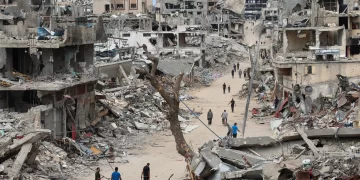
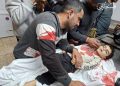
DaysofPal – A fragile US-brokered ceasefire is on the verge of collapse as systematic Israeli violations, territorial expansion, and a suffocating siege continue to plague the Gaza Strip. More than seven months into the October 2025 agreement, the promised path toward reconstruction and a full military withdrawal has instead devolved into a cycle of near-daily airstrikes and severe humanitarian restrictions, pushing the enclave back toward the brink of a full-scale crisis.
Israeli occupation forces have justified some of the attacks by accusing Palestinian factions of violating the agreement. Palestinian officials and rights groups, however, say many of those killed, displaced, or detained since the ceasefire have been civilians, including children.
The lack of progress in implementing later stages of the agreement has also cast growing doubt over the future of the truce. The first phase of the deal has yet to be fully carried out, while negotiations toward subsequent stages, including a full Israeli withdrawal from Gaza, reconstruction efforts, the deployment of international stabilization forces, and the disarmament of Palestinian armed groups, remain stalled.
At the same time, Israeli occupation forces continue to mass troops near Gaza, raising fears of a renewed large-scale assault.
Hundreds Killed Since Ceasefire Began
According to Gaza’s government media office, at least 2,400 Israeli ceasefire violations were documented between 10 October 2025 and 10 April 2026, with additional incidents recorded in the weeks that followed.
The reported violations included 1,109 air strikes and artillery attacks, alongside 921 shootings targeting civilians in different parts of Gaza.
Figures released by the Palestinian Health Ministry state that at least 857 Palestinians were killed and 2,486 wounded by Israeli attacks through 14 May. Among those killed were at least 229 children, according to UNICEF.
The media office also reported that Israeli occupation forces arbitrarily detained at least 50 Palestinians during the same period.
Documented incidents included attacks on displacement camps, civilian gatherings, aid workers, journalists, and police personnel. Israeli naval forces were also accused of repeatedly targeting fishermen and civilians near Gaza’s coastline.
In one reported incident last month, Israeli gunboats allegedly shot and killed a Palestinian woman off Gaza’s northwestern coast.
Overall, Palestinian officials say more than 72,700 people have been killed in Gaza since the genocide began in October 2023, while thousands more remain missing under the rubble.
Expanding “Yellow Line” and Continued Demolitions
The ceasefire agreement stipulated that military positions in place at the time of the truce would remain frozen until later phases of the deal were implemented.
That arrangement paved the way for what became known as the “Yellow Line,” a unilateral Israeli military zone cutting across large sections of Gaza and restricting Palestinian access to extensive areas of land.
At the time the agreement was signed, Israeli occupation forces controlled roughly 53 percent of Gaza across northern, eastern, and southern areas of the territory.
Subsequent phases of the ceasefire were supposed to include a gradual Israeli withdrawal from the entire strip. Instead, Palestinian officials say Israel has expanded the Yellow Line to encompass approximately 64 percent of Gaza, confining residents to less than half of the enclave’s territory.
Israeli occupation forces have also continued widespread demolition operations despite the ceasefire. While many demolitions occurred within areas under Israeli control, others were reportedly carried out inside zones where Palestinians had remained.
An analysis published by The New York Times in January found that more than 2,500 buildings were demolished during the first three months of the ceasefire alone.
Aid Restrictions and Deepening Humanitarian Crisis
Under the terms of the ceasefire agreement, Israel was required to facilitate the entry of up to 600 aid trucks per day carrying food, medicine, fuel, shelter materials, and commercial goods into Gaza.
However, Palestinian officials and humanitarian organizations say those commitments have not been fulfilled.
According to Gaza’s government media office, just over 4,500 aid trucks entered Gaza by the end of April, only one quarter of the 18,000 trucks stipulated under the agreement. That represents a daily average of slightly more than 200 trucks, far below the agreed threshold.
Humanitarian agencies say restrictions on fuel, medical supplies, tents, and mobile homes have severely limited relief operations and prolonged the humanitarian catastrophe.
The continued blockade has also fuelled growing fears of famine conditions returning to Gaza after famine was officially declared in parts of the territory in August following Israel’s siege.
Medical teams and civil defense workers say shortages of fuel and equipment have left hospitals struggling to provide treatment while rescue operations remain severely impaired.
Rafah Crossing Restrictions Continue
The ceasefire agreement also required Israeli occupation forces to withdraw from the Rafah crossing with Egypt and allow freer movement for Palestinians traveling in and out of Gaza.
Thousands of wounded Palestinians were expected to leave the territory for urgent medical treatment abroad once the crossing reopened.
However, Israel kept Rafah closed for nearly four months after the truce was signed.
In February, authorities began permitting limited movement through the crossing, allowing no more than 50 Palestinians per day to enter Gaza from Egypt while restricting departures from the enclave to approximately 150 people daily.
Even those limited quotas were not consistently maintained. Palestinian officials say approved travelers were at times blocked from crossing, while the border was periodically shut entirely, including during the escalation surrounding the war on Iran in late February.
According to Gaza’s government media office, only 1,567 Palestinians crossed through Rafah between 2 February and 30 April out of the 6,000 individuals who were supposed to be allowed passage under the agreement, a compliance rate of just 26 percent.
The Palestinian Health Ministry says the restrictions have contributed to the deaths of up to 10 patients per day who were unable to access treatment outside Gaza.
Shortlink for this post: https://daysofpalestine.ps/?p=74715