DaysofPal- Ceasefire negotiations remain stalled more than six months after the Sharm el-Sheikh agreement was signed in October 2025, despite being sponsored by the United States and guaranteed by mediators including Qatar, Egypt, and Turkey.
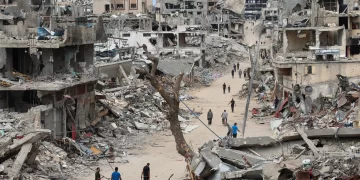
The ongoing deadlock has allowed Israeli occupation to continue the daily Israeli violations in the Gaza Strip, which has been heavily devastated by months of conflict.
Analysts say the lack of enforcement mechanisms and reduced international pressure have contributed to the continued collapse of the agreement’s implementation.
With the United States prioritizing Israeli interests, the role of President Donald Trump’s administration in monitoring the ceasefire plan it proposed has reportedly declined, while mediators have struggled to compel Israeli occupation to adhere to the timeline of the first phase obligations.
Instead of complying, the Israeli occupation has expanded its military control inside Gaza rather than carrying out a full withdrawal.
It has also imposed strict restrictions on the entry of humanitarian aid, blocked the delivery of shelter supplies, and continued daily airstrikes, demolitions, and targeted killings.
Political analyst Mohammed Shaheen argued that Israeli violations are not random but part of a deliberate and structured strategy.
He explained that these actions range from expanding what is referred to as the “yellow line” toward the “orange line,” to repeated evacuation orders and targeted assassinations.
Speaking to Filastin newspaper, Shaheen said the objective is to reshape the political and security landscape of Gaza according to new rules of engagement, prolonging the conflict without reaching a decisive resolution.
He added that Israeli occupation has shifted from purely military tactics to dismantling the political and social structure of Gaza by supporting local armed groups within controlled areas, fostering instability, and targeting influential figures, including political, governmental, and administrative leaders.
Shaheen also pointed to the recent killing of Azzam Al-Hayya, the son of Hamas political leader and head of the negotiation delegation Khalil Al-Hayya, describing it as part of a broader pattern of both physical and symbolic assassinations aimed at weakening Palestinian leadership and social cohesion.
He warned that such actions, alongside evacuation orders such as those issued in Al-Shati refugee camp west of Gaza City, contribute to expanding chaos and undermining societal stability.
According to Shaheen, Israeli occupation is effectively prolonging the first phase of the agreement by continuing violations and creating disorder in what he described as “irrational deterrence,” bypassing American guarantees and international sponsorship of the Sharm el-Sheikh deal.
He cautioned that the current phase poses serious risks to the future of the Palestinian cause, urging mediators to take stronger action through new initiatives and tangible pressure to halt violations.
In contrast, Israeli affairs analyst Adel Yassin rejected the notion of declining American influence, asserting that coordination between former President Donald Trump and Israeli Prime Minister Benjamin Netanyahu remains active across various issues.
Yassin stated that what is happening reflects a deliberate strategy to grant Netanyahu greater room for maneuver, enabling him to continue violations and intensify military operations to pressure Hamas into accepting Israeli conditions, particularly regarding disarmament.
He added that U.S. interests lie in reinforcing Israel’s image as a regional power capable of acting as a “regional policeman,” serving broader American strategic roles, even if this comes at the expense of Palestinians or Washington’s global image.
Yassin also suggested that Israeli occupation may be exploiting international silence and the weakness of Arab positions, despite some regional actors having the capacity to exert meaningful pressure to enforce international agreements.
He noted that there is growing consensus inside the Israeli occupation that military force alone is insufficient to achieve long-term objectives, prompting interest in political arrangements that could help repair Israeli international relations, as well as the army’s need for a period of calm after the longest war in its history.
However, these considerations conflict with Netanyahu’s political calculations, as he seeks to maintain escalation ahead of the upcoming general elections.
Yassin concluded that any commitment by Netanyahu to the first phase of the agreement would contradict the rhetoric of the far-right and expose the gap between the Israeli government’s rhetoric and its actual capabilities, whether in confronting Iran or managing the Lebanese front.
Shortlink for this post: https://daysofpalestine.ps/?p=74600