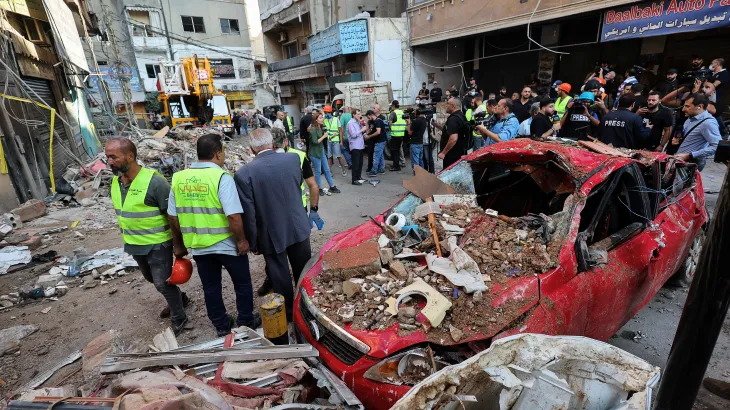
DaysofPal – The United Nations announced Tuesday that at least 30,000 people have been displaced in Lebanon following Israeli shelling and air strikes targeting several regions, particularly in the south, the Bekaa Valley, and Beirut’s southern suburbs.
Speaking at a press conference in Geneva, Babar Baloch, spokesperson for the United Nations High Commissioner for Refugees (UNHCR), said large-scale displacement has been reported in parts of southern Lebanon, the Bekaa region, and the southern suburbs of Beirut. The movement of civilians followed evacuation warnings issued for residents of more than 53 Lebanese villages and intensive air raids in those areas.
Estimates through Monday indicate that about 30,000 people have been registered and sheltered in collective accommodation centers. Many more spent the night in their vehicles along roadsides, according to UNHCR.
Samir Abdel Jaber, regional director of the World Food Programme (WFP), told reporters in Cairo that the number of displaced is expected to rise significantly. He said the Lebanese government began opening shelters on Monday, prompting WFP to distribute hot meals and ready-to-eat food in support of those forced from their homes.
Israel’s military launched an intensive bombing campaign against Lebanon on Monday, stating it was targeting Hezbollah in response to attacks carried out against Israeli territory that left 52 people dead, according to an official toll released Monday. Earlier, Hezbollah announced it had fired a salvo of advanced rockets and launched drones toward Israel in retaliation for the killing of Iran’s Supreme Leader, Ali Khamenei.
Abdel Jaber warned that the escalation could severely affect maritime and air transport, with direct consequences for humanitarian supply chains and the movement of aid personnel.
The United Nations Office of the High Commissioner for Human Rights expressed alarm over the widening conflict. High Commissioner Volker Türk said he was deeply shocked by the impact of the hostilities on civilians and civilian infrastructure since the outbreak of the conflict on Saturday, which followed Israeli and United States strikes on Iran, Iran’s retaliatory actions in the region, and Hezbollah’s subsequent involvement.
Ravina Shamdasani, spokesperson for the human rights office, told reporters in Geneva that fear and anxiety are visible across the Middle East and beyond. She said the situation is deteriorating by the hour and reiterated that the laws of war are clear in protecting civilians and civilian objects. She stressed that all states and armed groups must comply with international humanitarian law.
Türk called on all parties to exercise maximum restraint, prevent further escalation, and take all possible measures to protect civilians, including foreign nationals, along with critical infrastructure. He emphasized that returning to negotiations remains the only path to halt the killing, destruction, and despair.
A ceasefire agreement between Israel and Hezbollah was reached in late November 2024 after a year of fighting. Under its terms, Israel was expected to withdraw from southern Lebanon. Israeli forces, however, have remained in five positions described as strategic and have continued conducting regular strikes in Lebanon, often stating they target Hezbollah sites or operatives.
Beirut has pledged to begin disarming Hezbollah south of the Litani River near the Israeli border, under strong United States pressure and in the context of concerns over a possible widening of Israeli strikes.
Shortlink for this post: https://daysofpalestine.ps/?p=72685