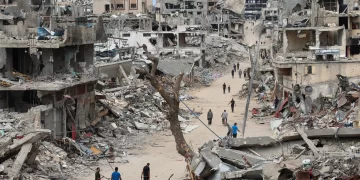

DaysofPal- The Ministry of Public Works and Housing in the Gaza Strip revealed on Sunday that over 60% of families in the enclave are now homeless due to the prolonged and devastating Israeli military offensive, which has persisted for more than 15 months.
The ministry described the situation as catastrophic, with destruction on an unprecedented scale rendering immediate recovery efforts nearly impossible.
“The extent of the destruction in this war is beyond the ability of any party to deal with it quickly and directly,” the ministry stated. It highlighted that the scale of devastation far surpasses the damage caused by the 51-day Israeli aggression in 2014. Tens of millions of tons of rubble now blanket cities, residential blocks, and neighborhoods, leaving the region in desperate need of large-scale recovery and rebuilding efforts.
The most important first step in rebuilding Gaza has been determined to be removing the debris. This process involves demolishing structures that pose a public safety risk, repairing and maintaining damaged buildings, and protecting surrounding infrastructure during debris removal operations.
However, the ministry emphasized the enormity of the challenge, noting that dozens of heavy machines are required for the task. Local equipment, much of which was destroyed or damaged during Israeli bombings of government, municipal, and civil facilities, is insufficient for such extensive work.
The dire situation is exacerbated by an unprecedented economic collapse. According to the latest data from the Palestinian Central Bureau of Statistics (PCBS), unemployment rates in Gaza have soared to an alarming 80%. Most of the affected individuals were daily wageworkers or employed by the Gaza government or the Palestinian Authority, further compounding the region’s vulnerability.
Economic activities across the occupied Palestinian territories plummeted throughout 2024, with the construction sector in Gaza experiencing a 98% decline, amounting to just $332 million in value.
Industrial activity fell by 90%, agricultural activity dropped by 91%, and the services sector contracted by 81%. These figures mark an unprecedented downturn in the history of the Israeli-Palestinian conflict, underscoring the severity of the ongoing crisis.
The situation worsened further following the Israeli onslaught that began on October 7, 2023. Israeli forces targeted industrial, commercial, and economic facilities through relentless airstrikes and ground offensives, forcing the closure of the majority of commercial activities in Gaza. This compounded the economic free-fall, leaving the region’s infrastructure and livelihoods in ruins.
Shortlink for this post: https://daysofpalestine.ps/?p=59978