Source: Electronic Intifada
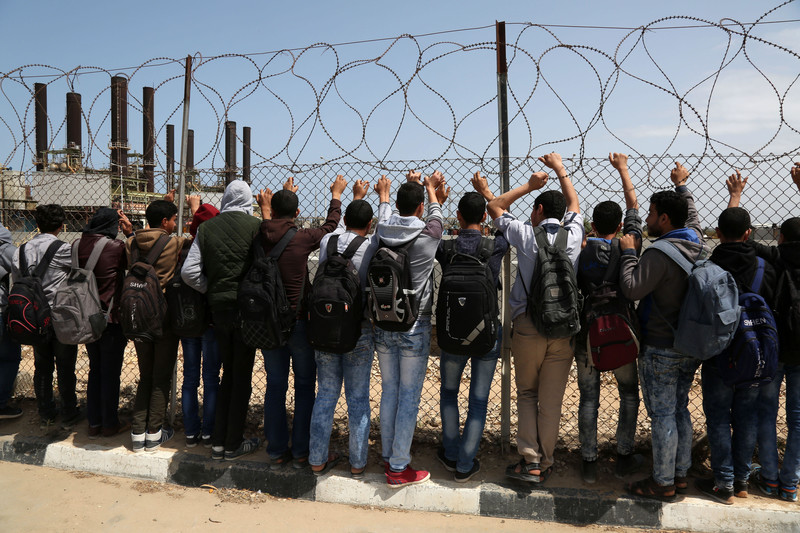
In June 2006, following the capture of Israeli soldier Gilad Shalit, Israel bombed the Gaza Strip’s only power plant. Since then, Palestinians have lived an average of two-thirds of those ensuing years in darkness amid a blockade Israel intensified in 2007. That comes to roughly 95,000 hours with no electricity over 16 years.
These figures are calculations based on the daily electricity-outage tallies uncovered by numerous surveys and reports from human rights groups.
For example, the International Committee of the Red Cross (ICRC) estimates that over 80 percent of Palestinians in Gaza have electricity for a meager six to eight hours a day. B’Tselem reports that Gaza’s power plant runs on a scant 180 megawatts when Gaza’s population of over 2 million needs at least 600 megawatts.
A main cause of the electricity shortage in Gaza is no secret: When Israel is not bombing the power plant, it is blocking the entry of the fuel needed to operate it – an action that Fadel al-Muzaini of the Palestinian Center for Human Rights says is indicative of Israel’s policy of collective punishment against the Palestinians.
But what does it mean to be on the other end of this policy of collective punishment? To live your life in the dark? The cost of a life with no electricity is so immense that a person living outside Gaza might struggle to imagine it.
And though statistics give us a grim overview – 94 percent of Palestinians in Gaza “believe that the lack of electricity is affecting their mental health,” according to that same ICRC survey – how can a person who lives an ordinary life imagine being deprived of such a basic necessity?
We can start with daily life in Gaza.
Life on hold
In Gaza, knowing the electricity distribution schedule is an essential part of organizing one’s day. It is a constant in your mind, always planning when you’ll have electricity and when you’ll be left in the dark.
For example, if you live on a high floor of an apartment building, you plan your errands around the power outages; when the power comes back on, you can return home so you can use the elevator.
Without power, your life is on hold, whether it’s taking a hot-water shower or watching television. Even inviting friends over must wait for electricity, as hot weather necessitates fans.
At night, candles and solar panels are useful. Students must do their homework by candlelight or otherwise rush through assignments and take advantage of the computer and internet while there is still power.
Yet alternate electricity methods pose dangers and inconveniences. Fires caused by candles and generator explosions killed 32 people between 2010 and 2018, according to Al Mezan Center for Human Rights. And electricity generators rumble and drone loudly, sometimes emitting plumes of toxic smoke.
During the sweltering heat of summer and the numbing cold of winter, the electric outages pose the biggest threats to one’s state of mind and health. Being indoors during the summer is essentially unbearable. One must go outdoors to get fresh air.
Yet the suffering through extreme temperatures is even greater if one belongs to a more vulnerable population, such as the ill or elderly.
Dialysis patients at risk
Khalil, 40, is unemployed and in pain much of the time. He has relied on dialysis for the past 12 years to keep his kidneys functioning. He needs three sessions a week at al-Shifa hospital, and each session lasts about four hours – a near impossible task for Gaza’s electric grid.
Though the backup generator kicks in, so as not to interrupt his treatment for too long, in those moments, when the power is out, Khalil’s life is in peril. There is always the fear the electricity will not come back on.
The Ministry of Health in the Gaza Strip says that about 820 patients in the coastal strip suffer from kidney failure.
A struggling, mid-40s dialysis patient named Husam told The Electronic Intifada that the dialysis machines in use at Gaza hospitals are in poor and aged condition. He attributed this to the Israeli blockade limiting the import of medical equipment. The power outages only compound the difficulties of dialysis, since, when the process is interrupted, it can cause blood clots.
At another hospital in northern Gaza, Ahmad, aged 2, has just undergone a urethral and bladder dilation surgery.
His father, Ali, says they spend at least nine hours a day without power at the hospital.
“During the time of power cut, the air conditioners don’t operate,” he notes of the situation they face at the hospital. “We suffer a lot due to the high temperature nowadays in Gaza.”
To cope, Ali uses paper to make a fan for his son, to provide some relief to the boy while he recovers from surgery.
The sea turns black
Away from hospitals and homes, the effects of the power outages can hit in unlikely places, including a day at the beach, a once blissful summer pastime and great obsession of Palestinians in Gaza.
Some families stay at the beach from early morning until midnight, playing soccer and volleyball, having picnics and flying kites.
Lately, however, a day at the beach is not the same.
Gaza’s municipalities pump sewage directly into the sea when Israel interrupts fuel shipments to the sewage treatment plant. Ahmed Hilles, the chairman of the National Institute for Environment and Development, said that 120,000 cubic meters of untreated or partially treated sewage is pumped out along Gaza’s shoreline every day.
The seawater, as a result, can become putrid and unsuitable for swimming, black and full of gastrointestinal parasites. Children break out in rashes and contract various intestinal illnesses from the polluted water.
In 2022, 15 years after Israel intensified its siege on Gaza, the conditions have only worsened, with numerous Israeli attacks destroying infrastructure, homes and ways of life.
A report issued by the United Nations Conference on Trade and Development stated that the total economic losses of Palestinians in the Gaza Strip from 2007 to 2018 amounted to about $17 billion, and the poverty rate increased to 56 percent.
Any semblance of a normal life in Gaza is undermined by this diminished economy, but its faltering electrical grid and the daily power outages are a reminder of how these statistics are not so abstract. They point to the real struggle of daily life in Gaza.
When my son Ahmed was 4 years old, we lived in Kuala Lumpur, Malaysia, as I obtained my doctoral degree in international relations and strategic studies. Over eight years, we experienced only three power outages, each outage lasting about seven minutes.
Ahmed would come to me with urgency, asking why the electricity was cut off, when will it come back on, and how to fix it. Yet when we returned to Gaza and would sit for hours without electricity on a daily basis, he had a different perspective and would lament, “I wish it would cut off seven minutes like before in Malaysia.”
The names of hospital patients and their family members quoted in this article have been changed to protect their privacy.
Raed Qaddoura is a political analyst specializing in Palestinian-Israeli affairs. He has a PhD in strategy and international relations from UKM Malaysia.
Shortlink for this post: https://daysofpalestine.ps/?p=27752