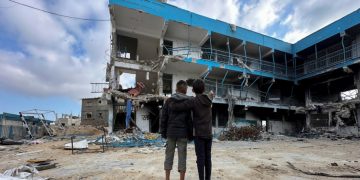
DaysofPal- As the deadline for moving to the second phase of the ceasefire that ended the Israeli genocidal war on the Gaza Strip passes without progress, growing questions are emerging over the true causes of the delay, beyond official explanations and procedural claims.
Palestinian political analyst and U.S. affairs expert Dr. Naim Al-Rayan says the failure to advance reflects intentional political obstruction rather than technical disagreement.
He points to stringent Israeli security demands, uncertainty surrounding the Palestinian Authority’s role in Ramallah, and the stalled proposal for an “international stability force” as key factors behind the impasse.
Speaking to Palestine Online, Al-Rayan said Israel has not fulfilled its commitments under the first phase of the ceasefire, which took effect on October 10.
Instead, he argued, the agreement has functioned largely as a tactical shield, amid hundreds of Israeli violations, including air and artillery attacks that have struck areas sheltering displaced civilians and caused significant casualties.
Al-Rayan said Israel, with backing from Washington, has chosen to keep Gaza in a state of prolonged insecurity to avoid locking in a permanent end to the war.
He argued that the phased ceasefire was treated as a tool to gain time, regroup politically and militarily, and retain the ability to escalate pressure without paying full political costs.
According to Al-Rayan, progressing to the second phase would effectively formalize an end to large-scale violence and open the door to a new political reality, an outcome he said is unacceptable to Israel’s far-right government, which views sustained calm as incompatible with its security doctrine.
He added that the Trump administration has provided political cover for this approach by conditioning the second phase on the unrealistic security requirements, particularly demands for the disarmament of Palestinian resistance factions, which he said disregard international law and UN legitimacy.
Al-Rayan warned that such disarmament demands amount to political coercion rather than a negotiated settlement. He said the proposed international stability force appeared aimed at enforcing these conditions by policing Gaza and suppressing resistance, rather than safeguarding civilians.
The failure to establish the force, he added, reflects increasing international reluctance to be drawn into a framework that could prolong the conflict under another guise.
He also criticized efforts by the Palestinian Authority to position itself as an alternative governing body in Gaza without broad national consensus, warning that imposing a West Bank–style governance model amid widespread devastation could spark internal unrest, potentially escalating into civil conflict.
On the regional level, Al-Rayan said Israel’s opposition to Turkish involvement in Gaza arrangements stems from concerns that Ankara could help guarantee a genuine and lasting ceasefire.
He linked the delay in advancing the agreement to a wider regional strategy targeting resistance movements in Gaza, Lebanon, Yemen, and Iran.
Al-Rayan concluded that the second phase of the ceasefire, in its current form, is unlikely to be implemented, as it prioritizes Israeli security demands over Palestinian rights.
He warned that stability cannot be achieved while military aggression continues and Israeli control over Gaza remains in place, describing current proposals as an illusion built on ongoing suffering.
Shortlink for this post: https://daysofpalestine.ps/?p=71138