DaysofPal- A senior United Nations official has painted a grim picture of life in the Gaza Strip, warning that starvation, destruction, and collapsing health services have pushed the enclave into a “beyond catastrophic” state.
Andrew Saberton, Deputy Executive Director of the United Nations Population Fund (UNFPA), said after a recent visit to Palestine that one in every four people in Gaza is starving, while thousands of women are being forced to give birth “between the ruins” amid the devastation caused by Israel’s prolonged siege and military assaults.
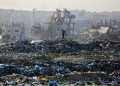
“The endless piles of rubble are seared into my memory,” Saberton told reporters in New York, noting that “What I saw looked like a scene from a dystopian film, but it was all too real. This devastation is not collateral damage.”
Saberton, whose agency focuses on sexual and reproductive health, said that 11,500 pregnant women in Gaza are suffering from severe hunger, with many lacking access to even the most basic hygiene or medical care.
He revealed that nearly 70% of newborns in Gaza are now premature or underweight and that one in three pregnancies is classified as high-risk. Around 94% of hospitals have been damaged or destroyed, leaving maternity care on the brink of total collapse.
“Maternal deaths are increasing because life-saving medicines are no longer available,” he said.
“In some hospitals, several babies are placed in a single incubator because of fuel and equipment shortages.” He added.
He added that ambulances are rarely operational, and women often have to deliver their babies in tents, on roadsides, or among the rubble, without privacy, clean water, or sanitation. “There are no normal births in Gaza anymore,” he said.
Saberton said that while the recent ceasefire had brought “a small glimmer of hope,” a permanent cessation of hostilities is urgently needed to allow meaningful recovery.
UNFPA managed to deliver a limited quantity of medical supplies to Gaza last week, but Saberton described the aid as “a mere trickle” compared to the overwhelming needs. The agency, he said, has more incubators, heart monitors, and hygiene kits waiting at border crossings, but access restrictions remain a major obstacle.
“We need all crossings opened, all barriers removed, and safe, sustained humanitarian access across Gaza,” he urged.
Highlighting the plight of women and girls, Saberton said 700,000 females in Gaza are enduring “a monthly nightmare” due to a lack of sanitary products, privacy, and clean water.
“One mother of three girls told me she had resorted to using old fabric as sanitary cloths, but even that ran out because she could only carry what was on her back when she fled her home,” he said.
UNFPA’s response plan aims to rebuild maternity and emergency delivery wards, deploy midwife networks, and provide postpartum and hygiene kits to thousands of women and mothers. The agency also intends to reopen safe spaces for survivors of gender-based violence, which, Saberton noted, has risen sharply during the conflict.
He stressed the importance of addressing the mental health crisis in Gaza as well, warning that “the psychological scars of this war will last for generations.”
According to Gaza’s health authorities, the Israeli genocidal war on Gaza, which began on 7 October 2023, has so far killed 68,280 Palestinians and injured 170,375 others, most of them women and children.
Around 90% of Gaza’s civilian infrastructure has been damaged or destroyed, including hospitals, health centers, and ambulances.
Despite the ceasefire that took effect on 11 October 2025, Israeli forces have continued to carry out violations, killing 89 Palestinians and injuring 317 in ongoing attacks.
Saberton concluded by saying that Gaza’s recovery “cannot begin until the bombs stop falling.”
“Only with a lasting ceasefire,” he said, adding, “can we begin the long road toward healing and rebuilding the shattered lives of Gaza’s women and children.”
Shortlink for this post: https://daysofpalestine.ps/?p=68720