DaysofPal – The mayor of Gaza City has warned that Israeli restrictions on heavy machinery are crippling efforts to clear debris and rebuild essential infrastructure, while tens of thousands of tons of unexploded Israeli bombs continue to pose a deadly threat across the devastated territory.
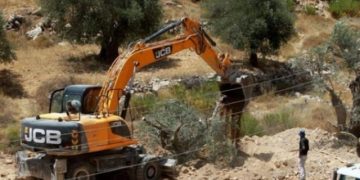
At a press conference on Sunday, Mayor Yahya al-Sarraj said the city urgently needs at least 250 heavy vehicles and 1,000 tonnes of cement to repair water networks and construct wells. Yet, according to local sources, only six trucks have been allowed to enter Gaza so far.
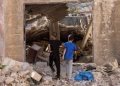
“Thousands of people remain trapped under the rubble, but the equipment that could help recover them is being redirected to search for the remains of Israeli captives,” one source said. “Palestinians know there will be no progress in the ceasefire until all Israeli bodies are returned.”
Videos circulating online show Red Cross vehicles arriving after meetings with Hamas’s Qassam Brigades to locate an Israeli captive’s body in southern Rafah. An Israeli government spokesperson confirmed that Red Cross and Egyptian teams have been allowed beyond the ceasefire’s “yellow line”, a designated boundary that enables Israel to maintain control over 58 percent of Gaza’s territory.
After two weeks of insisting that Hamas knew where all captive bodies were buried, Israel has now quietly allowed Egyptian machinery to enter Gaza to help recover them from beneath bombed homes and tunnels. Hamas officials said access to some tunnels had been impossible for weeks because of the destruction caused by Israeli airstrikes.
Meanwhile, Prime Minister Benjamin Netanyahu sought to reaffirm his control over Gaza policy, declaring that Israel alone determines which foreign forces may operate in the enclave. “We control our own security,” he said, adding that the U.S. has accepted Israel’s position.
Analysts say Netanyahu’s comments were aimed at reassuring his far-right supporters that he remains in charge. Israeli journalist Odeh noted that Washington now requires Israel to notify U.S. officials in advance of any planned military action in Gaza, a sign that decision-making may be increasingly constrained by international oversight.
While political tensions play out, Gaza’s reconstruction remains dangerously stalled. Nicholas Torbet, Middle East director at the HALO Trust, described the Strip as “essentially one giant city where every part has been struck by explosives.”
He warned that thousands of munitions designed to explode on impact had failed to detonate, leaving tens of thousands of tons of unexploded ordnance buried beneath the rubble.
“The best way to dispose of a bomb is to use a small charge to blow it up,” he said, noting that his teams aim to work directly with communities to remove the explosives safely.
According to Mahmoud Basal, spokesperson for the Palestinian Civil Defence, Israel dropped roughly 200,000 tonnes of explosives on Gaza during the war, with 70,000 tonnes failing to detonate. The remnants now endanger civilians, particularly children.
One tragic example is seven-year-old Yahya Shorbasi and his sister Nabila, who mistook an unexploded device for a toy while playing outside their home. “It looked like a regular toy,” said their mother, Latifa.
“Then we heard an explosion. It went off in their hands.” Yahya lost his right arm, and Nabila remains in intensive care.
Dr. Harriet, an emergency physician at al-Shifa Hospital, called the situation “a public health catastrophe waiting to unfold.” Children, she said, are being maimed by “ordinary-looking objects, cans, toys, or debris that turn out to be live bombs.”
The UN Mine Action Service reports that 328 people have already been killed or injured by unexploded ordnance since October 2023. Clearing the estimated 70,000 tonnes of bombs, mines, and mortar shells could take years and require millions of dollars.
For Palestinians in Gaza, the challenge is not only physical but existential. As one resident put it, “We want reconstruction, we want freedom of movement, and we want to see that the ceasefire can finally bring something real, not just more waiting under the rubble.”
Shortlink for this post: https://daysofpalestine.ps/?p=68843