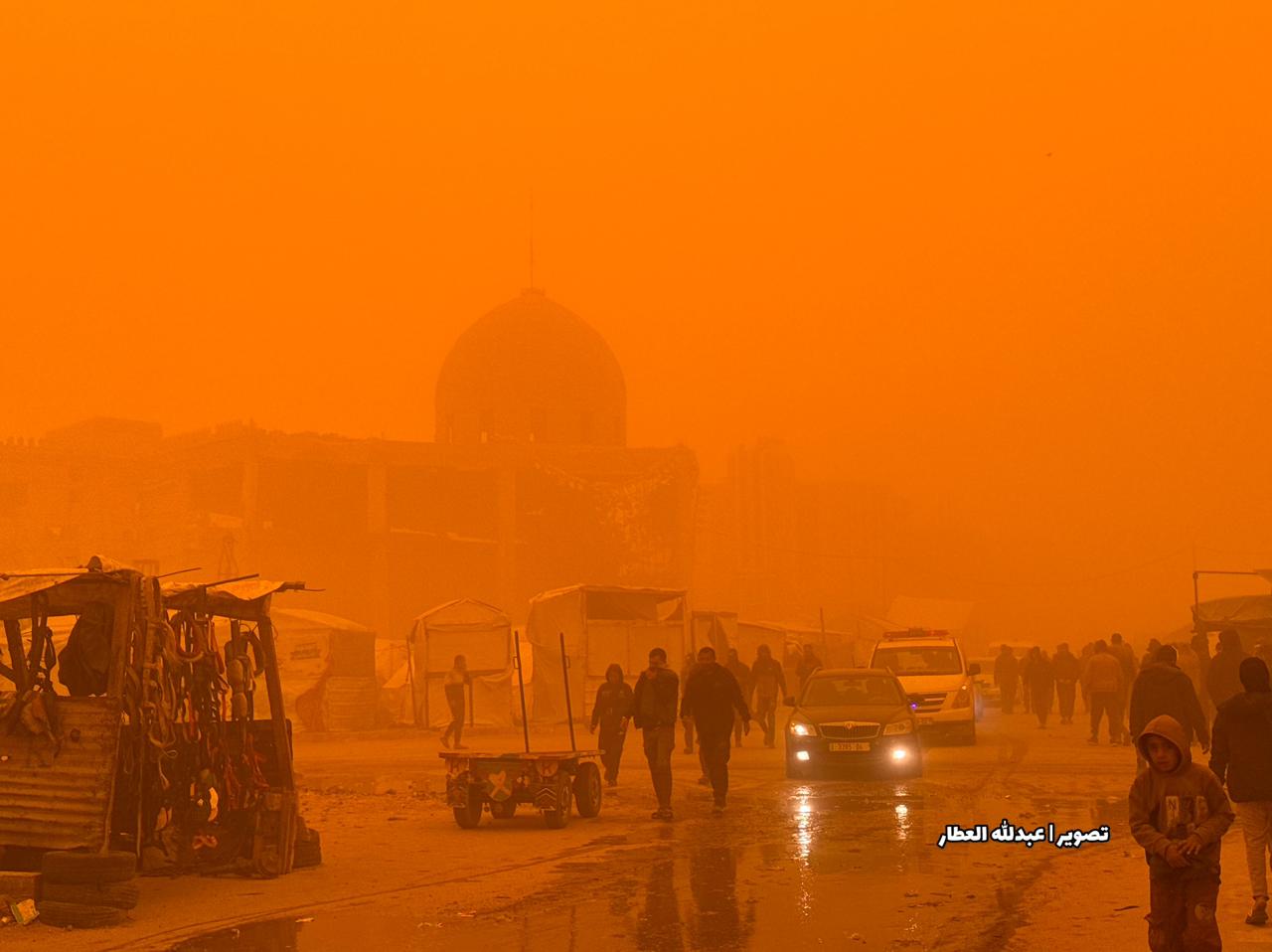
DaysofPal – A powerful sandstorm swept across large areas of the Gaza Strip on Saturday morning, bringing strong winds and dense clouds of dust. Hundreds of thousands of displaced Palestinians living in fragile tents faced harsh conditions, struggling to shield themselves and their children from the blowing sand and debris.
Across displacement camps, thin tents shook violently under the force of the wind. Sand pushed through every opening, covering blankets, food, and clothing. Families attempted to hold their shelters together while coping with a worsening humanitarian situation that grew more difficult with each new weather event.
The Palestinian Civil Defense urged residents to take precautions during the dust storm sweeping the Palestinian territories. Officials warned that patients, elderly people, and children face the highest risk from direct exposure to the dust. Authorities advised people to remain inside shelters whenever possible and secure tents and tarps firmly to prevent them from being blown away.
Displaced families struggle inside fragile tents
Inside one displacement camp set up on open land in Gaza City, a displaced resident identified as Abu Khaled al-Saadi stood gripping the ropes of his tent, anchoring them with heavy stones to stop the wind from tearing it away.
He said the storm struck early in the morning, adding another layer of hardship to the difficult life inside the camps.
“Dust entered the tent from every side,” he explained. “We tried to block the gaps with pieces of cloth, but the sand keeps coming. The children keep coughing, and we have nothing to protect them.”
Al-Saadi noted that many tents have already been damaged by months of rain and wind. The latest storm exposed how fragile the shelters have become.
“Whenever the wind grows stronger, we feel the tent could fly away at any moment,” he said. “There are no walls and no doors—only a piece of fabric that we try to live under.”
The risks go beyond the possibility of tents collapsing. Sandstorms also worsen health problems inside the camps. Respiratory illnesses have become increasingly common among children and elderly residents, while medical services remain extremely limited.
“We are living in the open”
Another displaced resident, Leila Hamdan, 41, said the storm turned her family’s tent into a suffocating space.
She spoke while trying to brush sand off blankets and bedding. “Everything is covered with sand, the food, the mattresses, and the children’s clothes,” she said. “We clean it, but the wind brings more sand minutes later.”
Her children became frightened by the loud sound of the wind and the shaking tent. The rising dust has caused coughing and breathing difficulties. Hamdan said the family has no real way to protect themselves.
“At home we could close the doors and windows,” she said. “Here we feel like we are living in the open.”
The danger of sandstorms increases in displacement camps because many tents are built on exposed land with little protection from strong winds. The camps stretch across uneven ground that leaves shelters directly exposed to blowing dust.
Rami Abu Shanab, 26, said some nearby tents were already blown away by the storm, forcing several families to crowd into other shelters.
“Moving outside the tents has become almost impossible,” he said. “The sand hits our faces, and we can barely open our eyes. Even going out to get water or food has become very difficult.”
For Gaza’s displaced population, the storm has turned an already severe humanitarian crisis into an even more exhausting struggle for daily survival.
Shortlink for this post: https://daysofpalestine.ps/?p=73039