DayofPal– Israel-Hamas ceasefire began early on Sunday, and displaced people, on foot, strated to return to Rafah City, south of the Gaza Strip, but all they find is rubble and large swaths of destruction.
Nine months of relentless war had displaced Abd Al-Sattari, a 53-year-old Palestinian farmer from Rafah in southern Gaza. Forced into a makeshift tent in Al-Mawasi with his wife and six children, Abd clung to a fragile hope: one of his two homes in Rafah might survive the devastation. It was a hope that kept him moving through the darkness of war.
But on Sunday morning, before the ceasefire officially took hold, Abd and his eldest son, Mohammed, returned to Rafah. They crossed roads shattered by bombs and passed by families returning to their homes with carts, bicycles, and what few belongings they had salvaged.
When they reached the site of Abd’s first house in Shaboura, all they found was rubble. His second home in Mirage was no different—reduced to dust and broken stone.
“Both homes gone. Both hopes extinguished,” he said.
Sunday’s ceasefire brought a halt to the war that had killed over 46,900 people, left 2 million displaced, and razed much of Gaza to the ground. Yet the destruction that came before the ceasefire didn’t pause for its approach.
Israeli airstrikes continued to bomb more houses until the final hours, claiming more lives and burying what little remained of Rafah.
For Abd and his family, the ceasefire was supposed to mean a return to safety and stability. Instead, it marked the beginning of a new ordeal—starting from nothing. Sitting among the wreckage of his 200-square-meter home, Abd called his wife, who waited with their belongings in Al-Mawasi.
Her voice broke into tears when he told her the truth: their two homes were gone, uninhabitable, with no walls, water, or basic services. Abd also refused her pleas to return to Rafah, the thing that left her in deep despair.
“The Rafah we knew is gone,” he said softly. “The streets we walked, the places we worked—everything is unrecognizable.”
Mohammed, Abd’s eldest son, took the phone and tried to console his mother. “We’ll prepare for a future return,” he assured her, though he too was overwhelmed by the enormity of the loss.
As thousands of families made their way back to Rafah, they encountered the same scenes Abd had seen—craters where homes once stood, streets swallowed by debris. Some set up camp on the ruins of their former homes, determined to stay there regardless of the costs.
Others, like Nasim Abu Alwan, resolved to rebuild his house, even if it meant carrying water from distant wells or walking long distances.
“We’re done with tents,” he said. “Rafah is where we belong.”
But for others, like Amjad Abdullah, the destruction was too much to bear. A burden that has clung on his shoulders. After finding his neighborhood in eastern Rafah inaccessible, even by foot, he chose to stay in Khan Younis ultimately.
“Rafah has become a graveyard of buildings,” he said. “Life here is unimaginable without water, roads, or basic infrastructure.”
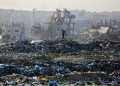
The United Nations reports that over 60 percent of buildings and 65 percent of roads across Gaza have been destroyed. In Rafah alone, the scale of devastation is described as “staggering” by Mayor Mohammed Al-Sufi.
“The city is uninhabitable,” he stated plainly, noting that 70 percent of Rafah’s infrastructure has been destroyed. Municipal workers are struggling to clear debris and restore essential services, but the sheer magnitude of destruction—over 42 million tons of rubble, laced with asbestos and unexploded ordnance—makes progress agonizingly slow.
Despite the warnings, families cling to Rafah, unwilling to give up their connection to the land. They chant, “We will rebuild. We will live.”
For them, Rafah is more than a city; it is a testament to their resilience, a foundation for their identity.
As Abd sits among the ruins of his home, he reflects on the unyielding spirit of his people. “We’ve suffered too much in displacement,” he says, but his voice filled with determination. “Rafah is home, and we will rebuild it—even if it takes a lifetime.”
For Abd, for Nasim, and for countless others, rebuilding is not just an act of survival—it is a declaration of hope. In the shadow of war, they refuse to surrender. Rafah may be in ruins, but its people are unbroken.
Shortlink for this post: https://daysofpalestine.ps/?p=60150