DaysofPal – During Ramadan iftar, Sara Warsh Agha and her brothers Ayman, Nafeth, and Ibrahim sat at the table without their mother, Basma Banat, who was killed by Israeli fire in northern Gaza.
Basma, 28, left her home in Beit Lahia on Sunday morning for work. Gunfire from Israeli military vehicles stationed east of the town struck her in the lower back, leaving her critically injured. She spent hours at Al-Shifa Hospital in Gaza City before doctors confirmed her death, while relatives waited outside.
This scenario has become a daily reality for Palestinians, with hospitals across Gaza receiving casualties from areas near Israeli positions. Many residents live among the rubble of destroyed homes or in tents, exposed to ongoing gunfire, artillery shelling, demolitions, and airstrikes.
The “Yellow Line,” a temporary boundary established under a ceasefire that took effect on October 10, separates areas under Israeli deployment, covering approximately 53 percent of Gaza, from western zones where Palestinians can move. Despite this, residents report heavy fire from new Israeli positions beyond the line.
Gaza’s Government Media Office reports that since the ceasefire, 326 Palestinians have been injured and 96 Palestinians have been killed by direct Israeli fire, including 36 women, children, and elderly individuals. Since October 10, at least 818 people have died and 1,663 have been injured as a result of repeated ceasefire violations, according to Gaza’s Health Ministry.
The ceasefire was intended to halt Israel’s two-year offensive, which has killed over 72,000 people, injured more than 171,000, and destroyed roughly 90 percent of civilian infrastructure. The United Nations estimates reconstruction costs at around $70 billion.
Emotional Farewell
Inside her damaged home in Beit Lahia, relatives mourned Banat. Her mother, Samar Banat, held her grandchildren, crying over the loss of her daughter, who had been on her way to work at an educational center.
Ahmed Banat, her brother, described the moment he found her body. “I was shocked when her children ran screaming, ‘Our mother has been martyred.’ I went out immediately and found her lying on the ground,” he recalled.
Her husband, Mousa Warsh Agha, stood with their four children, holding their youngest, Ibrahim, an infant unaware he would not see his mother again. He described the neighborhood as under daily fire from Israeli vehicles, snipers, and artillery, despite being classified as “safe” under the ceasefire.
Targeting Civilians
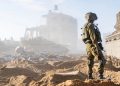
An Anadolu correspondent documented Israeli military positions near the “Yellow Line.” Elevated sand dunes host armored vehicles, sniper posts, and surveillance equipment that allow continuous targeting of Palestinian homes and tents. Metal towers mounted with machine guns fire regularly, while drones drop incendiary devices and fire on civilians. Bulldozers continue to level land to reinforce Israel’s military presence.
Ismail Al-Thawabteh, director of Gaza’s Government Media Office, accused Israel of exploiting the ceasefire to reshape the battlefield. He described 96 of the 615 Palestinians killed since the ceasefire as victims of direct fire from tanks, drones, and snipers near the “Yellow Line.” Of 1,651 wounded, 326 suffered from the same targeting.
Thawabteh stressed that over 99 percent of those killed were in areas classified as safe and outside Israel’s declared buffer zones. He characterized the incidents as a repeated pattern of deliberate, calculated killings aimed at civilians, undermining any stability resulting from the agreement.
He called for urgent action to stop targeting, implement ground monitoring, and hold responsible parties legally accountable.
Shortlink for this post: https://daysofpalestine.ps/?p=72546