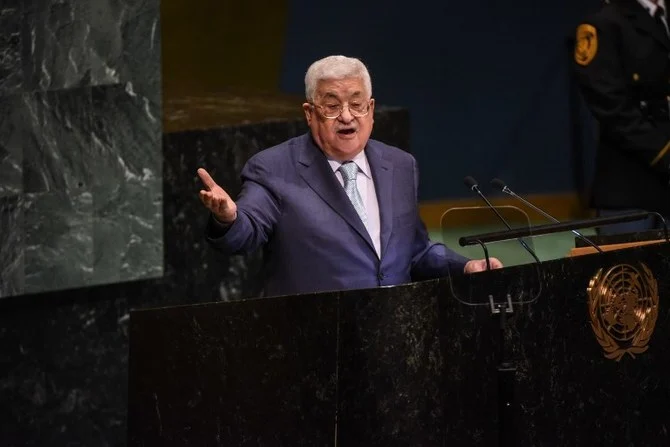
In his much-anticipated speech at the UN General Assembly on Sept. 23, Palestinian leader Mahmoud Abbas is expected to, once more, make a passionate plea for the recognition of Palestine as a full member.
In September 2011, the Palestinian Authority’s quest for full recognition was stymied by the Barack Obama administration, forcing Palestinians to opt for the next best option: A “symbolic” victory at the UNGA the following year. In November 2012, UNGA Resolution 67/19 granted the state of Palestine nonmember observer status.
In some ways, this resolution was indeed symbolic, as it improved nothing on the ground. On the contrary, the Israeli occupation has worsened since then, its convoluted system of apartheid has deepened and, in the absence of any political horizon, Israel’s illegal settlements have expanded like never before. Moreover, much of the West Bank is being actively annexed by Israel — a process that initiated a slow but systematic campaign of expulsion, which is felt from East Jerusalem to Masafer Yatta in the South Hebron Hills.
Proponents of Abbas’s diplomacy, however, cite facts such as the admission of Palestine into more than 100 international treaties, organizations and conventions. The Palestinian strategy seems to be predicated on achieving full sovereignty status at the UN so that Israel will be recognized as an occupier not merely of Palestinian “territories” but of an actual state. Israel and its allies in Washington and other Western capitals understand this well, thus their constant mobilization against Palestinian efforts. Considering the dozens of times Washington has used its veto power at the UN Security Council to shield Israel, its use of a veto is also likely should Palestinians return to the UNSC with their application for full membership.
Abbas’s international diplomacy also seems to lack a national component. The 87-year-old Palestinian leader is hardly popular with his own people. Among the issues that have resulted in a lack of support for him, aside from the endemic corruption, is the Palestinian Authority’s continued “security coordination” with the very Israeli occupation that Abbas rages against in his annual UN speeches.
Such coordination, which is generously funded by Washington, translates into daily arrests of Palestinian anti-occupation activists and political dissidents. Even when the Donald Trump administration decided to cut off all aid, including humanitarian assistance, to the Palestinians in 2018, the $60 million allocated to funding the Palestinian Authority’s security coordination with Israel remained untouched.
Such a major contradiction has taught Palestinians to lower their expectations regarding their leader’s promises of full independence, even if it is symbolic.
The contradictions did not start with Mahmoud Abbas and the Palestinian Authority, and certainly do not end with them.
Ramzy Baroud
But the contradictions did not start with Abbas and the Palestinian Authority, and certainly do not end with them. Palestine’s relationship with the world’s largest international institution is marred by contradictions.
Though the Balfour Declaration of November 1917 remains the main historical frame of reference for the colonization of Palestine by the Zionist movement, UN Resolution 181 was equally, and to some extent, even more important.
The Balfour Declaration’s significance stems from the fact that colonial Britain — which was later granted a “mandate” over Palestine by the League of Nations, the predecessor of today’s UN — made the first officially written commitment to the Zionist movement to grant Jews a home in Palestine.
“His Majesty’s Government view with favor the establishment in Palestine of a national home for the Jewish people,” the text read, in part. This quest, or “promise,” as known by many, would have culminated in nothing tangible if it were not for the fact that the Zionist movement’s other colonial, Western allies successfully managed to turn it into a reality.
It took exactly 30 years for the Zionist quest to translate the pledge of Britain’s then-Foreign Secretary Arthur James Balfour into a reality. UN Resolution 181 of November 1947 is the political basis upon which Israel came into existence. Though the current boundaries of the state of Israel far exceed the space allocated to it by the UN’s partition plan, the resolution is nonetheless often used to provide a legal foundation for Israel’s existence, while chastising the Arabs for refusing to accept what they rightly perceived at the time to be an unjust deal.
Since then, the Palestinians have continued to struggle in their relationship with the UN.
In 1947, the UN “was largely a club of European countries, English white-settler states and Latin American countries ruled by colonial Spanish-descendant elites,” former UN Special Rapporteur on the situation of human rights in Palestine Michael Lynk wrote in a recent article regarding the partition of historic Palestine.
Though the geographic and demographic makeup of the UN has vastly changed since then, real power continues to be concentrated in the hands of the former Western colonial states, namely the US, Britain and France. These three countries represent a majority of the UNSC’s permanent members. Their political, military and other forms of support for Israel remain as strong as ever. Until the power distribution at the UN reflects the true democratic wishes of the world’s population, Palestinians are deemed to remain at a disadvantage at the UNSC. Even Abbas’s fiery speeches will not alter this.
In his memoir, referenced in Lynk’s article, former British diplomat Brian Urquhart, “who helped launch the UN,” wrote that “the partition of Palestine was the first major decision of the fledgling United Nations, its first major crisis and, quite arguably, its first major misstep.”
But will the UN’s current power paradigm allow it to finally correct this historic “misstep” by providing Palestinians with their long-delayed justice and freedom? Not quite yet, but the global geopolitical changes currently underway might present an opening which, if navigated correctly, could serve as a source of hope that there are alternatives to Western bias, US vetoes and Israel’s historic intransigence.
- Ramzy Baroud has been writing about the Middle East for more than 20 years. He is an internationally syndicated columnist, a media consultant, an author of several books, and the founder of PalestineChronicle.com. Twitter: @RamzyBaroud
Shortlink for this post: https://daysofpalestine.ps/?p=27045