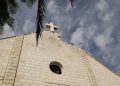
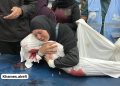
DaysofPal – On Thursday, Israeli warplanes bombed a Catholic church in Gaza City, killing three Palestinians and injuring several others, including Father Gabriel Romanelli, the parish priest of the Latin Church in the Gaza Strip. Father Romanelli, a key voice informing Pope Francis about conditions on the ground, sustained minor injuries, while six others were reported to be in serious condition.
This was not the first time a church has been targeted in Israel’s war on Gaza. In recent months, Israeli airstrikes have damaged the Holy Family Church, Gaza’s only Catholic parish, and bombed the historic Church of St. Porphyrius, one of the oldest Christian sites in the world. These attacks have left behind death, injury, and a growing sense that Christian sanctuaries are no longer off-limits.
Archbishop William Al-Chomali, Patriarchal Vicar of the Latin Patriarchate in Jerusalem, reacted to the strike with despair: “It is clear that no one is safe in Gaza, not even those who seek refuge in a church or a mosque.” Yet he vowed to continue supporting the displaced families sheltering in the church and its surrounding area.
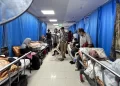
Perhaps the most harrowing strike came on October 19, 2023, when Israeli forces bombed the Greek Orthodox Church in Gaza, killing 20 people, 18 of them Christians, as they slept inside, believing they had found a safe haven. That attack followed just two days after the now-infamous bombing of the Arab Baptist Hospital, which killed 471 civilians in a single night.
Together, these assaults mark a pattern, not random collateral damage, but systematic targeting.
Exploiting the War to Reduce the Christian Presence in Palestine
The war on Gaza has provided Israel with an opportunity to advance a long-standing goal: diminishing and ultimately erasing the Christian presence from Palestine. Targeted bombings of churches, Christian hospitals, and entire communities suggest not a series of accidents, but a calculated campaign to uproot a faith native to this land.
Most of Gaza’s Christian population, approximately 340 families, now seek shelter in the last two functioning churches: St. Porphyrias and the Holy Family. Church. Inside these walls, they face cold, hunger, and the constant threat of death. The Christian presence, once a living part of Gaza’s society, is now huddled in survival.
According to reports, the Israeli government is negotiating with other countries, particularly Australia, to accept up to 1,000 Christian families from Gaza. Similar plans are reportedly being discussed with France, Greece, Russia, and Italy. Though described as humanitarian efforts, these deals may mark the beginning of a larger plan to remove the Christian community from its homeland under the guise of protection.
Palestinian priest Munther Ishaq has been one of the clearest and most vocal warning voices. He has raised an alarm that the Christian presence in Gaza is on the verge of extinction due to the ongoing genocide, oppression, and siege.
“We are living in a state of extreme fear,” he said, “watching what is happening in Gaza amid the silence of the Arab world and the world at large, and we ask ourselves, ‘Will this be our future in the cities of the West Bank?’ We saw what happened in Jenin in the northern West Bank, and this has sparked fear that there is no protection for Palestinians. So when we celebrate holidays, it is an occasion to renew our faith. Even if we are abandoned by everyone, God is always with us, and with our faith we can have hope and a message of consolation to persevere and resist.”
Father Ishaq then directed a heartfelt message to the world:
“To the whole world, to our Christian brothers in the East and West, do not forget the Holy Land and the cradle of Christianity. Do not forget or ignore what is happening in our land… Would anyone want Christianity to disappear from the Holy Land?”
He added, with grief and urgency, “Unfortunately, what I see in Gaza indicates that the Christian presence there will end because of the war of extermination, and I hope I am wrong.”
And he didn’t stop there. Father Ishaq emphasized the stakes for the global Christian conscience: “Our credibility as believers is at stake as we witness a war of extermination, which has been proven by studies and testimonies, and everyone knows what is happening in terms of extermination.”
He concluded with a clear and stark assessment of the crisis: “Christianity in Gaza is threatened with extinction, and this is no secret. Their numbers have been reduced by half. Some were killed or displaced, some fled at the beginning of the war, and some died due to lack of food, medicine, and basic necessities.”
Father Ishaq’s words serve not just as a warning but as a plea to the world, and especially to Christians, not to turn away from what is happening in the birthplace of their faith.
A Coordinated Strategy to Erase Christian Identity
The statistics are sobering. The Christian population in Israel has dropped to just 1.8%, down from 10% before 1948. Those who remain, including Armenians, Syriacs, Copts, Abyssinians, and various Catholic and Orthodox communities, report systematic discrimination and social hostility.
In 2023, members of the religious party Yisrael Beiteinu introduced a bill in the Knesset to criminalize Christian missionary activity, only to withdraw it after international outcry. Meanwhile, public harassment of Christians, especially by ultra-Orthodox Jews, has become normalized. Spitting on priests and pilgrims, hurling insults, and disrupting church processions are now weekly occurrences in Jerusalem’s Old City.
Jesuit priest David Neuhaus has been attacked five times in recent years, once by a man who spat on him and called him “Amalek”, an ancient biblical enemy. Church leaders estimate that more than half of Armenian religious processions on Fridays are disrupted by harassment.
Extremist Jewish leaders openly call for the erasure of Christianity from the land. Bentsi Gofstein, head of the extremist Lehava movement, called for a total ban on Christmas celebrations and declared, “Let’s expel the bloodsuckers from our country.” In some religious schools, rabbis teach that Christianity is a form of idolatry and should be wiped out.
These acts, once considered fringe, are now met with silence or tacit approval by Israeli authorities. Police routinely stand by during attacks. Ministers avoid condemnation. And settlers, emboldened by their political backing, march forward with their campaign of religious cleansing. Leaders of Christian denominations, including Coptic, Greek Orthodox, Maronite, Latin, and Syriac, have cautioned that the attack on their communities is a part of a broader attempt to rid the country of its religious diversity.
Shortlink for this post: https://daysofpalestine.ps/?p=65859