DaysofPal- For 32-year-old Jamal Abu Sukran and his three children, displacement has become a relentless cycle with no respite. Their latest move marked the family’s 25th displacement since the start of Israel’s genocide on Gaza in October 2023, forcing them once again to abandon what little stability they had managed to find.
The most recent displacement followed Israel’s expansion in June of the so-called “yellow line,” a military-controlled zone that now covers approximately 70 percent of the Gaza Strip. Humanitarian observers and residents say the expansion has further reduced the space available to the territory’s remaining population, leaving hundreds of thousands of people confined to increasingly overcrowded areas.
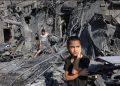
Abu Sukran’s home in Gaza City’s Shujaiya neighborhood was destroyed in an Israeli air strike during the early months of the war. Since then, he and his family have moved repeatedly between displacement camps, seeking safety from successive military operations and shifting evacuation zones.
His former home now lies within the yellow line, an area Israel was expected to vacate during the initial phase of the ceasefire agreement reached in October 2025. However, Israel has maintained its presence there, while declining to proceed to the second phase of the agreement, which would require a broader withdrawal.
“Even after the ceasefire, the shooting and shelling never stopped,” Abu Sukran said. “Life in the camps was unbearable. We would wait for the gunfire to stop just to go to the toilet.”
According to Abu Sukran, daily life in displacement camps remains dominated by insecurity, with gunfire frequently heard in the mornings and civilians often caught in the crossfire. He said his family’s temporary shelter eventually became part of the “orange line,” additional territory brought under Israeli control after the ceasefire.
“It was terrifying,” he recalled. “There were random shootings, stray dogs, rats, and destruction everywhere. Nothing remained except rubble.”
Families Watch Their Homes Disappear
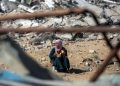
The experience of repeated displacement is shared by many families across Gaza. Sixty-eight-year-old Nabil Abu Armanah had already lost one home in Rafah before pitching a tent on the ruins of a second residence destroyed during the conflict.
Persistent gunfire, military activity, and the approach of Israeli tanks eventually forced his family to flee again. When he later returned, he found that the newly expanded yellow line now cut directly through his property.
“It is extremely dangerous there now,” Abu Armanah said. “Everything is gone. Nothing remains.”
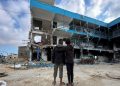
Residents and analysts say areas falling within the yellow line have increasingly been rendered uninhabitable. Since the ceasefire, heavy machinery and demolition operations have reportedly continued in these zones, leaving widespread destruction in their wake.
“I was hoping to return home soon, but now we are homeless,” Abu Armanah said. “The land means everything to me.”
His voice shaking with emotion, he added: “These are barbaric actions. We are innocent people. All we want is to live with dignity. I have lived through countless wars since 1967, and now everything I built over a lifetime has been destroyed.”
Concerns Over Long-Term Territorial Changes
Political analyst Abdel Nasser Abu Aoun said the yellow line has become a mechanism through which Israel is consolidating control over parts of Gaza while expanding military zones deeper into the territory.
According to Abu Aoun, the subsequent introduction of the orange line has further increased the area inaccessible to Palestinians, raising concerns about the long-term implications for Gaza’s geography and population distribution.
He argued that the policy is accompanied by extensive destruction of homes and infrastructure, creating conditions that make it increasingly difficult for displaced residents to return to their communities.
Abu Aoun also alleged that military observation points have been established overlooking areas from which residents were displaced, creating a constant reminder of loss for families living in nearby camps.
“From their tents, people can see the remains of their destroyed homes,” he said. “This has become a form of psychological pressure on displaced families.”
He warned that many residents are being pushed toward the al-Mawasi area, one of the few remaining zones outside the expanding military boundaries. However, the area’s severely damaged infrastructure is struggling to accommodate the growing number of displaced people, raising fears of a prolonged humanitarian and environmental crisis.
Water and Sanitation Systems Under Strain
The expansion of military-controlled areas has also had significant consequences for Gaza City’s essential services.
Maher Salem, Director General of Planning and Investment at Gaza Municipality, said roughly 35 percent of the city’s water sources have been lost after falling within the yellow line and subsequently being destroyed.
At the same time, he said water supplies entering Gaza have dropped from approximately 20,000 cubic meters per day to around 12,000 cubic meters, contributing to severe shortages. As a result, residents now receive an average of only about 10 liters of water per person each day.
Salem also reported the destruction of the main desalination facility in the Sudaniya coastal area, which had previously supplied around 10,000 cubic meters of water daily.
The damage extends beyond water production. Approximately 150 kilometers of water distribution networks, sewage pumps, and sanitation infrastructure have been destroyed during the war, severely limiting municipalities’ ability to provide basic services.
Waste management has also become a growing challenge. According to Salem, access to Gaza’s main landfill sites near the border has been restricted, forcing local authorities to store waste inside residential areas.
An estimated 400,000 cubic meters of garbage have accumulated throughout Gaza City, creating a major environmental and public health emergency.
The deteriorating conditions have heightened concerns about disease outbreaks. Earlier this year, the United Nations Office for the Coordination of Humanitarian Affairs reported that more than 80 percent of Gaza’s displacement camps had recorded frequent sightings of rodents and pests, while residents reported increasing cases of skin infections and other health problems linked to overcrowding and poor sanitation.
For thousands of displaced families, the combination of repeated displacement, shrinking living space, damaged infrastructure, and worsening public health conditions has turned daily survival into an increasingly difficult struggle, with little certainty about when they will be able to return home, or whether they will be able to return home.
Shortlink for this post: https://daysofpalestine.ps/?p=75573