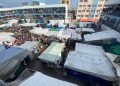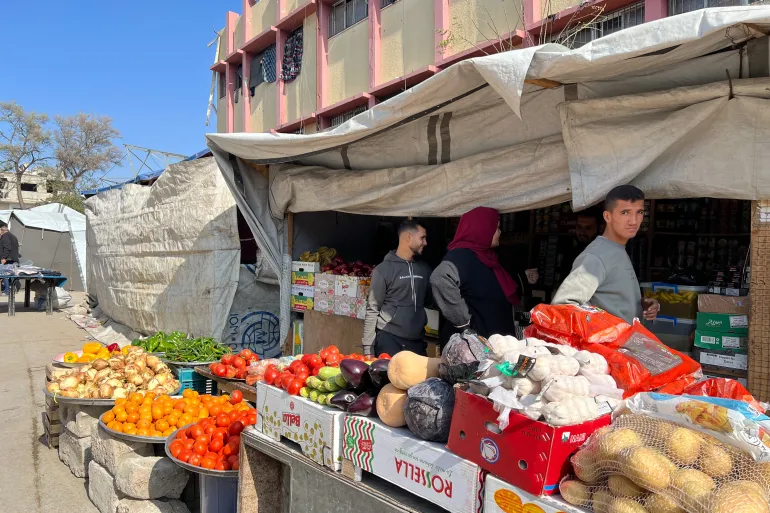
Gaza City – In the crowded streets of the Remal neighbourhood, where makeshift stalls have replaced destroyed shops, Samar Abu Harbied pauses at a small roadside stand to buy a few basic groceries for iftar. Ramadan has arrived, but like everything else in Gaza, even the simple act of preparing a meal has become a struggle.
She opens her purse. It is empty.
The 45-year-old mother quietly asks the grocer if she can take the food on credit until her husband or son can transfer the money.
“I haven’t touched a paper bill in months,” she says. “I don’t even have money for a taxi anymore. We walk everywhere now — long distances.”
In Gaza, survival is calculated in small coins that no longer exist.
Worn-Out Money in a Broken Economy
Nearby, Najlaa Sukkar, 48, stands exhausted after walking to a clinic for a post-surgery check-up — only to return without treatment.
She didn’t have the 30 shekels needed for the appointment. The only banknote she carried, a worn 20-shekel bill, was rejected.
“At the pharmacy, they refused the torn notes,” she says. “The taxi driver wouldn’t take it either. He wanted small change, which I don’t have. I went back home without medicine.”
In Gaza today, even when people have money, it is often unusable.
Since October 2023, when Israel launched its devastating war and tightened its siege, a severe cash shortage has gripped the Strip. Israel controls the supply of the Israeli shekel, the currency used in Gaza. No new bills have entered in sufficient quantities. Nearly 90 percent of bank branches and ATMs have been destroyed.
The result: people cling to worn, torn, nearly disintegrating notes from before the war — notes that shops increasingly refuse.
Digital Payments in a Place Without Electricity
To cope with the liquidity collapse, authorities pushed mobile payment systems like PalPay and Jawwal Pay. For some families, this has become the only way to buy food.
Samar’s son, Shady, works as a night guard. He used to be paid in cash — bills so damaged that no one would accept them.
“Now his salary goes to his bank account,” she explains. “We pay using the phone.”
But even this “solution” comes with suffering.
Most families do not receive regular bank salaries. Many do not own smartphones. Electricity is scarce. Internet coverage is weak and unstable. A simple transfer can take hours — if it works at all.
Samar says she cannot even go to the market alone anymore.
“I need my husband or my son with me so they can pay,” she says. “I prefer cash in my hand. With cash, I could buy what I need freely.”
In Gaza, freedom now includes the freedom to hold your own money.
When Cash Becomes a Commodity
Economists say what began as a cash shortage has evolved into something far more dangerous: the collapse of the formal financial system.
Ahmed Abu Qamar, a board member of the Palestinian Economists Association, describes a reality where the black market now controls liquidity. Brokers exchange digital balances for physical cash — charging commissions that can reach 50 percent.
“When money itself becomes a commodity, the system is distorted,” he explains. “Cash is scarce, so its value rises beyond its real worth. This is a structural collapse.”
The formal banking sector has been sidelined. What remains is a fragmented survival economy shaped by siege, scarcity, and political control.
Today, about 95 percent of Gaza’s households rely on aid. Credit has become widespread — not as a sign of stability, but as a sign of desperation.
“When debt grows and income does not,” Abu Qamar warns, “society begins to fracture.”
Profiting from Hunger
For families like the Sukkars, the crisis has opened the door to exploitation.
When cash is urgently needed, brokers demand enormous cuts.
“We lose half our money to them,” Najlaa says. “They take it with our full consent because we have no choice.”
At the same time, many residents distrust digital balances they cannot physically see.
“Where is this money?” Najlaa asks. “Who is holding it? I used to count my banknotes in my hands. Now, when the app stops working, we panic — afraid it will disappear.”
Selling on Credit to a Starving City
Abdallah Sukkar now runs a small roadside stall after his family’s well-known shop in Shujayea was destroyed in the war.
He accepts all banknotes — new or worn — and allows people to buy on credit. He cannot turn away neighbours who come asking for food.
“People have no money,” he says. “How can I refuse them?”
But the cost is crushing. Debts have risen by more than 500 percent since the war began. His profits barely reach 2 percent. He has given out 20,000 shekels’ worth of goods to customers who emerged during the war — families who had nothing left.
“From the beginning of Ramadan until now, I haven’t had small change,” he says. “Even when someone has cash, I cannot give change, so they go elsewhere.”
And when the bank app crashes?
“We are terrified,” he says quietly. “Terrified that the little we have will vanish.”
Even Money Is Not Safe
In Gaza, the siege has reached beyond borders and buildings. It has entered pockets, wallets, bank accounts, and market stalls.
A mother cannot buy food without permission from a phone app.
A patient cannot pay for medicine because her banknote is too worn.
A shopkeeper sinks into debt because hunger does not wait.
Here, every choice carries risk:
Cash that no one accepts.
Digital money that may freeze.
Credit that deepens poverty.
In Gaza, even money is no longer simply money.
It is another battlefield in a city already fighting to survive.
Shortlink for this post: https://daysofpalestine.ps/?p=72560