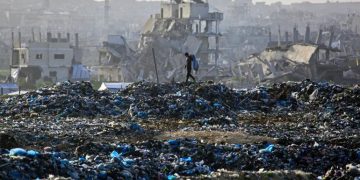
DaysofPal- Nine days after the ceasefire took hold, the Gaza Strip remains a graveyard of memories and survival. The roar of warplanes may have stopped, but the echoes of devastation are everywhere, in the smell of dust, the cries of the hungry, and the endless queues for a loaf of bread.
The ceasefire has brought neither calm nor comfort. More than two million Palestinians are trapped in a wasteland of ruin, displaced, jobless, and hungry, struggling to rebuild life on the wreckage of what once was home.
When the last missiles fell, many Gazans thought their nightmare had ended. But as Sami al-Najjar, a displaced father from Al-Zaytoun, puts it, “We thought the end of the bombs would bring relief. Instead, it brought hunger.”
Families now live in tattered tents or shattered schools with no running water, little electricity, and no steady source of food. With entire neighborhoods flattened, Gaza’s economy has collapsed, leaving even the most basic goods beyond reach.
Hunger on Every Corner
Food has become a dream. Around the few remaining aid points, crowds gather for hours hoping for a single hot meal. Local sources say Israel still blocks the entry of key supplies, meat, poultry, eggs, and vegetables, allowing only token quantities that barely sustain life.
“I’ve been cooking lentils and rice every day,” says Umm Wasim, a mother of five. “We haven’t seen vegetables for weeks. Fruit, if you find it, costs three times what it used to.”
The blockade has also crippled Gaza’s farms. According to UNRWA, nearly 88% of agricultural land is now destroyed or inaccessible. The loss of local produce has sent food prices soaring and wiped out the livelihoods of farmers who once fed their communities.
An Economy in Ruins
With shops buried under rubble and factories in ashes, Gaza’s economy has been reduced to rubble. “Everything is now priced in dollars,” says resident Mahmoud Awad. “Even bread feels like a luxury.” Daily workers have no income; merchants adjust prices by the currency, and most families live below the poverty line.
UN agencies warn that humanitarian access is a race against time. The World Food Program says the closure of northern crossings has blocked vital aid from reaching Gaza City, deepening the risk of famine, particularly among children and pregnant women.
UN Human Rights Chief Volker Türk has urged that Gaza’s recovery begin with restoring dignity: food, water, healthcare, and an end to what he called the “collective punishment of civilians.”
According to Gaza’s Ministry of Health, Israel’s war since October 2023 has killed 67,967 people and wounded 170,179 more. Thousands of families are still buried under debris; hundreds of thousands more live in unbearable conditions, stripped of everything but endurance.
Yet amid ruin, resilience persists. Mothers bake bread over open fires despite scarce flour; young men rebuild walls with bare hands; children sketch hope on the remnants of their schools.
“We’re not asking for the impossible,” says Ayyham al-Amour from Deir al-Balah. “Just to live like other people, to have a home, a meal, and a sky that doesn’t rain fire.”
Shortlink for this post: https://daysofpalestine.ps/?p=68660