DaysfoPal- In the chaos of Israel’s genocidal war, some stories slip quietly beneath the headlines, stories not of strategy or politics, but of fragile beginnings and the endurance of love.
Our story today is one of them.
When Samer Al-Loulo’s daughter was born, he saw her only once, just minutes before she was taken away.
What followed was not the life he imagined as a father but a long and uncertain vigil marked by silence, fear, and hope stretched to its limits.
A Birth Under Fire
Samer, a resident of northern Gaza’s Al-Saftawi area, had already been displaced with his family to Jabalia camp when the war intensified.
His wife, Shaima, was eight months pregnant when her condition suddenly deteriorated due to preeclampsia, a life-threatening complication.
They rushed her to Al-Awda Hospital under relentless bombardment. Doctors quickly determined she needed more advanced care and referred her to Al-Shifa Hospital. But in a city paralyzed by airstrikes, even an ambulance was out of reach.
“We waited until the next day. Our hearts were hanging between life and death.” Samer recalls.
On October 30, 2023, they made the dangerous journey to Al-Shifa amid shelling. There, doctors performed an emergency cesarean section.
Their daughter, Khadija, was born prematurely, tiny, fragile, and in immediate need of intensive care.
“I saw her only for a few moments before they took her to the incubator. I didn’t know that would be the last time for months,” Samer says.
Waiting in Fear
After the surgery, Shaima was transferred to another hospital, where she remained under observation for four days. Khadija stayed behind in neonatal intensive care.
Samer never left.
“I slept on the street outside the hospital; there were rockets, explosions, and stray dogs all around. But I had no other choice,” he says.
Then came another blow. News spread that the hospital where his wife was recovering had been bombed.
“I collapsed to my knees. I thought I had lost her… while my daughter was already fighting for her life alone.” he remembers.
Thirteen Days of Silence
Days after Khadija’s birth, communications across Gaza collapsed. For 13 days, Samer had no way of knowing whether his daughter was alive.
“No internet, no phone calls, nothing. Every day, we hear about premature babies dying because of a lack of oxygen and heat. Every piece of news felt like it could be about her,” he says.
Inside Al-Shifa’s neonatal unit, conditions were deteriorating. Power outages cut off oxygen and heating systems. Khadija’s condition worsened.
She developed severe complications, including enlargement of her liver and spleen. Her weight dropped from around 1.5 kilograms to less than one.
When communication was partially restored, the family discovered, by chance, that Khadija had been transferred south with other premature infants and later evacuated to Egypt for treatment.
“We didn’t even know she had left Gaza. We found out through a social media post seen by a relative abroad, almost a month later.” Samer says.
A Long Separation
Determined not to give up, Samer traveled south to Nasser Hospital in Khan Younis. There, arrangements were made for Shaima to leave Gaza and reunite with their daughter in Egypt.
She managed to cross before the Rafah border closed.
“I asked her to come back at one point. But we were afraid our daughter wouldn’t survive in Gaza. So she stayed with her in Egypt,” Samer admits.
For six months, Khadija remained in intensive care. Her tiny body endured more than most, her heart stopped twice, and her weight fell to just 700 grams.
“It was very difficult. But slowly, she began to improve.” Samer says.
Reunion and Uncertainty
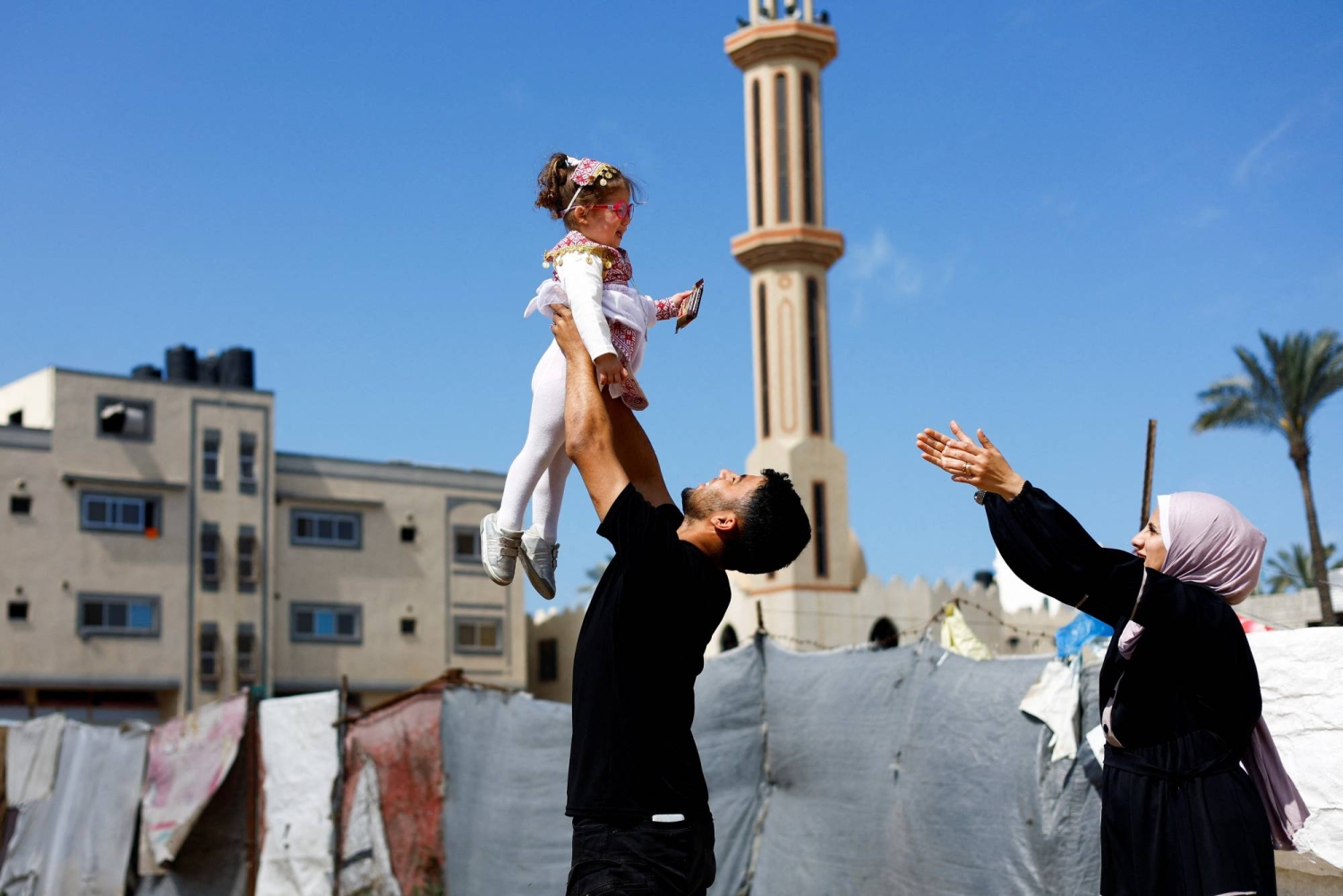
After months of separation, Khadija finally returned to Gaza with her mother. The reunion was overwhelming.
“It was indescribable. We were so happy, but also afraid,” Samer says.
Doctors warned that Khadija’s condition remains delicate. She needs proper nutrition, a clean environment, and careful monitoring, things that are painfully scarce in Gaza today.
“She shouldn’t live in a tent. She can’t rely on canned food,” Samer explains.
“We are afraid she could go back to zero.” She added.
A Fragile Future
Khadija’s story is one of survival against extraordinary odds. But like many in Gaza, her future remains uncertain.
For Samer, fatherhood began not with lullabies or first steps, but with distance, silence, and fear. Yet through it all, one thing never wavered: the quiet, stubborn hope that his daughter would come back to him.
He saw her for only a few minutes.
He waited for her for months.
And now, he holds on, just as tightly, to the fragile promise of what comes next.
Shortlink for this post: https://daysofpalestine.ps/?p=73545