DaysofPal- A new report by The Economist warns that the Gaza Strip may now contain the world’s highest concentration of unexploded ordnance (UXO), leaving millions of civilians at risk for decades to come.
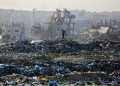
According to the British magazine, unexploded munitions represent one of the most lethal long-term legacies of war, continuing to kill and injure civilians long after fighting subsides. In Gaza, much of the danger lies buried beneath the vast rubble left by two years of Israeli bombardment.
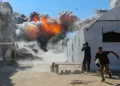
The report notes that many of the bombs used by Israeli forces were fitted with delayed-action fuses meant to detonate inside structures or underground.
These devices often failed to explode, turning Gaza’s destroyed neighborhoods into a maze of unstable explosives.
Citing UN figures, The Economist reports that more than 53 people have already been killed and hundreds wounded by leftover munitions, a number aid agencies believe is significantly higher due to limited access and insecurity.
Among the most tragic cases are six-year-old twins Yahya and Nabila al-Sharabasi, who suffered severe injuries after mistaking an unexploded bomb for a toy.
Humanitarian groups estimate that Gaza now contains more than 7,000 tons of unexploded ordnance, an unprecedented amount for a densely populated area.
UN assessments indicate that UXO is scattered across roughly 40% of residential areas, with more than 3,000 tons concentrated in the heavily destroyed northern towns of Beit Hanoun, Beit Lahiya and Jabalia.
The humanitarian organization Humanity & Inclusion warns that fully clearing Gaza could take between 20 and 30 years unless significant international engineering support is mobilized quickly.
Nick Orr, an explosives-removal specialist with the group, said some bombs will likely never be recovered: “We will still find them for generations to come. They’re underground. It’s similar to what British cities faced after World War II.”
The report points out that the UN is still working to remove unexploded bombs from Mosul years after it was retaken from ISIS, despite far less destruction than Gaza, highlighting the unprecedented scale of the challenge.
Although the UK has pledged £4 million (5.25 million dollars) to support UN clearance operations, The Economist says Israeli restrictions remain the biggest obstacle.
The Israeli occupation has prevented the entry of essential equipment and foreign experts and has also blocked Palestinians from receiving professional explosive-removal training. Many tools needed for demining are labeled “dual-use” by the Israeli occupation, making them subject to strict bans.
As a result, Gaza’s demining teams have been forced to improvise rudimentary solutions, such as using old food sacks filled with sand as protective barriers.
The report stresses that even with access and proper tools, Gaza presents a unique challenge. Unlike Mosul, where civilians were evacuated during clearance operations, Gaza has no safe zones to relocate residents.
Most of the territory is heavily damaged, densely populated, and littered with hidden explosives.
With thousands of tons of unstable ordnance buried beneath collapsed homes and ruined neighborhoods, the report concludes that Gaza faces a long and dangerous recovery. Without significant international intervention and the removal of restrictions that currently hinder it, civilians will remain at risk for generations.
Shortlink for this post: https://daysofpalestine.ps/?p=69395