DaysofPal- French historian and Middle East scholar Jean-Pierre Filiu has revealed firsthand testimony from his month-long stay in Gaza earlier this year, describing what he calls “conclusive evidence” of Israeli support for local gangs that looted humanitarian aid convoys during the war.
Filiu, a professor at Sciences Po in Paris, documented his observations in a new book titled A Historian in Gaza, published in French in May and translated into English this month. His account was highlighted by The Guardian.
Filiu entered Gaza in December, hosted by an international aid organization in the southern coastal area of al-Mawasi, at a time when Israel had barred foreign media and independent observers from entering the Strip.
He remained inside Gaza until after the second ceasefire in January.
In his book, Filiu described multiple incidents where Israeli forces struck local security teams protecting aid trucks, creating conditions that allowed looters to raid large quantities of food and essential supplies destined for desperate families.
International organizations at the time warned of looming famine in several areas of Gaza, as Israeli airstrikes repeatedly targeted the Palestinian police units responsible for escorting humanitarian convoys.
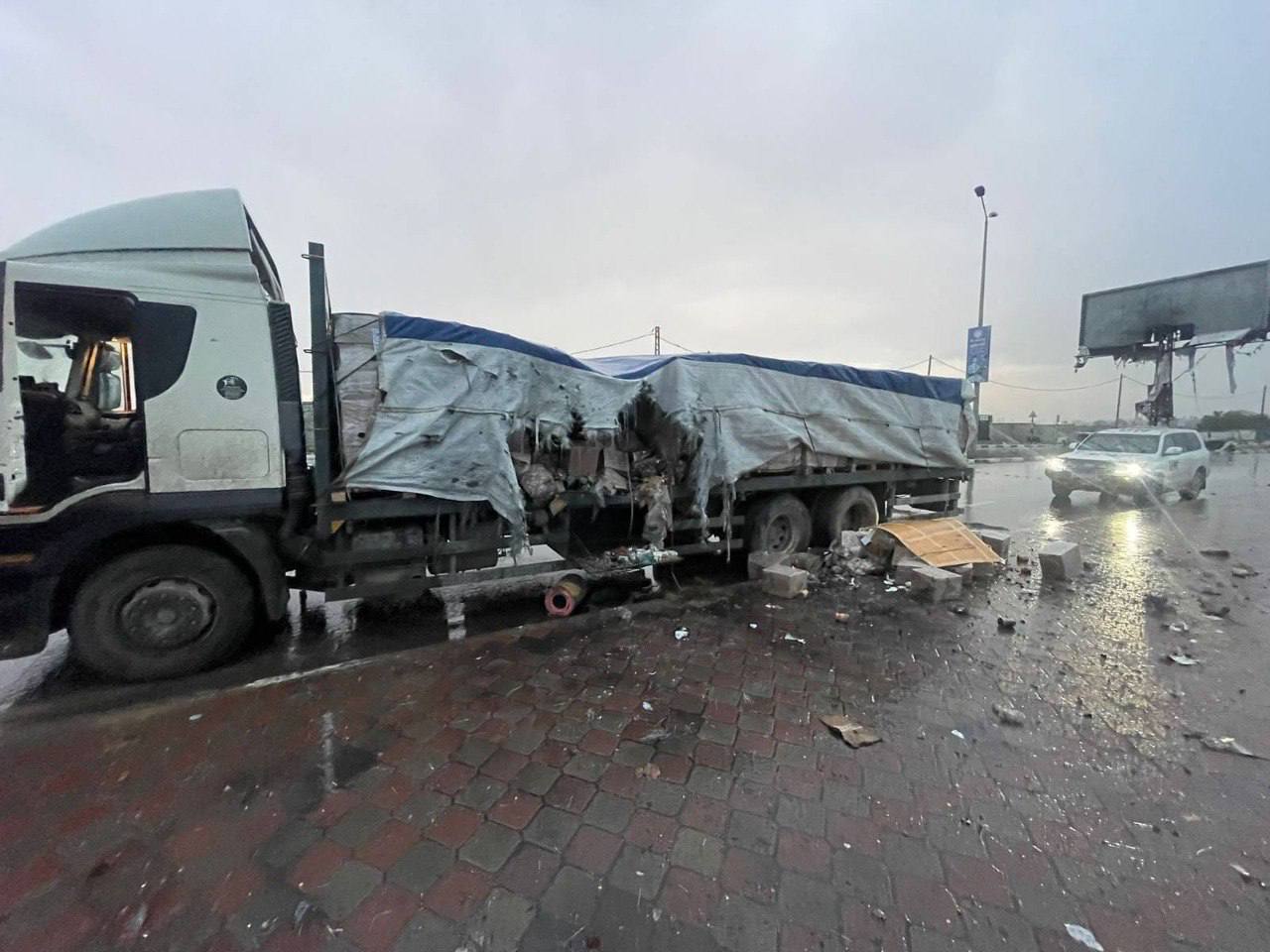
One of the most striking events he recounts occurred near his residence in al-Mawasi. After repeated attacks on aid routes by armed groups, some driven by starvation, the United Nations attempted to test a new delivery route.
A convoy of 66 trucks left the Kerem Shalom crossing heading toward the coastline, with Hamas providing security by recruiting guards from prominent families along the road.
But the convoy came under fire almost immediately. “I was only a few hundred meters away,” Filiu writes.
“I could clearly see Israeli drones supporting the attackers and striking the protection teams.” He said.
He said Israeli forces assassinated two influential local leaders tasked with guarding the convoy, killing them inside their vehicle before looters seized 20 of the trucks. Despite this, UN officials considered losing only one-third of the convoy an “improvement” compared with earlier missions that were entirely looted.
Filiu argues that the Israeli objective was to “discredit Hamas and the UN,” while enabling local gangs tied to Israeli intelligence to distribute or sell the aid for profit and influence.
His claims align with an internal UN memo at the time that referenced “tolerance, if not direct support,” by Israeli occupation toward groups involved in looting humanitarian supplies.
According to Filiu, Israeli forces also bombed an alternative road that the World Food Programme attempted to open to bypass known ambush zones. “They struck the middle of the road deliberately. The goal was to disable the route before it could function,” he writes.
Although the Israeli occupation continues to deny any involvement in facilitating the looting, Prime Minister Benjamin Netanyahu later acknowledged that Israel had supported what he called “popular forces” , a militia that included individuals linked to earlier attacks on aid convoys.
Filiu concluded that what is happening in Gaza goes far beyond a regional conflict. He describes the Strip as “a terrifying global experiment,” exposing the breakdown of international law.
“This is not just another Middle Eastern war, It is a laboratory for a world after the UN, after Geneva, after the Universal Declaration of Human Rights, a world that is no longer even rational, but one of sheer brutality.” he warns.
Shortlink for this post: https://daysofpalestine.ps/?p=69931