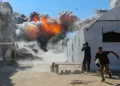
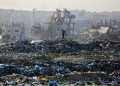
DaysofPal — In the Gaza Strip, loss is not measured only by the number of those killed. Thousands of families are also grappling with the far more uncertain fate of missing relatives, men who disappeared under the rubble of the Israeli genocidal war or in unknown circumstances, leaving behind lives suspended between hope and grief.
Behind each missing person is a family caught in an open-ended wait. For wives in particular, the absence of certainty creates a deeply complex reality: they cannot confirm death, yet they have no assurance of survival.
As the war intensified, hundreds of men went missing under varying circumstances, some buried beneath collapsed buildings, others lost during displacement or in areas rendered inaccessible by heavy bombardment and ongoing military operations.
With little or no evidence of their fate, their disappearance becomes a suspended condition with no clear resolution.
Fatima Youssef, a resident of Gaza, told Safa News Agency that her husband left home on the first day of the war and never returned.
“We don’t know where he went or what happened to him. It’s been nearly three years with no information,” she said.
“I searched in hospitals and through the Red Cross, but I found no record of him among the dead or the detained.” She added.
She described the psychological and financial toll of his absence:
“As time passes, not knowing what happened exhausts my children and me. We are stuck in legal complications that prevent us from moving forward.”
Like many others, Fatima lives between two painful possibilities.
“I hold on to hope, and I fear it at the same time,” she said.
Displacement has only worsened her situation. Without a stable income or institutional support, she struggles to provide for her children.
Humanitarian aid often requires official documentation of the father’s status, documents she does not have.
Fatima attempted to obtain a death certificate to resolve the uncertainty and access assistance, but her husband’s family refused to approve the request, holding onto the belief that he may still be alive.
“Their refusal leaves me unable to prove his death or claim my rights. I am left suspended,” she said.
The absence of official confirmation of death extends beyond emotional suffering into daily life. Without legal documentation, women are denied basic rights such as inheritance or financial support designated for families of the deceased. It also prevents them from making critical decisions about their future.
This “legal limbo” places women in an extremely vulnerable position, forcing them to shoulder full family responsibilities without formal protection or entitlement.
Sharia lawyer Riwaal Farwana explained to Safa News Agency that the war has forced judicial institutions in Gaza to adapt to exceptional circumstances.
She noted that courts issued a directive reducing the waiting period required to obtain a death certificate, from four years to just six months, starting from the implementation of the ceasefire.
However, she cautioned that these measures are far from ideal.
Some individuals previously declared dead have later been found alive, creating severe legal and social complications affecting entire families.
Farwana stressed that wives are left with two equally difficult options: remain in prolonged uncertainty or make life-altering decisions that could later be overturned.
Financially, the consequences are also severe. The law prohibits distributing the missing person’s assets without an official death ruling, depriving wives and children of potential income and increasing the burden of daily survival, especially under wartime conditions.
For Shorouq Abdel Karim, the crisis continues to deepen. Her husband disappeared in the Netzarim corridor in central Gaza, and his fate remains unknown.
“I searched everywhere, hospitals, and prisoner organizations. I asked every released detainee but found nothing,” she said.
“The absence has become exhausting for my children and me.” She added.
She described the emotional strain of facing her children’s questions: “They ask me where their father is, alive or dead? Will he come back? I have no answers.”
Like many others, she lacks any official documentation confirming her husband’s status, whether as a detainee or deceased. As a result, she is unable to access aid or support.
“Any assistance requires official papers, especially a death certificate. Without them, we are excluded from help,” she said.
As the Israeli genocide continues, the plight of Gaza’s missing and the women left behind remains one of the most painful and unresolved humanitarian crises, where uncertainty itself becomes a lasting burden.
Shortlink for this post: https://daysofpalestine.ps/?p=74490