
DaysofPal – A prominent French historian who spent more than a month in Gaza during the peak of the conflict says he witnessed “utterly convincing” evidence that Israeli forces supported looters who repeatedly attacked humanitarian aid convoys inside the besieged strip.
Jean-Pierre Filiu, professor of Middle East studies at Sciences Po in Paris, entered Gaza in December and remained there through January while hosted by an international humanitarian organization in al-Mawasi, the southern coastal zone Israel had declared a “humanitarian area.”
His account, published in A Historian in Gaza, offers one of the rare eyewitness testimonies from inside the territory at a time when Israel barred international media and independent observers.
Filiu: Israeli drones aided looters attacking aid convoys
In his book, Filiu describes numerous attacks on security teams protecting UN aid convoys, attacks he says were not only unimpeded by Israeli forces but, in some cases, actively supported.
In one incident near al-Mawasi, where he was staying just a few hundred meters away, Filiu recounts how a UN convoy of 66 trucks carrying flour and hygiene kits attempted a new route to avoid a series of violent looting incidents. Hamas and local community leaders had mobilized armed guards from influential families along the route to protect the trucks.
But the convoy quickly came under fire. “It was very clear that Israeli quadcopters were supporting the looters in attacking the local security teams,” Filiu writes.
He says Israeli forces killed two local notables who had been stationed in a car to protect the convoy. Despite the security effort, 20 trucks were looted—a loss the UN reportedly considered an “improvement” compared with previous convoys that were almost entirely stripped.
According to Filiu, this pattern suggested a deliberate Israeli strategy: “The rationale was to discredit Hamas and the UN and to allow Israel’s clients, the looters, to redistribute the aid to build their own support networks or resell it for cash.”
UN sources at the time raised similar concerns
International agencies had warned earlier that law and order had collapsed after Israel targeted Gaza’s police officers, who traditionally escorted aid convoys. Israel considered the police part of Hamas’s governance structure and legitimate military targets.
A leaked internal UN memo described Israel’s stance as “passive, if not active benevolence” toward some looting gangs, echoing Filiu’s allegations.
Israeli officials strongly rejected Filiu’s account. The military said the incident he described involved a “precise strike” against armed men planning to divert aid into Hamas storage sites.
The IDF said the strike was intended to “avoid harming the aid” and insisted it continues to “facilitate the transfer of humanitarian assistance while acting in accordance with international law.”
Israel has repeatedly accused Hamas of stealing aid, a charge Hamas denies.
Historian: Israel also struck a new humanitarian route
Filiu says Israeli forces also attacked an alternative route that aid agencies were attempting to open to avoid known looting zones.
“The World Food Programme was trying to set up an alternative route to the coastal road, and Israel bombed the middle of it. It was a deliberate attempt to put it out of action,” he said.
Israel, which severely restricted or fully blocked aid entry during large portions of the war, denies deliberately targeting relief systems. But Prime Minister Benjamin Netanyahu has acknowledged that Israel assisted the “Popular Forces,” an anti-Hamas militia that included individuals involved in looting.
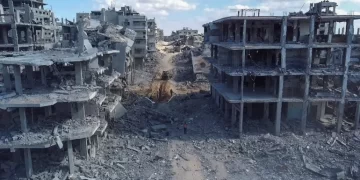
Having visited Gaza for decades, Filiu said he was stunned by the scale of devastation: “Anything that stood before has been erased, annihilated.”
The war that followed Hamas’s attack on Israel in October 2023, when approximately 1,200 people were killed and 250 taken hostage, left nearly 70,000 Palestinians dead and reduced much of Gaza to rubble.
Filiu warned that the consequences went far beyond the region: “This is a universal tragedy. It is a laboratory of a post-UN world, a post-Geneva Convention world, and a post-human-rights world. And this world is very scary, because it’s not even rational, just ferocious.”
Shortlink for this post: https://daysofpalestine.ps/?p=69899