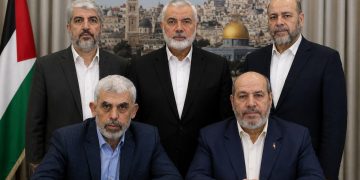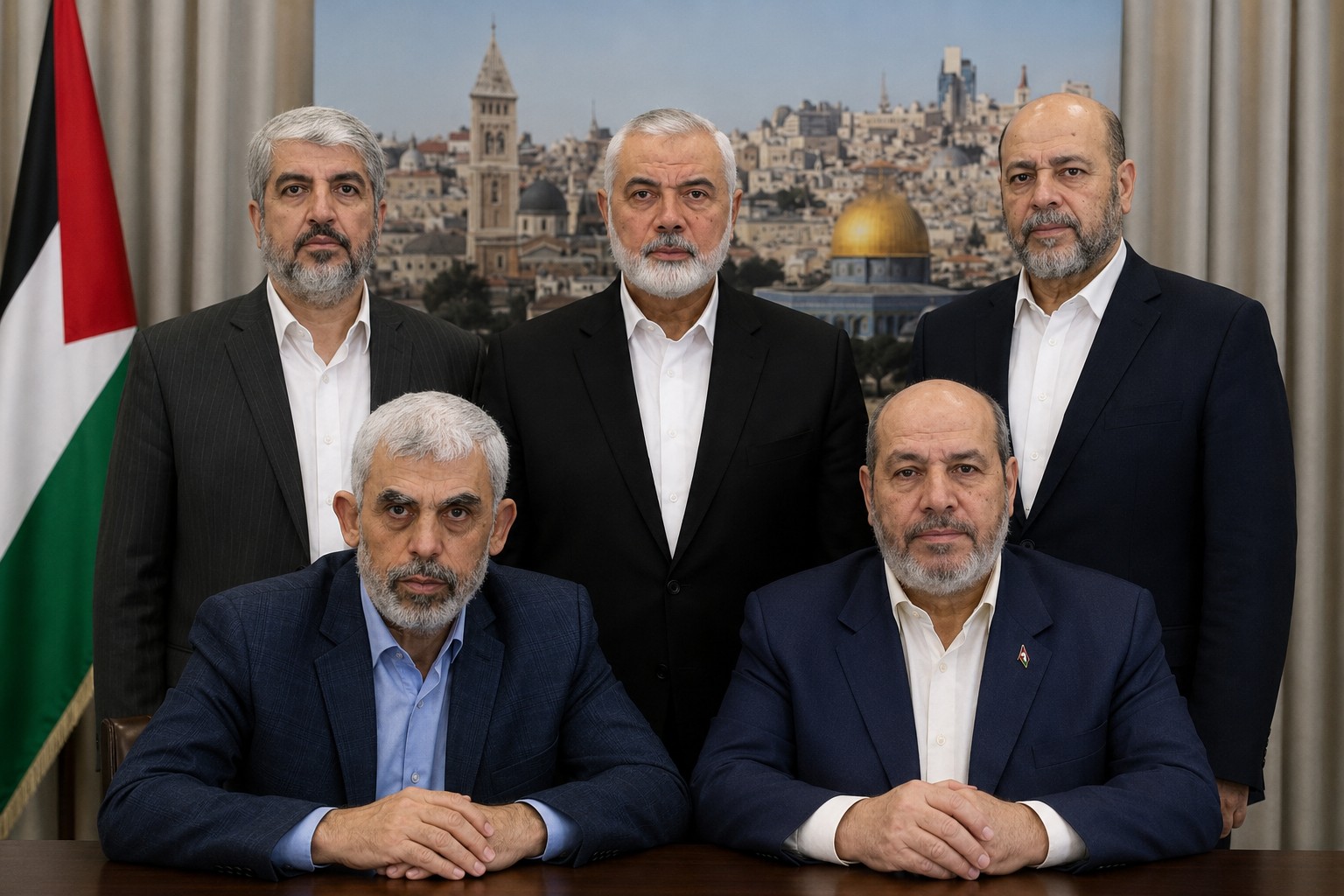
DaysofPal – Ever since Hamas formed its political bureau in the early 1990s, the chair’s office has served as the movement’s strategic nerve center. Over the past three decades, a succession of leaders has steered the bureau through pivotal historical turning points, with each era’s political and security pressures dictating whether the movement focused on international institution-building, governing Gaza, or navigating all-out conflict.
Hamas established its political bureau in the aftermath of Israel’s 1992 deportation of hundreds of its members to Marj al-Zohour in southern Lebanon. The move prompted the movement to establish an organized political body to manage its external relations and oversee its institutions.
Dr. Mousa Abu Marzouk was elected as the bureau’s first chairman. During his tenure, he focused on strengthening Hamas’ political presence, building ties with Arab and Islamic countries, and laying the foundations for the movement’s external organizational structure.
His leadership was interrupted in 1995 when he was arrested in the United States at Israel’s request. After leaving the U.S. for Jordan, Hamas entered a new phase under Khaled Meshaal.
Khaled Meshaal: Two Decades of Transformation
Khaled Meshaal assumed leadership of the Political Bureau in 1996, beginning the longest tenure in the position’s history, which lasted for more than two decades.
His time in office coincided with several defining moments for Hamas. In 1997, he survived an Israeli assassination attempt in the Jordanian capital, Amman. The movement’s leadership later relocated from Jordan to Syria, then eventually settled in Doha, Qatar.
Meshaal led Hamas through the Second Intifada, its victory in the 2006 Palestinian legislative elections, its takeover of governance in the Gaza Strip in 2007, and successive Israeli military offensives against the enclave.
He also oversaw Palestinian reconciliation efforts and expanded Hamas’ regional and international relations before leaving office in 2017 after completing the maximum terms permitted under the movement’s internal regulations.
Ismail Haniyeh: Expanding Political and Diplomatic Engagement
In May 2017, Ismail Haniyeh was elected head of the Political Bureau, ushering in a period marked by expanded diplomatic activity abroad while continuing to oversee the movement’s internal affairs in Gaza.
During his tenure, Hamas played a central role in ceasefire negotiations, prisoner exchange agreements, and Palestinian reconciliation efforts, while broadening communication with regional mediators.
His leadership also encompassed the 2021 “Sword of Jerusalem” confrontation and the war that erupted following the events of Oct. 7, 2023. Haniyeh became one of Hamas’ most prominent political figures on the regional and international stage before he was assassinated in Tehran, Iran, in July 2024.
Yahya Sinwar: The Shortest Tenure
In August 2024, Hamas’ Shura Council elected Yahya Sinwar to succeed Haniyeh as head of the Political Bureau, a move widely seen as affirming the movement’s determination to maintain leadership from inside the Gaza Strip despite wartime conditions.
His tenure proved to be the shortest since the office was established, lasting only about two months before Israel announced his assassination in October 2024. His brief leadership coincided with one of the most complex periods in Hamas’ history as it directed the movement during the ongoing war.
Khalil Al-Hayya: Leading a New Phase
The election of Khalil Al-Hayya as head of Hamas’ Political Bureau marks the beginning of a new chapter for the movement at a time widely regarded as one of the most challenging periods since its founding.
Among the key challenges facing the new leadership are managing political negotiations, responding to developments on the ground in the Gaza Strip, maintaining regional relationships, and restructuring the movement’s institutions after the loss of several senior leaders in recent years.
Over more than three decades, the evolution of Hamas’ Political Bureau leadership has reflected the movement’s changing priorities and the shifting political landscape surrounding it.
From building institutions and managing its external organization to governing Gaza and leading the movement during wartime, the Political Bureau has remained central to shaping Hamas’ political and organizational direction. With Khalil Al-Hayya now at its helm, the movement enters a new phase marked by unprecedented Palestinian and regional challenges.
Shortlink for this post: https://daysofpalestine.ps/?p=76521