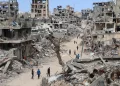
DaysofPal – Panic spread across Gaza after Israel shut the territory’s crossings following the start of the US-Israel war on Iran last week. The sudden closure of the enclave’s main lifelines triggered fears that famine could return to the densely populated strip.
Residents rushed to local markets to buy essential supplies before they disappeared. Within hours, food shortages and sharp price increases began to appear, particularly for vegetables and cooking staples.
Gaza relies almost entirely on border crossings for the entry of food, fuel and other basic goods. When those crossings shut, the impact is felt immediately in markets and inside family homes.
For Ibrahim Madoukh, a father of eight living in Gaza City’s al-Sahaba neighborhood, the rising prices are already threatening his family’s fragile livelihood.
Since the October ceasefire, Madoukh has supported his family by selling falafel from a small street stall. Business had remained stable because he kept his prices low, making his food affordable for residents struggling with poverty.
That balance has now collapsed.
Ingredient costs have surged, forcing him to raise prices. Customers who once depended on his stall are now buying less or not at all.
“The economic situation in Gaza has been deteriorating since the war,” Madoukh said. “Many people can no longer afford what is available in the market.”
After hearing that the crossings had closed, he hurried to the market to secure supplies before they ran out. Instead, he found crowds of residents trying to do the same.
A kilogram of onions that previously cost three shekels (about $1) now sells for 15 shekels ($5). Cooking oil has climbed from five shekels to 13. Parsley has increased eightfold.
“Traders say prices are rising because the crossings are closed and supplies are running out,” he said.
The surge has forced Madoukh to change the price of his falafel. What once sold as two pieces for one shekel is now a single piece for two.
Even that is too expensive for many families.
“Before the crossings closed, displaced children sometimes came to my stall asking for falafel because they were hungry and had no money,” he said. “I used to give it to them, but now I can’t. I’m already losing money.”
He fears the stall may soon close entirely.
“I only have enough supplies for one week,” he said. “If the situation continues like this, we may face the same hunger we experienced before.”
Our lives are already hell
Israel closed all crossings into Gaza on Saturday, halting the movement of people, aid, and goods shortly after the war with Iran began.
The Karem Abu Salem crossing with Israel partially reopened on Tuesday, allowing limited quantities of fuel and humanitarian aid to enter. Other crossings, including the Rafah border with Egypt, remain closed.
The United Nations has called for additional crossings to reopen in order to expand humanitarian assistance, particularly as many aid organizations operating in Gaza face severe restrictions.
Only a few meters from Madoukh’s stall, Ahmed al-Shoubaki was carrying a large bag filled with food staples: canned goods, tahini, ghee, spices and olive oil. He stopped to ask a vendor about the price of sugar.
“Since the crossings closed on Saturday, I’ve been going to the market every day to buy whatever I can and store it at home,” said the 39-year-old father.
He and his wife agreed to preserve their basic supplies.
“We decided to keep flour, cooking oil, and canned goods untouched and buy only the daily necessities while they are still available,” he explained.
Before the Israeli war on Gaza, Shoubaki worked as a painter. Shortages of construction materials ended that job. He later opened a small food stall selling kebab and grilled chicken.
Falling sales forced him to shut it down last month.
His experience reflects that of thousands of Palestinians whose livelihoods disappeared after entire sectors of Gaza’s economy collapsed.
“The economic situation in Gaza has collapsed,” he said. “There is no work, so no one can cope with rising prices.”
When news broke of the war with Iran, he spent nearly all his savings buying supplies.
“I spent more than $1,000 to stock food for a month,” he said. “I don’t know how I will manage later, but I had to do it. My children cried from hunger last Ramadan. I can’t let that happen again.”
Shoubaki believes Gaza is being forced to endure the consequences of a conflict it has no role in.
“Why must Gaza pay the price for wars it’s not involved in?” he asked. “Our lives are already hell from siege, destruction, and hunger.”
He fears the crossings may remain closed for a long time.
“I’m afraid our suffering will only continue,” he said.
Families with little left to buy
Despite the rush to stockpile food, most residents cannot afford to buy more than a single day’s supply.
Rana Rajab, a 38-year-old mother of six, worries the closures could bring famine back to Gaza. Her family lacks the income needed to store food.
Her husband works as a mechanic on daily wages. Some days he finds work; many days he does not.
“Since the ceasefire began, we have been suffering from poverty and hunger,” Rajab said.
“When my husband works, we buy food. When he doesn’t, we depend on charity kitchens or any aid we can find.”
The recent price increases have deepened the crisis.
“Many goods, especially vegetables, have doubled in price,” she said.
The family still carries painful memories from the previous famine.
“Last year my youngest daughter, Haya, who is five, got hepatitis during the famine and had to stay in hospital for several days,” Rajab said.
Anticipating further shortages, she has begun reducing both the number and size of her family’s meals.
Life before the war feels distant.
“During Ramadan before the war, we ate chicken, fish, or meat every day,” she recalled. “I cooked different dishes and sometimes two meals in a single day. We shared food with relatives and neighbors.”
That reality has vanished.
“Now we can barely afford meals for ourselves.”
Market prices have shocked her.
“Yesterday chicken cost 46 shekels per kilo, more than double the usual price,” she said. “I couldn’t buy it, so we ate lentils from our storage. My children dislike them because they remind them of last year’s famine.”
Rajab fears each crisis pushes families deeper into hardship.
“Every time we go through famine, it becomes worse than before,” she said.
She hopes international pressure will force Israel to reopen the crossings and allow food and commercial goods into Gaza.
“We are not responsible for the wars between Israel and anyone else,” she said. “Yet we are the ones who pay the price.”
Shortlink for this post: https://daysofpalestine.ps/?p=72881