DaysofPal- Although the Gaza ceasefire has formally entered its second phase, Palestinian officials and analysts say Israeli violations on the ground point to a continuing Israeli war that is eroding the agreement’s core provisions.
Rather than announcing an explicit withdrawal from the U.S.-mediated truce, Israeli occupation forces (IOF) are accused of gradually reasserting control through incremental military measures.
Observers say this approach has shifted the ceasefire from an effort to end the war into a mechanism for regulating ongoing conflict.
At the center of these developments is the expansion of the so-called “Yellow Line,” a buffer zone marked by yellow concrete blocks.
Recent evidence indicates that Israeli forces have moved these barriers tens to hundreds of meters beyond the agreed ceasefire boundary, accompanied by the demolition of numerous buildings outside the truce line.
Images published by Reuters show yellow concrete barriers positioned deep inside civilian neighborhoods, as well as the construction of at least six fortified Israeli military sites near the Yellow Line.
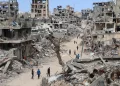
The expansion is especially visible in Gaza City’s eastern Tuffah neighborhood, an old residential area that has suffered extensive destruction after nearly two years of sustained bombardment.
Hamas spokesperson Hazem Qassem said Israeli forces are continuing to push the Yellow Line westward, calling the move a “serious and explicit violation” of the ceasefire agreement.
He warned that the expansion is compressing Gaza’s population into a narrower western area, cutting access to nearly 30 percent of the territory.
Military analyst Nidal Abu Zaid said the widening of the buffer zone highlights a contradiction between Israeli political commitments and its military actions under the ceasefire.
While the Israeli occupation has moved into the agreement’s second phase, he said, it continues to breach both the initial and subsequent stages on the ground.
In comments to Palestine Online, Abu Zaid described the strategy as an attempt to “redesign Gaza’s geography” by extending areas of control under the Yellow Line framework.
He said Israeli forces previously exerted control over about 52 percent of Gaza. With the latest expansion, particularly in strategic areas between Jabalia and Shuja’iyya, that figure has risen to roughly 61 percent. These zones, he noted, provide significant surveillance and firepower advantages, allowing Israel to maintain long-term tactical dominance even during a ceasefire.
According to Abu Zaid, the measures are not aimed at resuming large-scale fighting but at preparing a new operational environment based on indirect or “proxy” warfare, involving local armed groups operating inside the Yellow Line with Israeli intelligence support.
Abu Zaid also said the Israeli occupation is weakening the political dimension of the ceasefire’s second phase by blocking the entry of a proposed technocratic committee tasked with administrative responsibilities in Gaza.
He described this as part of a broader policy of maintaining control without formal governance, ensuring calm without addressing underlying political issues.
He cited a recent resistance attack on members of Israeli-backed militias near the buffer zone, which reportedly left one fighter dead and forced others to retreat behind the Yellow Line. The incident, he said, underscores how the area has evolved from a buffer into an active base for militia operations.
The construction of new Israeli fortifications along the Yellow Line further signals a shift in the status of nearby areas.
Abu Zaid estimated that around 205 residential blocks have effectively moved from contested zones into areas under direct Israeli control, subject to constant surveillance and fire coverage.
Since the ceasefire began on October 10, Israeli forces have continued demolishing structures behind the Yellow Line while steadily extending it deeper into Gaza, according to local reports. Residents returning to their neighborhoods say they remain fearful, citing ongoing artillery fire and shooting from Israeli military vehicles, particularly in the eastern parts of the Strip.
Analysts warn that the continued alteration of Gaza’s physical and security landscape could cement a new reality on the ground, one that undermines the ceasefire’s stated aim of ending hostilities and allowing civilian life to recover.
Shortlink for this post: https://daysofpalestine.ps/?p=71566